
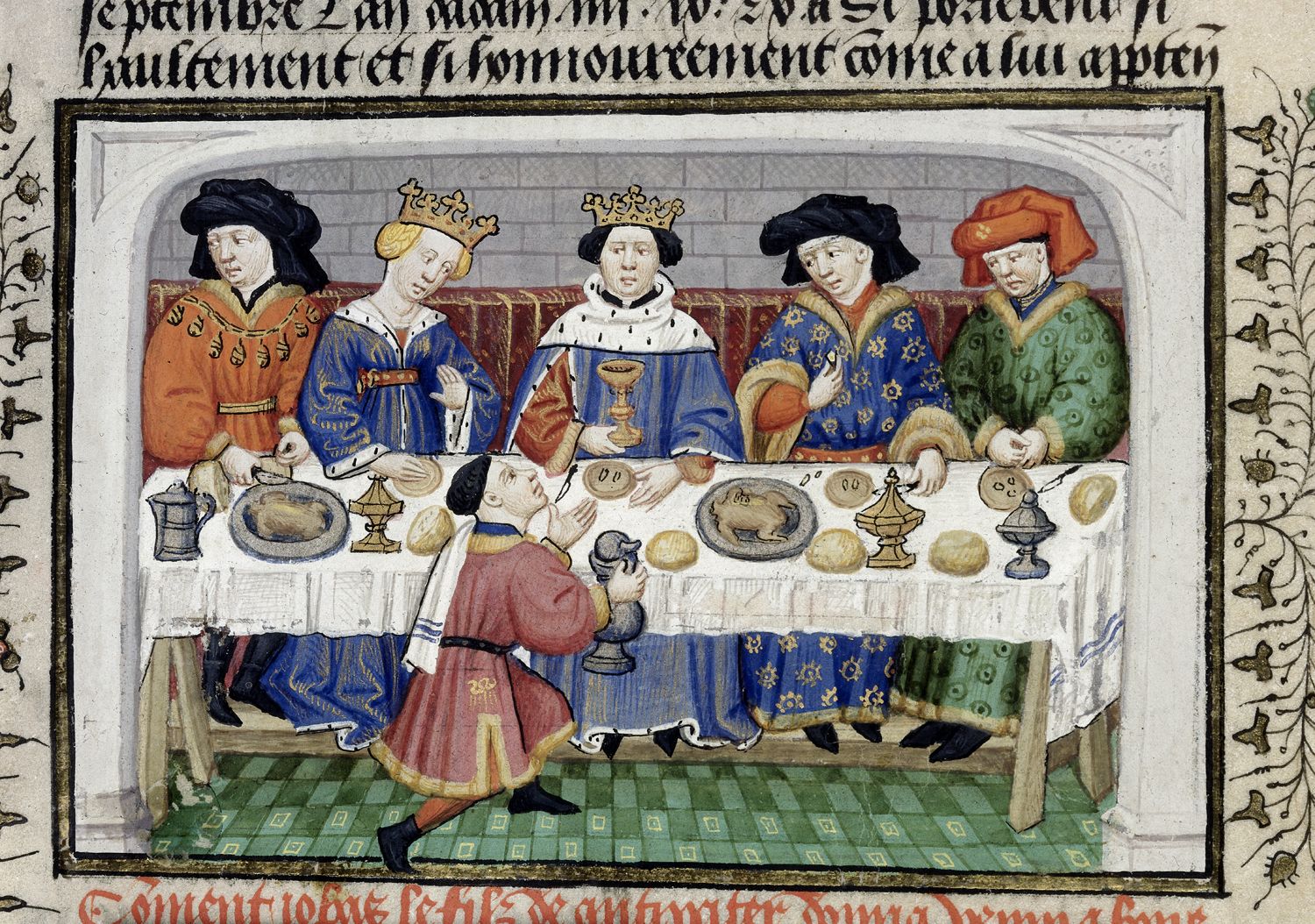
Featured image: London, British Library, Royal MS 15 E VI, folio 22v. Unfortunately, due to the recent cyber attack at the British Library, I cannot provide a link back to the source of the image.
Hello everyone. We’re fast approaching the end of 2023, and I just have time for one more blog post. So, continuing with the draft entries from my encyclopaedic glossary of culinary ingredients, equipment and terminology of Richard II’s cookery treatise, Fourme of Cury (c.1390), please find, below, my entry for Vernaccia, an expensive sweet wine.
My thanks to Elise Fleming for suggesting (in response to my recent post on Appulmoy) I elaborate on vernage, the Middle English name for this wine.
Vernaccia vernage. During the medieval period, a sweet, probably white wine from Tuscany in Italy; produced from late-harvested, semi-dried grapes; known to the English as vernage.[i] As with other varieties of luxury sweet wines, its high alcohol content – perhaps as much as 17 percent, ‘almost twice the strength of thin northern wines’ – meant Vernaccia would store well and travel long distances without turning sour.[ii]
Vernaccia appears only once in Fourme of Cury in the poached pears dish, Peerus in confyt (130, ch.9), where either it or Greek wine is used to make the syrup into which the poached fruit are placed (see Greek wine, above).
The Dominican friar Geoffrey of Waterford, who flourished around the turn of the fourteenth and fifteenth centuries, provides us with a rare glimpse into the taste of medieval wine, particularly Vernaccia. As an experienced wine taster, he observes in a tasting note that this wine was better than Greek or Cyprus wine, ‘because its strength is tempered, it opens out sweetly as it comes into the mouth, greets the nostrils and comforts the brain, taking the palate softly but with force’.[iii]
The alcoholic strength and luxury status of the wine is hinted at in Geoffrey Chaucer’s late fourteenth-century fabliau The Shipman’s Tale, where the dishonest monk Daun John brings as a gift to his host, a very wealthy merchant, ‘a jug of malmsey and also another full of fine vernage’, that they may ‘drink and play’ for ‘a day or two’.[iv]
If you wish to support my work, you can “Buy Me A Coffee”
Choose an amount
Or enter a custom amount
Thank you! Your contribution to support my creative work and independent research is appreciated.
Donate[i] Johnson, p. 229; Rose, pp. 101-102.
[ii] Johnson, p. 230.
[iii] Johnson, p. 186.
[iv] Chaucer, The Shipman’s Tale, lines 70-74; my own translation.
Bibliography
Chaucer, Geoffrey. The Canterbury Tales, Second Edition, ed. Robert Boenig and Andrew Taylor (Peterborough, Ontario: Broadview Press, 2012).
Johnson, Hugh. From Noah to Now: The Story of Wine, New Edition, E-book (Académie du Vin Library, 2020).
Rose, Susan. The Wine Trade in Medieval Europe 1000-1500 (Bloomsbury, 2011).
 MONK'S MODERN MEDIEVAL CUISINE
2 thoughts on “Medieval culinary glossary: Vernaccia”