
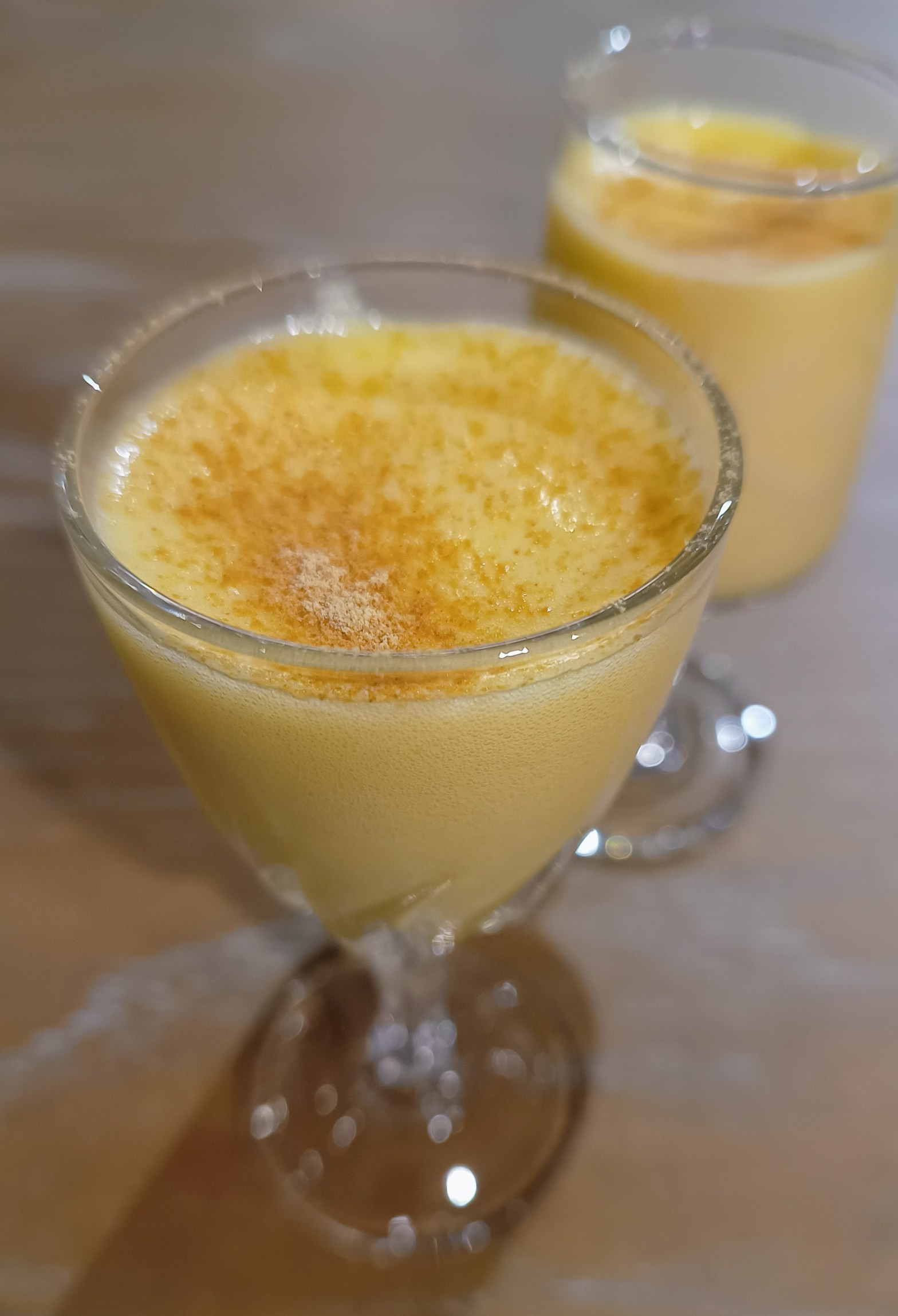
It has been a while since I’ve posted, for which I must apologise. But Ray and I have benefitted from a holiday and we have moved house. We are now settled in our new home, or at least there is now a degree of order created from the chaos!
And a quick note on my health: the meds are working well, and I’m feeling significantly improved.
So I thought I would experiment with a fifteenth-century recipe with the view to giving you an option for a Christmas beverage, or is it a pudding, or even a pick-me-up after all the feasting? I’ll leave it to you to decide.
I wrote about medieval caudles a while back and explained how they were sometimes viewed as a curative. They also varied from thin to very thick in their consistencies. Here, as you see from the title, is one of the thinner versions, eminently suitable as a Christmas drink, I would say.
Caudel rennyng.
Take vernage, or other gode swete wyne, and ȝolkes of eyren beten, and streyned, and put therto suger, and colour hit with saffron, and sethe hit tyl hit begyn to boyle, and strawe pouder of ginger theron; and serve hit forthe.1
Flowing caudle
Take vernage [i.e. vernaccia], or other good sweet wine, and egg yolks beaten and strained, and into this put sugar, and colour it with saffron, and simmer it to the point of boiling, and strew ginger powder on top; and serve it forth.
(My own translation)
This is rather like a thinner version of modern-day Italian zabaglione, or zabaione – the French equivalent is sabayon: a silky custard, flavoured traditionally with Marsala wine (the French might use champagne).
The medieval cook was looking for something that could be described as flowing, which is the sense behind the word rennyng.2 I imagine it as something that was pourable into a goblet or cup.
The wine known in England as vernage was actually the Italian wine vernaccia, which back in the medieval period was a sweet, probably white wine, made from dried grapes. In my experiment I chose an analogous modern wine from Italy, Vin Santo.
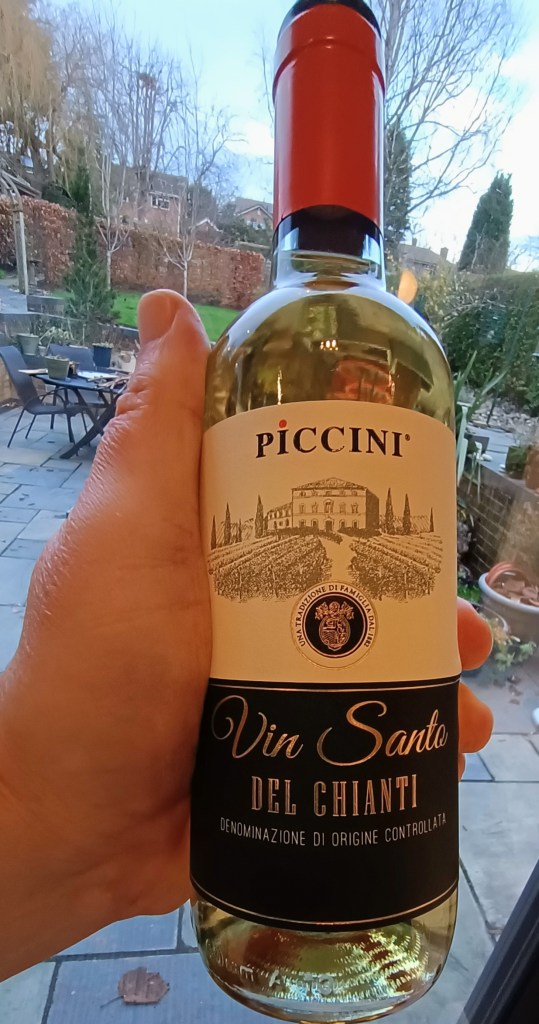
With the modern method of zabaglione very much in mind, here’s what I did:
Ingredients
2 egg yolks (30g)
1 tablespoon golden caster (superfine) sugar
100ml Vin Santo wine
six strands of saffron, crumbled and mixed with a teaspoon of hot water
a little ginger powder
Method
I whisked the egg yolks and sugar, off the heat, in a mixing bowl, using a balloon whisk. I did this for about 3 minutes, until the mixture was very smooth and silky.
I then whisked in the saffron for ten seconds or so.
Then I added all the wine, still off the heat, incorporating it well.
Next, I took the bowl and placed it over a pan of simmering water. The pan had about 6-7cm of water in it, so that it wouldn’t boil dry, but the water did not touch the bottom of the bowl, so that the heating of the yolks would be gentle and wouldn’t result in scrambled eggs!
I constantly whisked the mixture for about 4 minutes, until the mixture began to thicken a little. I kept checking the water to make sure it was gently bubbling away.
I knew it was ready once the mixture stopped separating into yolk and alcohol. In other words, it was properly emulsified.
The caudle was then ready to pour. I transferred the caudle to a jug and then poured it into sherry glasses.
Finally, I sprinkled a little ginger powder atop each glass.
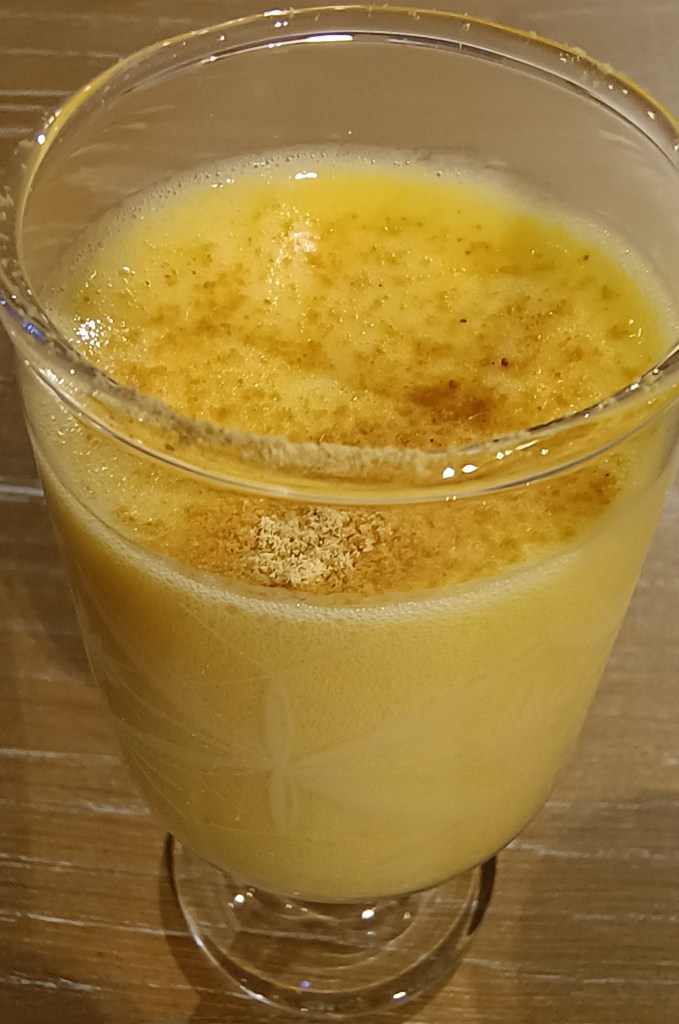
The amount made was sufficient for 5 sherry glasses (and some judicious finger swiping and licking, of course). Ray and I really enjoyed our tasting session.
I must say, it’s great when the first experiment works so well. My Christmas caudle was light, silky, a little boozy, not too sweet (you could make it sweeter if you wished), and with a fantastic hit of warm spice.
Ray suggested using ground mixed spice for our final half-glass. We both thought that was even better than just the ginger.
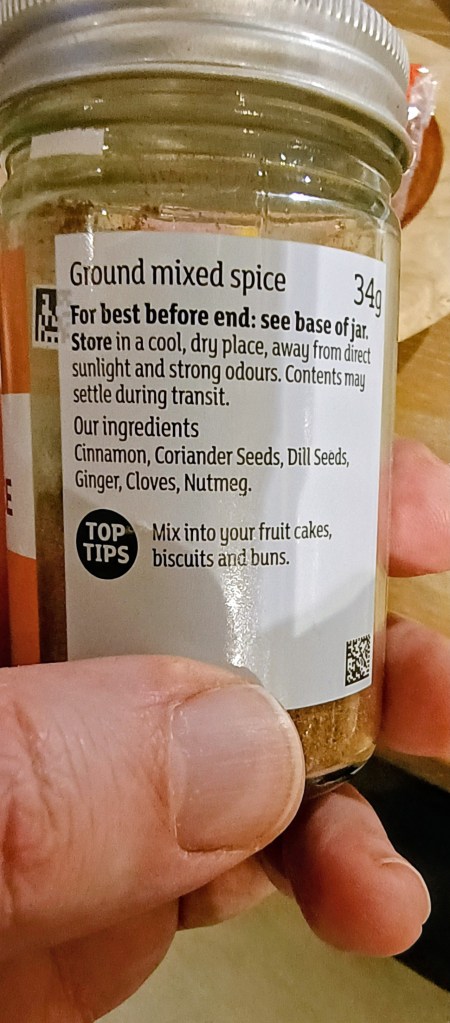
I hope you try this. It was fun making it. Not too difficult, really. You just need to be careful and patient whilst heating and whisking.
Merry Christmas to you all!
If you have enjoyed this blog, or any other post this year, you may feel like giving a small donation to support my independent research. Many thanks.
Bibliography
Ancient Cookery: Anon. (ed.), A Collection of Ordinances and Regulations for the Government of the Royal Household, Made in Divers Reigns. From King Edward III to King William and Queen Mary. Also Receipts in Ancient Cookery (London: The Society of Antiquaries, 1790), available online as a digitised facsimile, https://wellcomecollection.org/works/evs98d3z/items.
- The recipe is found in a British Library manuscript, Arundel MS 334, dated to about 1425. For an edition of the Middle English text, see Ancient Cookery, p. 463. ↩︎
- See renning(e, Middle English Dictionary, renning and renninge – Middle English Compendium; and rennen, 8b (a), past participle renninge, Middle English Dictionary, rennen – Middle English Compendium [accessed 14 December 2025]. ↩︎
 MONK'S MODERN MEDIEVAL CUISINE
This sounds delicious! I will definitely try it. Thanks! – and Merry Christmas in the new house!
LikeLiked by 1 person
And to your first Christmas in yours, too x
LikeLiked by 1 person
True. I hadn’t thought of that.
LikeLiked by 1 person
Do you think a larger proportion of wine would be okay? I think I would prefer it proper rennyng: I’ve had zabaglione that you had to eat with a spoon, and I’d prefer to sip…
LikeLiked by 1 person
Yes, it’s all a matter of preference. Zabaglione can be quite set, can’t it. I prefer it not too thick. This caudle is certainly meant to be thin. I reckon increasing the wine by no more than 50% would give you a sipping consistency. But you would also need to increase the sugar, as more wine means greater sharpness from the alcohol.
LikeLiked by 1 person
Vin Santo is pretty sweet (and strong) – certainly more so than modern Vernaccia. I wonder – would this be a use for Mavrodaphne? Apart from poaching dried fruit, I think it’s undrinkable on its own…
LikeLiked by 1 person
Yes, I think so. Quite often, Greek wine is specified as the sweet wine in medieval recipes. It’s not my favourite either, but it should work well in this.
LikeLiked by 1 person
And Mavrodaphne would make it pink! Well, pinkish.
LikeLiked by 1 person
Ah yes!
LikeLiked by 1 person
Very neat! Halfway between egg nog and a sweet pudding. Also looks extremely adjustable as long as you’re careful about the heating/emulsification. And I love seeing the Middle English and going ‘rennyng? Oh, running!’
LikeLiked by 2 people
I was going to translate it as ‘running’ caudle, then thought ‘flowing’ was a little more elegant 🤣.
LikeLike
Ha ha, absolutely, ‘flowing caudle’ definitely sounds more appetizing than ‘running caudle’. I do a lot of Japanese translation, and knowing when you don’t want to go with 100% literal is an important skill.
LikeLiked by 1 person
So true! 😆 And how interesting that you know Japanese!
LikeLike
Yum!!! Practical question: Even from the video, I can’t figure out how you put a bowl over a pan of simmering water without the water touching the bowl…can you explain, please? I can’t wait to try this!
LikeLiked by 1 person
You need a full-sized mixing bowl and a medium pan so that most of the bowl sits above the rim of the pan. You only partially fill the pan with water, just a couple of inches.
LikeLike
Aha! Makes sense, Chris. Thanks! Gonna give it a try.
–Kay
LikeLiked by 1 person
Great. Let me know how you get on.
LikeLike
A very Happy Christmas to you Christopher, and to Ray too!And a question: would a running caudle be the ancestor of the bright yellow Advocaat stuff that my Mum insists on drinking as “snowballs” (with lemonade, and a glace cherry on top) every festive season? Or is that a different style of thing entirely?
LikeLiked by 1 person
What a great question, though difficult to answer. Advocaat is Dutch and I do not (yet) know its direct history. It seems to me, caudles arrived in England via France, perhaps specifically Notmandy, as the earliest English example of a caudle is written in Anglo-Norman French, and the word itself is a French loan word. However, French wines were not known at the time for being sweet; such wines were being distributed from elsewhere, esp. Greece, Italy, Spain, into north-western Europe during the medieval period. It would be interesting to explore the connection between sweet wine origins and caudle recipes.
LikeLiked by 1 person
This looks fun. I’ve even got a bottle of vin santo somewhere.
I’m glad to hear that life is a bit more settled now. Merry Christmas to you both.
LikeLiked by 1 person
Hope you give it a try. Thank you, and Merry Christmas to you, April! 🎄🎄🎄
LikeLiked by 1 person
So glad to hear that your new meds are working! This caudle sounds so good but I have been tested recently for more food intolerances and sure enough, wine (grapes) and cinnamon are amongst the new ‘no-nos’.
Anyway, have a lovely Christmas in your new home!
LikeLiked by 1 person
Thank you!
What a shame about grapes and cinnamon.
Merry Christmas 🎄 🎄 🎄.
LikeLike