
The fires brenden vpon the auter brighte, That it gan al the temple for to lighte.
Chaucer, The Knight’s Tale
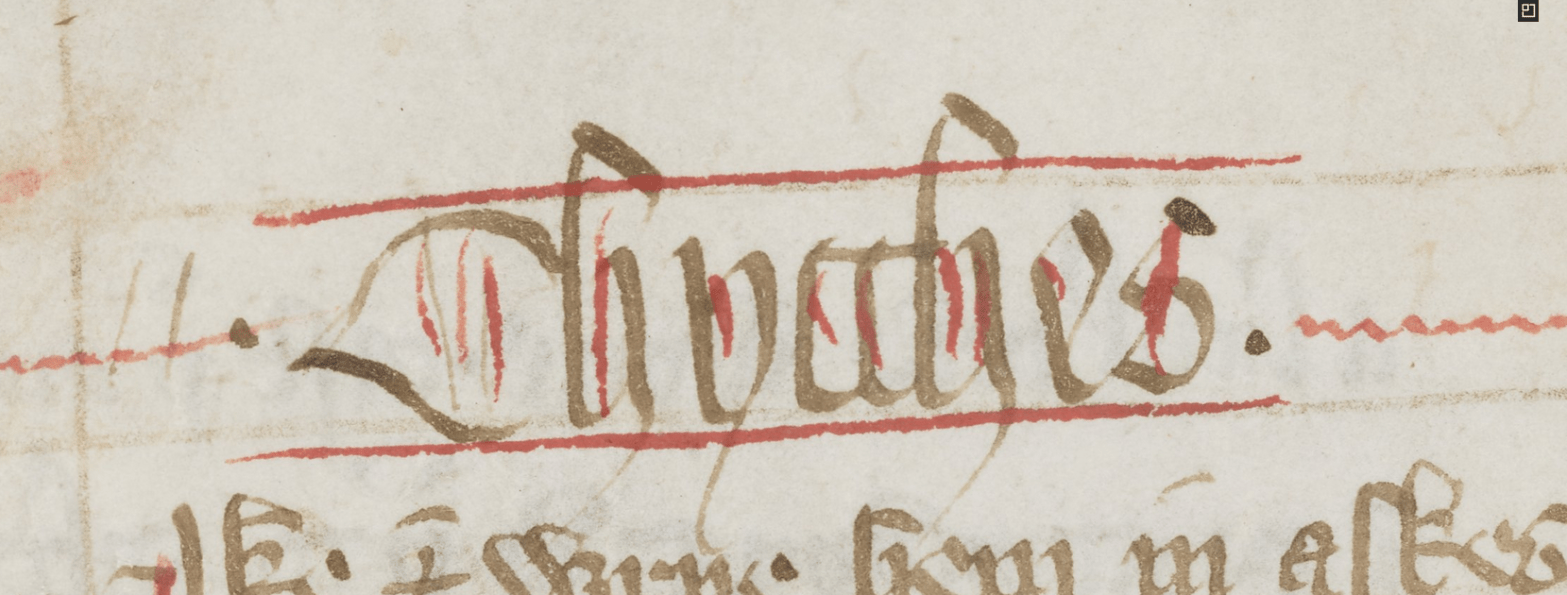
Featured image: Chycches, from Fourme of Cury, Manchester John Rylands Library, English MS 7, folio 40r, cropped.
In this series of short research pieces, I will be shedding a little scholarly light on lesser-used ingredients from medieval cookery, with particular focus on Richard II’s late-fourteenth-century cookery book Fourme of Cury (method of cookery).
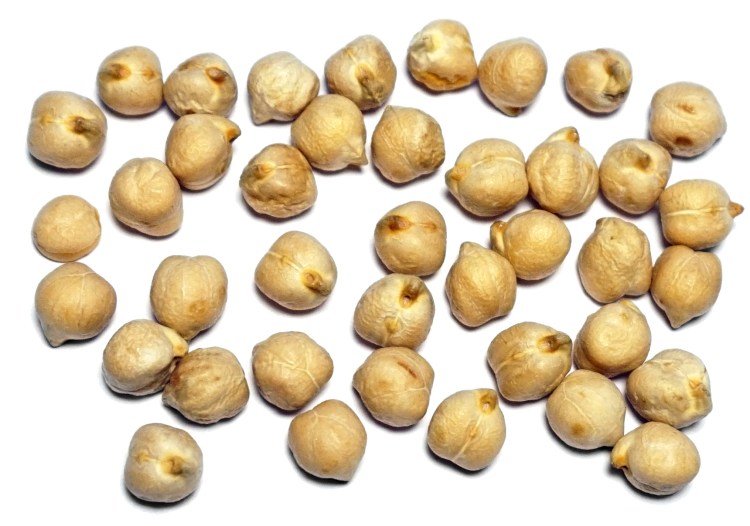
Chickpeas
In a medico-botanical list, written down at the beginning of the fifteenth century, the chickpea is noted as having three colours: red (sanguineus), black (niger), and white (albus), or chyche þe whyte, as the last of these was written in English.1
The chickpea, Cicer arietinum, appears only once in Richard II’s cookery book, in the recipe for a dish simply named after this legume, Chycches. The colour is not indicated in the recipe. There is no other surviving version of this dish in medieval English culinary collections, so it is worth recreating if only for its uniqueness, but especially for its deliciousness.
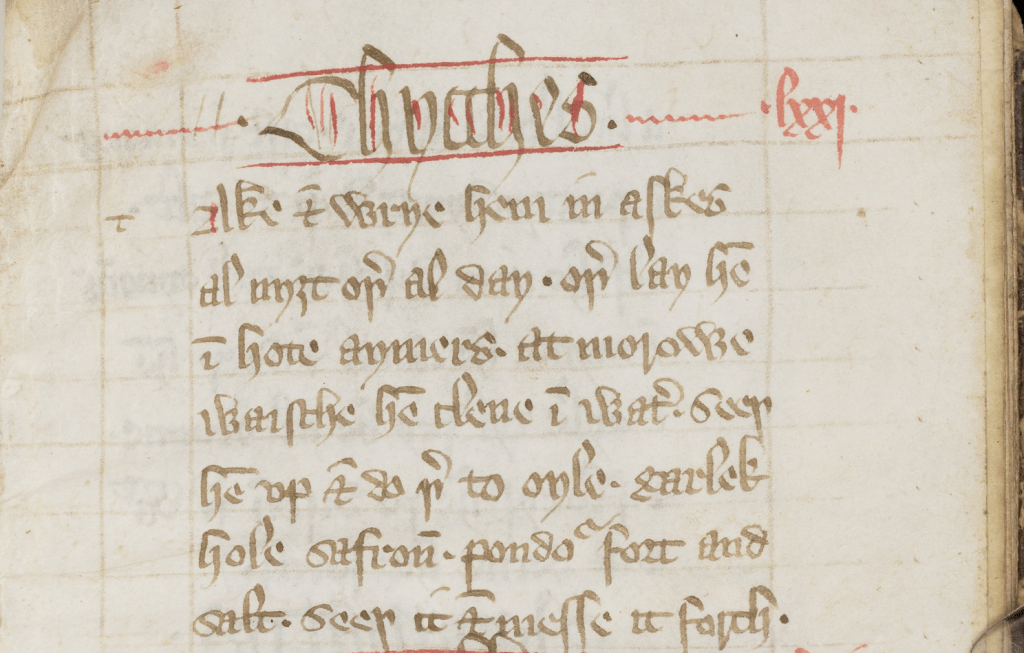
I provide links to two of my own adaptations of this dish at the end of the post. But for now, here is the recipe as it appears in the John Rylands Library version of the text, along with my translation:
Chycches
Take & wrye hem in askes al nyȝt oþer al day, oþer lay hem in hote aymers; at morowe waische hem clene in water, seeþ hem vp & do þerto oyle, garlek hole, safroun, poudour fort and salt, seeþ it & messe it forth.
Chickpeas
Take and cover them in ashes all night or all day, or lay them in hot embers; in the morning wash them clean in water, simmer them up and add to them oil, whole garlic, saffron, powder fort and salt; simmer it and serve it forth.
From where did Richard II’s cook get chickpeas?
It isn’t possible to state explicitly the origin of the chickpeas for the above recipe. The following traces the possibilities:
The evidence for chickpeas being farmed in medieval England is non-existent. As it is not a native legume, this is not especially surprising. For Richard II’s dish, it is possible they were grown in a royal garden or were imported from Europe, though to date I have not found any historical records to confirm either of these suppositions.
We gain insight into the rarity of the chickpea in fourteenth-century England from the botanist and physician Friar Henry Daniel who maintained a large garden in Stepney near London, and also wrote an encyclopaedic herbal during Richard II’s reign.2 Gardening historian John Harvey observes that Daniel was frank about his ignorance of certain legumes:
He is explicit in declaring his ignorance, as of the ancient Faceolus (probably Vigna unguiculata L. [i.e. the black-eyed pea]): ‘What it is, I am in doubt’; and of the chickpea: ‘what is proprely Cicer [i.e. chickpea] fynde y noȝt to my pay.’3
Daniel, then, could not find any satisfactory information specific to the chickpea, the meaning behind his words, above. Evidently, it wasn’t one of the specimen plants that he grew in his garden.
Unfortunately, the entry for chickpeas in the Plant Atlas (a usually reliable resource) states that chickpeas were grown in British gardens by 1200, citing Harvey as support.4 However, Harvey’s own reference is not to be understood as evidence for such early cultivation in Britain.
Harvey cites Alexander Neckam (b. 1157) in his ‘Dated List’ of plants found in his work Medieval Gardens.5 Neckam, an English scholar and theologian who studied and, for a while, lectured in Paris, briefly alludes to the chickpea in his Latin poem De laudibus divinæ sapiantiæ (c. 1190), observing that the cicer (chickpea) gave its name to the great Roman, Cicero: Et cicer excelso nomen præbens Ciceroni.6
This is hardly proof that chickpeas were grown in British gardens by 1200! Rather, it simply shows an English scholar knew about chickpeas in the late twelfth century.
Moreover, Harvey actually states that Daniel’s lack of knowledge regarding the chickpea implies that by the fourteenth century no form of chickpea had reached England.7 Harvey may, here, be referring specifically to the cultivation of chickpeas at this time, rather than to their importation, for we know chickpeas had reached the kitchens of Richard II, otherwise we wouldn’t be reading the recipe above.
Chickpeas were associated with the mediterranean during the medieval period. One possible source of chickpeas for the king’s cook was Cicerale, in southern Italy. Chickpeas were certainly grown there. The town’s name derives from the Latin word for chickpea, cicer, and would seem to indicate it was somewhat famous for chickpea production.8
Chickpeas in medieval English medicine?
There are references to the chickpea in medieval English medical writings, but the vast majority of these are Middle English translations of continental authors, such as the translation of the writings of Guy de Chauliac. So, though not irrelevant, they are not direct proof of the chickpea in English medicine.
De Chauliac was a preeminent French physician who wrote a medical inventory in Latin in 1363.9 In the fifteenth-century Middle English translation of this work, we find several chickpea recipes, including a perry of chiches, which was borrowed from a certain Maister Arnaldes, probably the famous Arnaldo de Villanova, a Catalan physician (d. 1311).10
From the name perry, and the description given, it sounds like it was a purée of strained chickpeas that had been pre-soaked overnight in clean water, then boiled long in water flavoured with parsley, spikenard, saffron and white wine.
Additions to the purée, we are told, included juniper berries, cumin (in the winter), juice of lemons or oranges, and melon seeds, the latter two ingredients pointing to a southern European source. And we are informed that this chickpea purée would cleanse the liver and kidneys, and prevent stones forming.
This brings us to a possible English medical use of the chickpea. There is a similar Anglo-Norman recipe for a chickpea purée. It is one of many medical recipes in a compendium of medical texts found in a manuscript dating to about 1320-30.11
It is for the treatment of stones and stomach ache (pur gravel e mal de flanc). A handful of red chickpeas (chites ruges) or, if not available, white ones (de blancches) are washed well and then put into a clean pot with a quart of water, where they are left to soak from the evening until the morning (lez lessez temperer de soir deke a matyn).
A powder is made up using, in equal amounts, powders of wild celery seed (apie), fennel (fenoul), parsley (percyl) and fenugreek (fenegrek); and then also added to this is powder of squinante, which appears to be a kind of sweet-scented grass, known as camel grass, somewhat like common lemongrass.
The final instruction is:
E a checun foiþe cum vous voudrés user, vous mettez un quilieré de argent de ceste pouder en pot ouveke lez chites en le ewe e le matyn en la jour [a]vaunt fettez lez tant bulier dekez il seit a la manere de purré de peiz. E dunkes bevés un bone tret de cele purré si chaude com vous le poés suffrer. En jour le puit humme user tres foiþe la semeygne.12
And each time when you wish to use it, you put a silver spoon’s worth of this powder into the pot with the chickpeas in the water on the morning of the day before boiling it, which is done until it is like a pea purée. And then drink a good amount of this purée, as hot as you can bear it. In a day, one may use it three times, for a week.
Though not the chickpea purée of the above medicinal drink, the dish designed, and presumably made, by one of Richard II’s master cooks may well have been considered of medicinal value. We should always bear in mind that the Fourme of Cury was compiled by his master cooks with the assent of the king’s physicians, as we are told in the book’s preface.
We only have to look to the Savoyard lands, twenty years into the fifteenth century, to observe that Master Chiquart Amiczo, the chief cook of Amadeus, eighth Count of Savoy (1391-1416) and Duke of Savoy (1416-40), was advocating a dish of chickpeas for those at great feasts who were ‘sickly or delicate individuals […] afflicted with infirmities or illness’.13
In his cookery treatise, Du fait de cuisine (1420), we find les syseros, translated as ‘a Chickpea Dish’ by Terence Scully, the editor of the text. The method outlines a careful preparation of chickpeas, with multiple changes of water, and instructs that the cook should add almond oil, parsley root, a little sage, and – if the doctor orders it – a little cinnamon and verjuice, ‘to give it flavour’.14
Chycches, adapting the recipe
My approach, a few years ago, to recreating the dish Chycches in Fourme of Cury was certainly about maximising taste, and though I didn’t consult any doctors, I’d go as far as to say it was rejuvenating!
I made some changes. I added an additional spice, cumin; and I enriched it, rather naughtily you might think, with cheese and egg yolk. However, I was simply taking the idea from a contemporaneous Italian version of the dish, created, once more, for the sick and infirm.
The recipe does use an oven-top smoker to replicate, what I believe would have been, the smoky flavour imparted by the medieval pre-cooking process of leaving the chickpeas in ashes. But if you don’t have one, you could skip this part and go for a non-smoky version of the dish. Still delicious!
You can download the recipe at the end of the post.
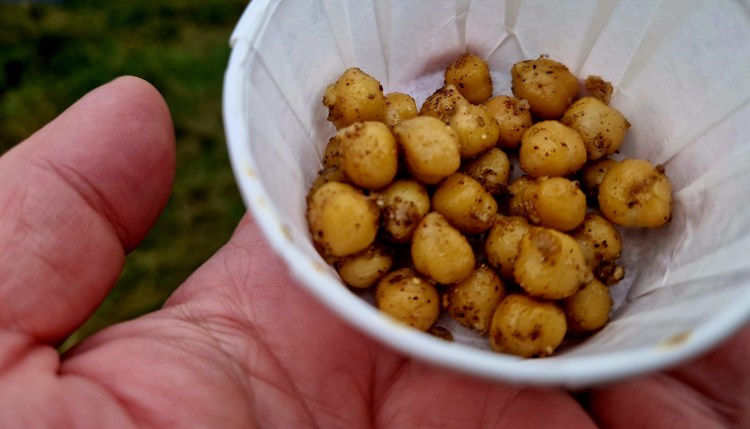
If you would also like to see a dry version of my recipe, shown just below, created as an easy-to-eat snack for a modern food event in a medieval wood, then check out this post.
If you’ve enjoyed this or any other post, please consider making a small donation to offset the cost of independent research. You can do so at the Yieldeth me a cup of mead tab. Or you might want to consider becoming a monthly subscriber.
Selected bibliography
Harvey, John. Medieval Gardens (B. T. Batsford Ltd., 1981).
Harvey, John H. ‘Henry Daniel: A Scientific Gardener of the Fourteenth Century’, Garden History 15.2 (1987), pp. 81-93.
Hunt, Tony. Plant Names of Medieval England (D. S. Brewer, 1989).
Hunt, Tony and Michael Benskin (eds.). Three Receptaria from Medieval England: The Languages of Medicine in the Fourteenth Century (The Society for the Study of Medieval Languages and Literature, 2001).
Ogden, Margaret S. The Cyrugie of Guy de Chauliac, Early English Text Society no. 265 (Oxford University Press, 1971).
Scully, Terence (ed. and trans.). Du fait de cuisine / On Cookery of Master Chiquart (1420) (Arizona Center for Medieval and Renaissance Studies, 2010).
Wright, Thomas (ed.). Alexander Neckam: De naturis rerum et De laudibus divinæ sapientiæ (Longman, Green, Longman, Roberts, and Green, 1863).
Notes
- Hunt, Plant Names, pp. xxv and 80. ↩︎
- Harvey, ‘Henry Daniel’, p. 81. For an overview of Daniel’s life and works, see the online Henry Daniel Project. ↩︎
- Harvey, ‘Henry Daniel’, p. 86. ↩︎
- Plant Atlas, ‘Chick Pea’, Cicer arietinum L. in BSBI Online Plant Atlas 2020 [accessed 20 February 2026]. ↩︎
- Harvey, Medieval Gardens, p. 170. ↩︎
- VIII, ll 21-2, in Wright, p. 481, available here ↩︎
- Harvey, ‘Henry Daniel’, p. 86. ↩︎
- See ‘Cicerale Chickpea’, Slow Food Foundation for Biodiversity, online, https://www.fondazioneslowfood.com/en/slow-food-presidia/cicerale-chickpea [accessed 20 February 2026]. ↩︎
- The original work goes by the Latin title Inventarium seu collectorium in parte cyrurgicali medicine, ‘An inventory or collection in the field of surgical medicine’. ↩︎
- Ogden, p. 519. ↩︎
- The manuscript is MS Cambridge, Corpus Christi College 388; see Hunt and Benskin, p. 85. ↩︎
- Hunt and Benskin, pp. 127-28, no. 443 ↩︎
- Scully, p. 245. ↩︎
- Scully, pp. 267-68, no. 76. ↩︎
 MONK'S MODERN MEDIEVAL CUISINE

I can’t imagine it’s bad with the smokiness, cheese, and egg yolk! And of course the garlic and saffron.
I do try to read the middle English and figure out what the heck they’re saying before reading your translation. But I basically learned almost everything I know from your Youtube channel and writings. I hadn’t seen the ‘3’ as in ‘nyȝt’ before. On a quick search (guessing it would sub for ‘gh’) I found this pretty fascinating for any readers who didn’t already know – https://en.wikipedia.org/wiki/Yogh
LikeLiked by 1 person
I’m glad I’ve been of help in understanding Middle English. In the case of niȝt, yes, we could substitute gh, or indeed just h. In fact there are multiple spelling variants for this word. Check out the ME Dictionary: night – Middle English Compendium
The Chycches dish is one of my favourites. The cheese and egg yolk just take it to another level.
LikeLike
Aha, it helps to know the right site to look on! You’ve mentioned it before, but that really drives home how everyone was just basically spelling by what they thought the word sounded like. Which goes down this rabbit hole: https://en.wikipedia.org/wiki/Dictionary#English_dictionaries_in_Britain
LikeLike
I don’t understand why chickpeas aren’t bar snacks. They’d be much less an assault on the nose than pork scratchings or ‘flavoured’ crisps.
LikeLiked by 1 person
Now there’s a business idea 💡! 😉
LikeLiked by 1 person