
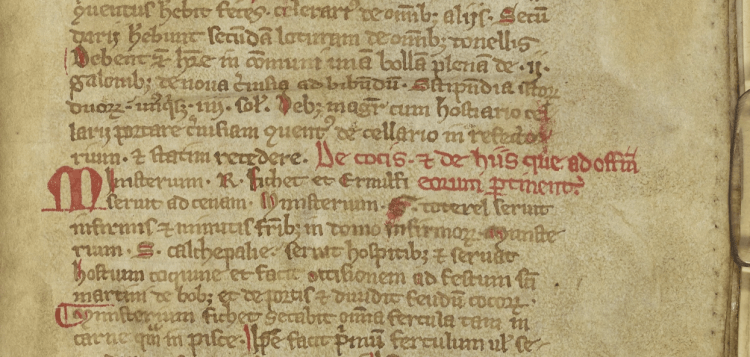
This page includes translations of excerpts from medieval works that relate to food and cookery.
Please note that the translations are all my own and are copyrighted. Should you wish to reproduce more than a line or two, please contact me directly. I am happy for you to quote a line or two without permission, but please do so accurately and you must credit me as translator.
The initial focus will be on medieval texts that I have researched for educational purposes for heritage projects and television work. I will be adding more translations as I complete them.
Translations of recipes from Fourme of Cury, the focus of my ongoing book project, will not appear here, but will be available in my book once it is published. You will, however, find some translations from that medieval cookery book and other medieval culinary collections throughout my blog, though these are all subject to revision/editing.
My translations on this page may appear elsewhere, such as on the website of the Kent Archaeological Society or Rochester Cathedral’s website. These organisations have my permission to reproduce them. Please note, however, that translations here may supersede those elsewhere, though I shall endeavour to update those elsewhere, as and when I have the time to do so.
One final thing: these translations will be ‘live’ in the sense that I reserve the right to make corrections and refinements, though I shall endeavour to indicate when and where such amendments have been made.
I hope you enjoy reading the translations. I do provide some notes to help with context and interpretation, but please feel free to contact me if you have any queries regarding any of them.
If you wish to support my independent research, you may wish to subscribe or make a one-off donation.
Here are the translations:
The master baker at Rochester Priory, Custumale Roffense, f. 53r, 13th-century
(Translated from Latin by Christopher J. Monk © 2026.)
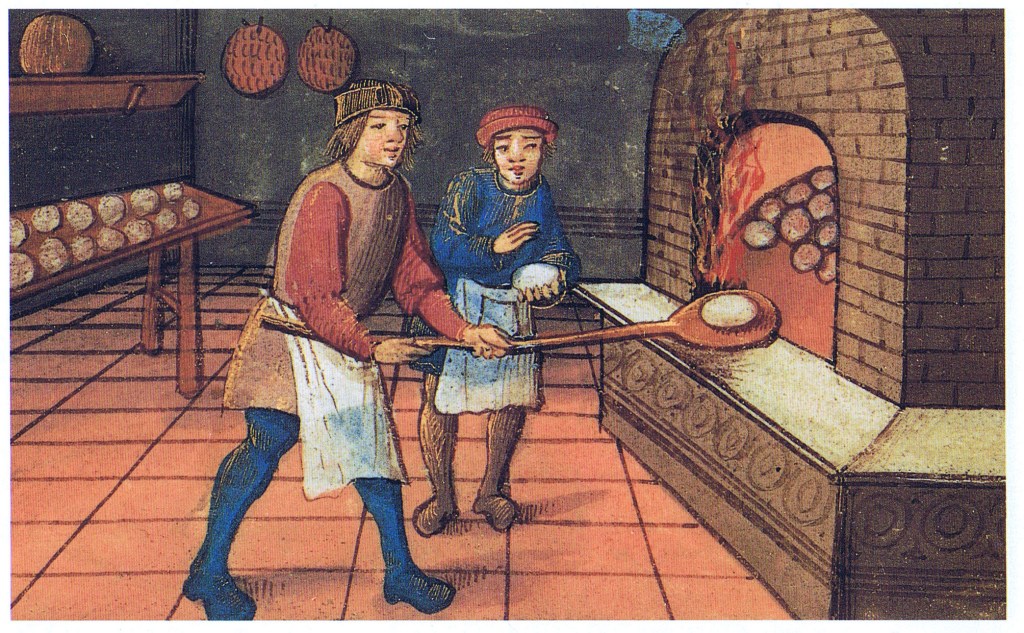
You can find the digitised manuscript page from Custumale Roffense here. You will need to ‘turn the pages’ by either tapping on the edge of the page or using the arrows bottom right. You need 117/164. The text is found at the top of the right-hand folio, numbered 53, top right in pencil; it runs from the first heading in red ink to the next heading. If using a phone, scroll down to 116/164.
This extract commences a fascinating section (folios 53 to 60) of the customs book of Rochester Cathedral priory, all about the lay servants and their duties.
Translation
It begins with the office of the bakers, what they should do.
The master of the bakers ought, in fact, to see and feel the wheat in the sacks at the door of the granary,1 [to judge] if it could make for the monastery the best and finest bread, or not;2 he should accept or reject it through [or, by means of] his mouth. He weighs the bread. Also, he must account for all the bread at the cellarer’s store.3 And afterwards he will have one monk’s loaf and at Easter time a flan. His stipend, 7 shillings. It belongs to him to mix and knead the dough of the monastery.
Commentary
through his mouth Lat. per os eius. The phrase may carry two meanings. It may simply signify that he was to give a verbal yea or nay; or it may mean he was to test the grain by means of chewing. Since the baker was establishing whether he was able to make the finest bread, he needed to be sure the grain would be of sufficient quality. Chewing the grain into a kind of dough-ball, and then stretching it between the fingers, is one way of physically establishing the quality of the grain.
He weighs the bread. Though weighing the bread must refer, at least in part, to the predetermined size of the monks’ and servants’ loaves – the sizes are alluded to elsewhere in the record – there is some evidence that the priory’s bread may have been sold to pilgrims and other passers-by, making it necessary for the baker to conform to the rules of the Assize of Bread and Ale, i.e. the thirteenth-century law governing the price, weight and quality of bread and ale produced in towns and villages. Indeed, a copy of the Assize relating to bread is included in the Custumale Roffense.
cellarer. One of the senior monks responsible for all the food and drink supplies of the monastery. The ‘cellarer’s store’, or range, is thought to be located along the West side of the present-day ruins of the priory’s cloister. See this post on Rochester Cathedral’s website.
flan Lat. flaco.4 A flan, or flawn, was essentially an open tart made with an egg and dairy custard filling. The earliest surviving English recipe closest to a custard tart are the pies called Tardpolane. The recipe dates to around the very end of the thirteenth century, found in the Anglo-Norman collection Coment l’en deit fere Viande e Claree (‘How One Should Make Food and Spiced Wine’).5 The pastry cases are two fingers deep, and they are filled with a mixture of eggs and soft cheese with ground pears, dates, almonds, figs, raisins, and spices. The pastry lids are brushed with egg yolk to give a good colour to the baked pies. There are plenty of recipes in the fourteenth and fifteenth centuries that are more straightforwardly open flans; most commonly there are sweet milk or cream egg custards, usually sweetened with sugar, but ones containing cheese are also documented. Quite a number contain spices, including saffron, cinnamon, ginger, and cloves. Since dairy foods and eggs were forbidden fare during Lent, a flan would have been a suitably delicious way of marking the end of abstinence.
The role of the second baker
(Translated from Latin by Christopher J. Monk © 2026)
This section continues on from the above section on the master baker, and is also found on folio 53r, beginning at the second red ink heading.
Translation
What the second in command should do.
The second in command will measure all the wheat that pertains to the bread of the monastery, both when receiving it and sending it to the mill. He should also measure the flour when it has been brought back by him from the mill, and see whether he has 7 skeps of flour from five skeps of wheat. He will also measure the servants’ entire corn allowance on receiving it; and, on the nod of the cellarer, release it to the servants. 6 And afterwards he will have a monk’s loaf and a gallon and a half of ale.
He will grind the wheat [at the mill] as often as is necessary, and he will have a horse for this purpose and a groom, which groom will have the same as one in the guesthouse, and twelve pennies per year from his master, [paid] once at the Mandatum of the Lord’s Supper [i.e. Maundy Thursday].
His stipend, 5 shillings. To him it belongs to mix and knead the dough of the monastery one day and the master [baker] the next. They will provide the knives for preparing the bread of the monastery, and they will have the trimmings of the monastery’s bread, the master one day, the second in command the next.7
They will make the sacramental bread and wafers; and on that day they shall have bread and a gallon and a half of ale and one dish from the kitchen with pottage.
Commentary
skep Lat. eskippa. A dry measurement. The Latin eskippa derives from Old English sceppe and Old Norse skeppa, originally meaning a wicker or wooden basket. In the thirteenth century, a skep was equivalent to a half-bushel. A bushel equalled 8 gallons.8
corn allowance. In the text, the word metecorn is Latinised; metecorn has an Old English origin, and it meant the ‘allowance of corn for dependents’.9 In the context of the Rochester custumal, the dependents were the servants. Indeed, in a later section of the custumal, the amount of grain was the same for each servant, regardless of rank, and was distributed once a month.
trimmings Lat. parura, literally ‘parer’. The sense here is that the two senior bakers share in taking the edible trimmings, that are cut from the loaves, as a perquisite, a perk. The Latin parura should be understood as a noun of result. In other words, the two bakers used their own knives, just mentioned, to trim any unsightly darkened crust from the monk’s loaves, making them presentable. Rather than this be wasted, the custumal officially gave the two bakers permission to take the trimmings for themselves.
The three under-bakers
(Translated from Latin by Christopher J. Monk © 2026)
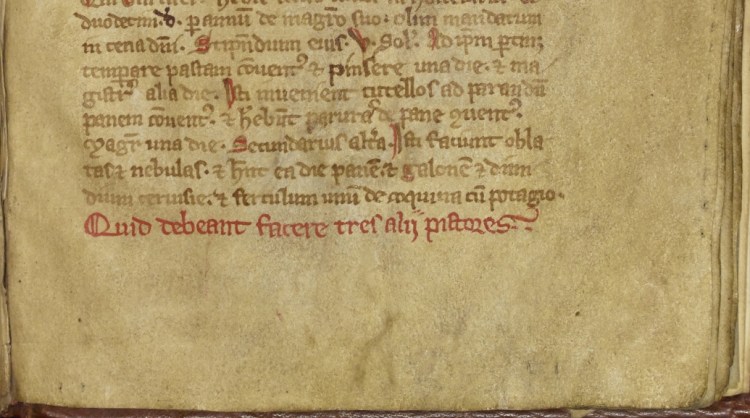
Carrying on straight from the preceding section, this begins right at the bottom of folio 53r, at the final red ink heading on the last line, continuing overleaf on 53v, approximately halfway down the page until the next red ink heading.

Translation
What the other three bakers should do:
The other three bakers: according to how their days fall, the first will heat the oven, the second will shape the bread at the table, the third will sit [at the gate] to sell.
Their stipend, for each one 4 shillings. They will have in common one loaf and three gallons of ale. It is noted that they ought not to eat there [in the bakery] nor have ale until after the main meal.
They will carry wood and draw water.
They will bolt [enough flour for] a batch, and – having stripped [off their outer garments] – they will enter the [bolting] chamber when they do this; the guard of the granary, or anyone else acting for the cellarer, will make firm the door over them until they have finished this. The cellarer will supply the brewers [perhaps to do the guarding].
They will have a turtel of the weight of one monk’s loaf, and for carrying the bread to the storeroom, four guest loaves.
And it will be observed that the first loaf which is weighed will be Christ’s.
Commentary
will sit [at the gate] to sell. The Latin phrase ad bracam (a variant spelling of ad brocam) literally means ‘on the broach’, or ‘from the tap’, we might say. In the twelfth and thirteenth centuries, this phrase was used to distinguish small retail (particularly of wine) at a premises, such as a tavern, as opposed to retailing in grosso, ‘in bulk’, selling wholesale.10 The context of baking points to a broader use of the term to mean the sale of other foodstuffs at a fixed place. Here, it refers to the sale of bread at the priory, most probably at the priory’s gate, to pilgrims and other passers-by. The three under-bakers took this in turn.
main meal, Latin, prandium. Prandium is often rendered as ‘dinner’, but for modern readers dinner is associated with an evening meal. According to the Benedictine Rule, which was followed by the monks at Rochester Priory, from Easter to Pentecost ‘the brothers should dine at the sixth hour and have supper in the evening’, and from the ides of September (the 13th) until the beginning of Lent, the main meal was at the ninth hour, roughly corresponding to 3 in the afternoon. There was no supper, but during Lent, they fasted until the evening.11 It is reasonable to assume that the servants at the priory had to follow the meal times of the brothers.
bolt. To further refine milled wheat that has already been sieved to remove the coarser particles of bran; this was done using a bolting cloth made from fine-meshed linen. The result would be fine white flour for making the monks’ loaves. 12
turtel Lat. tortellus. The word used in the text, tortellus, is a Latinised form of Anglo-Norman turtel, a small round loaf made using unbolted flour. Compared to the monk’s loaf, the turtel was coarse, but it may have been more nutritious. Woolgar discusses the large variety of breads made at St Augustine’s Abbey, Canterbury, around the same time as Custumale Roffense was being written. This included the largest loaf, a turta, weighing 1.62 kg. The turtel was evidently the smaller version of this. Woolgar explains that the turta was ‘largely for servants’, and that it may be synonymous with the treat loaf which ‘[a]ccording to the Assize of Bread and Ale of c. 1256 was the lowest quality of wheat bread’. Moreover, at the beginning of the fourteenth century, these servants’ loaves were made from barley, thus becoming ever more distinguishable from monks’ loaves.13
the first loaf… will be Christ’s. The act of marking out the first loaf for Christ was both symbolic and practical at once, and appears to relate to the monastic duty to care for the poor. This small rule was written right at the end of the three sections describing the rules within the bakery, so its position is significant. The rule probably drew upon the Benedictine teaching that ‘the greatest care should be shown in the reception of the poor and pilgrims because in them especially Christ is welcomed’. Though a single loaf would not feed the poor, the nominating of the first loaf was a moment when deep religious belief was integrated into the otherwise mundane act of baking bread. Practically, the loaf was likely added to those to be distributed to the local poor or pilgrims, which would have been overseen by the almoner, one of the senior monks.
The cooks at Rochester Priory, Custumale Roffense, folio 54r-v, 13th-century
(Translated from Latin by Christopher J. Monk © 2026)
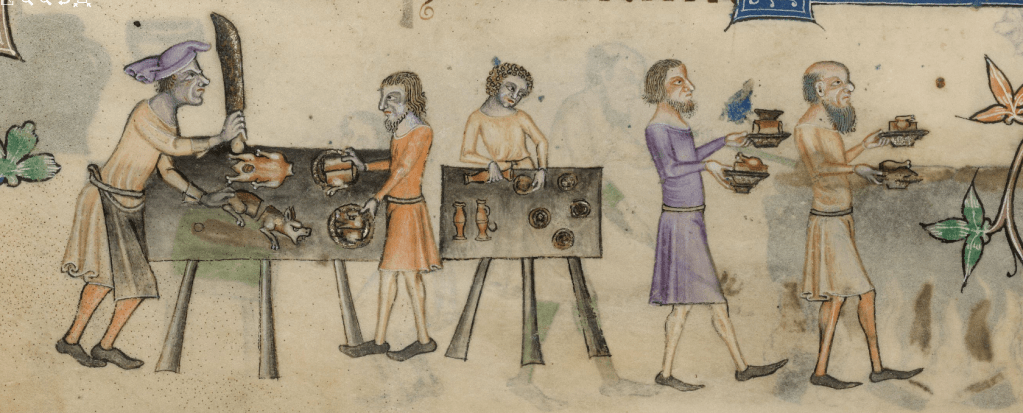
You can find the digitised manuscript pages from Custumale Roffense here. On a PC, you will need to ‘turn the pages’, either by tapping the edge of the page or using the arrows bottom right until you arrive at 118/164; the folio is numbered 54 in pencil, top right. The text begins at the red ink heading, halfway down the the right-hand folio, and continues overleaf until the next heading. On a phone, scroll until you arrive at 119/164.
This extract is part of the section (folios 53 to 60) of the customs book of Rochester Cathedral priory which describes the duties of the lay servants.
Translation
Concerning the cooks and those things that pertain to their duties
The office of R. Fichet and Ernulf serves at the [monks’ communal] meal. The office of G. Toterel serves the sick and weak brothers in the infirmary. The office of S. Calchepalie serves the guests, and guards the kitchen door, and carries out the slaughter of sheep and pigs at the Feast of St Martin, and divides the cooks’ fee.
The office of Fichet will portion all the dishes, both meat and fish. He himself makes the first or second dish and then serves the monastery. He himself is witness to the buyer in order that all purchasing may be bought well and faithfully and later accounted for before the cellarer in the cellar. His stipend, 7 shillings. Ernulf’s office, 5 shillings. Toterel’s office, 4 shillings. Calchepalie’s office, 4 shillings.
They have in common daily bread of one monk, and 2 and a half gallons of ale, but this from goodwill; and this was made by joint decision on account of the offences which used to happen when they were eating at home, because there was no one who might respond to guests arriving. They will also have in the evening, after the reckoning of the dishes, a pot of ale in common to drink.
They also have, when the cellarer makes his larder, all necks of oxen and cows and all pieces from the knee to the foot, so that the tendons [or, sinews] of the aforementioned bones will remain attached to the feet. They have the heads for their skinning; and the cellarer the tongues. They have at the same time, to be sure, all necks and tails of pigs, attached to the backbone in a single joint. They also have all heads of fish, except salmon, from which they have the tail.
For preparing the innards [or, offal] of oxen, cows and pigs, the cooks will find women and the cellarer will supply them. And when the cellarer wishes that one pig, or two or three, should be slaughtered for the nourishment of the court, the swineherd has the tail, the cooks the neck. And for preparing the innards, they [the women] have charity, namely bread and ale, but by the goodwill of the cellarer. They [the cooks or the women is unclear] will also pluck all the kinds of birds that come into the kitchen for eating.
Commentary
the meal, Lat. cena. DMLBS offers ‘meal, dinner, supper’.14 The context implies a meal in general terms, either dinner or supper, not specifically the supper, which is often how cena is used or understood. We should note that Fichet, who serves this meal, is cooking and serving meat or fish, dishes that would certainly be part of the main communal meal of the day. Depending on the calendar, Benedictine monks were to eat either one or two meals per day. (See main meal in the commentary section for ‘The three under-bakers’, above.)
Feast of St Martin. St Martin’s Day, 11th November. In England, a key date in the calendar for slaughtering animals for food.
Makes his larder. Prepares his meat for storage by butchery and salting.
all necks and tails of pigs, attached to the backbone in a single joint. The Latin is a little ambiguous at this point: addita una iunctura de spina dorsi eodem tempore may be translated as ‘with one joint added from the backbone’, perhaps meaning each neck and tail bone was attached to a single joint from the spinal column. However, I suggest it makes more sense to understand that the cooks were to receive from each pig the entire joint from neck to tail bone, since the context implies the cellarer is preserving the main muscle joints of both beef and pork, and handing over the minor, bony joints to the cooks, as perquisites.
They have also all heads of fish except salmon, from which they have the tail. The implication is that the cellarer was salting the fish (the main body thereof) as part of his larder. Whether other methods of preservation were used is unclear. No doubt, fresh fish and seafood were also available to the monks.
The fish heads and tail of the salmon were, like the bony pieces of meat, perks or ‘cook’s fees’, and would be useful to supplement pottages or broths of their own, either cooked and eaten at the priory or, failing that, cooked by their wives for their families. However, fish broths must have been needed for cooking fish dishes for the brothers. Perhaps it is reasonable to suggest that such fish broths were made from some of the preserved fish, as meat broths would have been made from preserved meat. Of course, locally available fresh fish may have also been available to make fish broth.
And when the cellarer wishes that one pig, or two or three, should be slaughtered for the nourishment of the court, the swineherd has the tail, the cooks the neck. This appears to relate to a more impromptu slaughtering and eating of fresh pork, as a contrast to the pigs being killed and butchered for salting on St Martin’s Day. In this case, the swineherd, presumably acting as slaughterman, gets to keep the tail for himself as a fee of sorts, the cooks receiving the neck, as they would if the pig was being prepared for the larder. The mention of the nourishment of the court (Lat. curia) rather than of the monastery (conuentus), suggests a meal not of the everyday kind, but rather a feast suitable for noble or distinguished visitors. There may be, too, an inference to be drawn concerning the expression unus porcus, duo uel tres, literally ‘one pig, two or three’: when fresh pork was required at short notice, or an especially illustrious guest was visiting, then two or even three younger pigs – suckling pigs perhaps – may have been substituted for the normal single porker.
Concerning the new fishing weir of Rochester
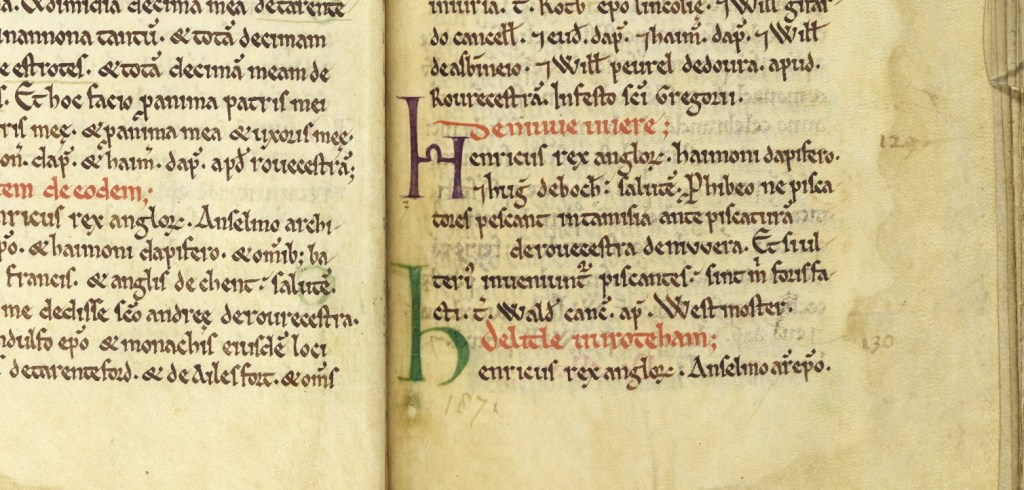
This document appears in the cartulary section of Rochester Cathedral’s Textus Roffense, the most important collection of early English laws.
The original document was copied into the cartulary, a collection of royal charters and other texts pertaining to the monks of the cathedral priory of St Andrew’s.
The royal writ was issued by Henry I (r. 1100-1135), fourth son of William the Conqueror. The cartulary dates to about 1123. The original writ would have been written some time between 1102/3 and 1107, since it states that Waldric, who witnessed the document, was the royal chancellor at the time.15
It is succinct in its advocacy of the fishing rights of Rochester. In short, it was an attempt to stop Thames fisherman blocking the migratory path of fish up the Medway estuary, though the Medway is not actually named.
Translation
Concerning the new weir: Henry, king of the English, to Haimo Dapifer and Hugh de Bocland, greetings. I forbid any fishermen to fish in the Thames in front of the fishing of the new weir of Rochester. And if they are found fishing beyond [this point], let them be forfeited to me. Witnessed by Waldric, the Chancellor, at Westminster.
Commentary
Haimo Dapifer. The sheriff of Kent at the time. His administration included the River Medway.
Hugh de Bocland. Concurrently, the sheriff of multiple counties, most notably Berkshire. His administration extended to the jurisdiction of the River Thames.
In front of… the new weir of Rochester. Although the wording only mentions Rochester, it seems quite probable that the monks of Rochester Priory had a direct stake in the newly constructed weir.
The use of ante in Latin contextually means ‘in front of’ or ‘before’. The Medway estuary merges into the mouth of the Thames, which then proceeds into the North Sea. If Thames fishermen were to fish in front of the Medway estuary they would diminish the likelihood of good numbers of salmon swimming up the Medway and into the weir. They would have been, in effect, blocking the migratory route of the salmon or, more dramatically, stealing salmon from Rochester.
An estuary or river weir was a fishing trap, likely a long, V-shaped wattle-fenced structure, embedded into the estuary via stakes, and terminating in conical baskets. Migratory salmon would have swam upstream and, without realising, many of them would have been guided into the basket traps. For more information on weirs, please read the excellent article by Historic England.
Let them be forfeited to me. Violating this royal writ would have made the fisherman on the Thames criminals against the crown, with the prospect of facing forfeiture of their property and possessions to the king.
Selected Bibliography (for all sections)
Brears, Peter. Cooking and Dining in Medieval England (Prospect Books, 2012).
Fryde, E. B., D. E. Greenway, S. Porter, and I. Roy (eds.). Handbook of British Chronology, Third Edition (Royal Historical Society, 1986).
[Hieatt & Jones] Hieatt, Constance B., and Robin F. Jones. ‘Two Anglo-Norman Culinary Collections Edited from British Library Manuscripts Additional 32085 and Royal 12.C.xii’, Speculum 61.4 (1986), pp. 859-882.
Dictionaries:
[CA-SD] A Concise Anglo-Saxon Dictionary, fourth edition, J. R. Clark Hall (University of Toronto Press, 1960) ].
[DMTP] A Dictionary of Medieval Terms and Phrases, ed. Christopher Corèdon with Ann Williams (D. S. Brewer, 2005).
[OF-ED] Old French-English Dictionary, ed. Alan Hindley, Frederick W. Langley, and Brian J. Levy. (Cambridge University Press, 2000) .
Online sources:
[AND] Anglo-Norman Dictionary.
[DMLBS] Dictionary of Medieval Latin from British Sources.
[MED] Middle English Dictionary.
Notes (for all sections)
- ‘in the sacks’, Lat. in saccis, was added, as I had accidentally skipped over the Latin in my initial translation; added 6 September 2026. ↩︎
- This clause is an improved rendering of the Latin; changed 6 September 2026. ↩︎
- This sentence is an improved rendering of the Latin; changed 6 September 2026. ↩︎
- See DMLBS, flado [var. flato, flaco] 1, ‘flawn, custard tart’ [accessed 13 May 2026]; cognate with Old French: see OF-ED, fladon/flaon, ‘flat cake; tart, flan’. See also AND, flaon, ‘flawn, a sort of pie, cake, bun’ [accessed 14 May 2026]. ↩︎
- This is the English title given by the editors of the text, Hieatt & Jones; see pp. 864 and 875 for the recipe. ↩︎
- This sentence is an improved rendering of the Latin; changed 6 September 2026. ↩︎
- The second clause of this sentence has a corrected rendering of the Lat. paruram; see the commentary on this; changed 6 September 2026. ↩︎
- See DMTP, Skep. ↩︎
- See CA-SD, metecorn; see also MED, mete-corn. ↩︎
- See DMLBS, broca, 5, ad brocam. ↩︎
- See Venarde, p. 143. ↩︎
- See Brears, p. 115. ↩︎
- See C. M. Woolgar, The Culture of Food in England, 1200-1500, pp. 154-55. For definitions, see DMLBS, tortilla, and the AND, turtel [accessed 28 March, 2022]. ↩︎
- DMLBS, cena [accessed 14 May 2026]. ↩︎
- It is not clear to me whether 1102 or 1103 was the year in which Waldric commenced his chancellorship. The Handbook of British Chronology, p. 83 gives 1102, but other sources state 1103. ↩︎


