
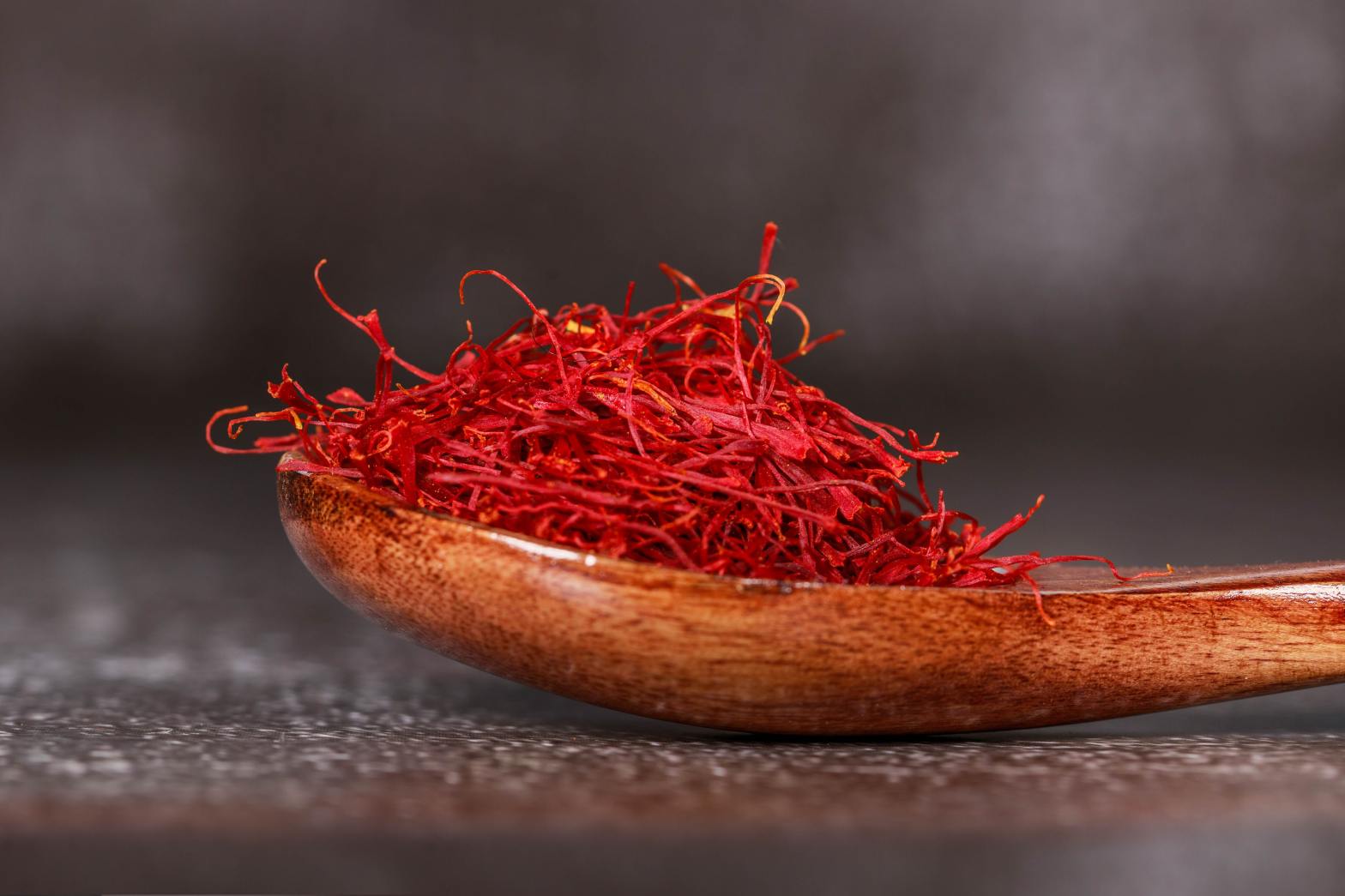
(Image: Saffron on spoon, by Victoria Bowers, via Pexels)
Hello! I thought it was about time I caught up with you all. I’m back from holidaying in sun-drenched Florida and am now trying very hard to adapt to my new reality of a sodden Manchester. My health is improving, so fingers crossed I can get a few things done.
It’s been far too long since my last sample entry from my encyclopaedic glossary of the culinary ingredients, equipment and terms used in Richard II’s cookery treatise, Fourme of Cury. So here’s a nice long one about that almost ubiquitous medieval ingredient for elite cooks, saffron.
saffron safroun. The dried, vivid red-orange stigmas (and, in inferior products, the styles) of the small lilac flowers of the autumn-flowering saffron crocus, Crocus sativus, used as a luxury spice during the medieval period.[1] The individual dried stigmas are often referred to as threads. It is primarily used as a yellow colourant in Fourme of Cury, though its distinctive ‘pungent, bitter taste’ can also transform the flavour profile of dishes,[2] depending on the other ingredients in the dish and the amount used.
As saffron is sterile, it does not produce seeds and therefore is reproduced by dividing its corms.[3] This is alluded to by the fourteenth-century botanist and gardener Friar Henry Daniel, who perhaps grew saffron among his collection of 252 ‘herbs’ in his own garden at Stepney ‘by syde London’ (‘on the outskirts of London’).[4] ‘Master John Gardner’, probably writing in the fourteenth century, provides a quite detailed account of how to grow saffron.[5]
William Harrison (1535-1593), in his Description of England, supports the idea that cultivation of saffron in England happened during the fourteenth century, specifically that as a ‘commodity’ it was ‘brought into this island in the time of Edward the Third’, who reigned from 1327 to 1377, but that it was ‘not commonly planted till Richard the Second did reign’, that is from 1377 to 1400.[6]
Even though saffron may have been cultivated during Richard’s reign, it was still being imported, as can be seen from a legal petition made in 1391 by a certain merchant, Stephen de Sancto Johanne, to have returned to him 10 pounds of saffron, unlawfully withheld at the port of Sandwich, and which was destined by land to London.[7]
Before being cultivated in England – particularly in Cambridgeshire, soon after the middle of the fourteenth century –[8] saffron was imported from Spain, where it had been grown perhaps as early as the eighth century.[9] Saffron appears in the earliest surviving, English household account, namely an unidentified household in London of the late twelfth century.[10] Eleanor de Montfort, Countess of Leicester and Pembroke, made five bulk purchases of saffron during 1265, amounting to three pounds in weight, at a total cost of 1 pound, 15 shillings and 6 pence – or the equivalent of about 2 horses or 5 cows, or 177 days of work for a skilled tradesman.[11]
Further showing its value is an early fourteenth-century record from Staffordshire, in which we read of a suit brought against Roger de Bodenham who was accused (though eventually acquitted) of seizing goods from the Earl of Lancaster, and his fellow rebels, that should have been forfeited to Edward II (r.1307-1327). Amidst the barrels of silver, jewels and other treasures, ‘two pockets of saffron worth 100 s[hillings]’ and ‘twenty pounds worth of crocus’ had been taken.[12]
Saffron engenders a golden hue to otherwise pale sauces and broths, and this seems most fitting for the household of King Richard. In fact, it is named as an ingredient in 74 of Fourme of Cury’s dishes, and alluded to in one further dish, amounting to almost 40% of the book’s recipes. In the context of a royal cookery, then, saffron may be seen as the chief signifier of superior cuisine, the go-to ingredient for elevating food.
Previous: rost, the roast, roasting iron
Buy me a coffee
Choose an amount
Or enter a custom amount
Thank you for valuing my work. Your contribution is appreciated.
Donate
Buy me a coffee
Show your appreciation for my work by “buying me a coffee”. Thank you! If you wish, you can send a direct PayPal payment, using the link paypal.me/drcjmonk. Thanks again!
£2.00
[1] See Bilton for an excellent introduction to the history of British saffron.
[2] Description in Lakshmi, ‘Saffron’.
[3] Bilton, p. 18.
[4] Harvey, Gardens, pp. 159 and 119.
[5] Gardener, pp. 166-7.
[6] Bilton, p. 23; citation is Bilton’s.
[7] Calendar of Close Rolls, Richard II, Vol. 4, pp. 234-35.
[8] Harvey, Gardens, p. 121.
[9] See the section ‘Saffron in Cambridgeshire and Essex’ in the online resource Boddy and Lander Johnson (?2023): https://www.cam.ac.uk/stories/saffron#section-Introduction-C8CwsvXpJn; on the date of the cultivation of saffron, Bilton states, ‘Cultivation of saffron began in Spain at some point between the eighth and tenth centuries, primarily in La Mancha, Valencia and Aragon, where it arrived with Berber invaders.’ Bilton, p. 27.
[10] HAME, part 1, pp. 108-9.
[11] Based on the National Archives currency converter for the year 1270, The National Archives, https://www.nationalarchives.gov.uk/currency-converter/.
[12] Wrottesley (1889), pp. 62-74, British History Online, https://www.british-history.ac.uk/staffs-hist-collection/vol10/pt1/pp62-74 [accessed 20 September 2023].
Bibliography
Bilton, Sam. Fool’s Gold: A History of British Saffron (Prospect Books, 2022).
Calendar of Close Rolls, Richard II: Volume 4, 1389-1392, ed. H. C. Maxwell Lyte (London, 1922), British History Online, http://www.british-history.ac.uk/cal-close-rolls/ric2/vol4.
Gardener, John. Alicia M. Tyssen Amherst, ‘A Fifteenth-Century Treatise on Gardening by “Mayster Ion Gardener”’, Archaeologia 54 (1894), pp. 157-72.
HAME. Household Accounts from Medieval England, ed. C. M. Woolgar (2 vols., British Academy, Records of Social and Economic History, New Series, 17-18; 1992-93).
Harvey, John. Medieval Gardens (B. T. Batsford Ltd, 1981).
Lakshmi, Padma. The Encyclopaedia of Spices and Herbs: An Essential Guide to the Flavors of the World (EPub Edition, Ecco/Harper Collins, 2016).
Wrottesley, G. (ed.), ‘Plea Rolls for Staffordshire: 19 Edward II’, in Staffordshire Historical Collections, Vol. 10, Part 1 (London, 1889), pp. 62-74. British History Online, http://www.british-history.ac.uk/staffs-hist-collection/vol10/pt1/pp62-74.
(All links accessed 12 November, 2023.)
 MONK'S MODERN MEDIEVAL CUISINE
Thanks for this! Now I’ll have to go track down Master John; I’d never heard of him!
LikeLiked by 1 person
His poetic treatise on gardening is very important historically. Whether the author was actually John Gardener or that’s just a made-up name is unclear. The text does seem to have been written around the middle of the 14th century, though it survives in a 15th century manuscript. And it has been argued that he must have been a royal gardener, so the text is most relevant to a study of Richard II’s culinary work.
Happy researching!
LikeLiked by 1 person
I’ve got some saffron to go in the garden and I have to find out when they need to go in. Friends have said they’re not worth the effort or the space they take up, but I thought I’d give them a go.
LikeLiked by 1 person
The RHS says to plant the bulbs between August and October, presumably to flower the following autumn. I reckon if you planted them now, you’d be OK. I’ve thought about growing them too, though space is a premium in my garden. Let us know how you get on.
LikeLiked by 1 person
I will
LikeLiked by 1 person