

Whilst on my hols in sunny Florida, I thought I’d rustle up something medieval in the kitchen, something that’s been in the back of my mind for a while. It was pretty easy to put together but I should say that some of the cooking can’t be rushed. Less ‘rustle up’, then, and more leisurely holiday cuisine.
My creation was a combo of two medieval dishes, Makke and Aquapatys. If I were to describe it in posh modern terms, I’d call it a legume dip with confit garlic. It was delicious!
You can find the recipe below. My lovely monthly subscribers can also find the full accompanying video; it was shot on a phone without my usual equipment, so it’s a bit wobbly in places, but I thought it would be nice for you to see me making the dish.
First, however, are the two original recipes along with my translations. They are from Richard II’s cookery treatise, Fourme of Cury (c.1390), and I don’t think it’s a total coincidence that they are together in the manuscript (nos. 72 and 73). They were made for each other!
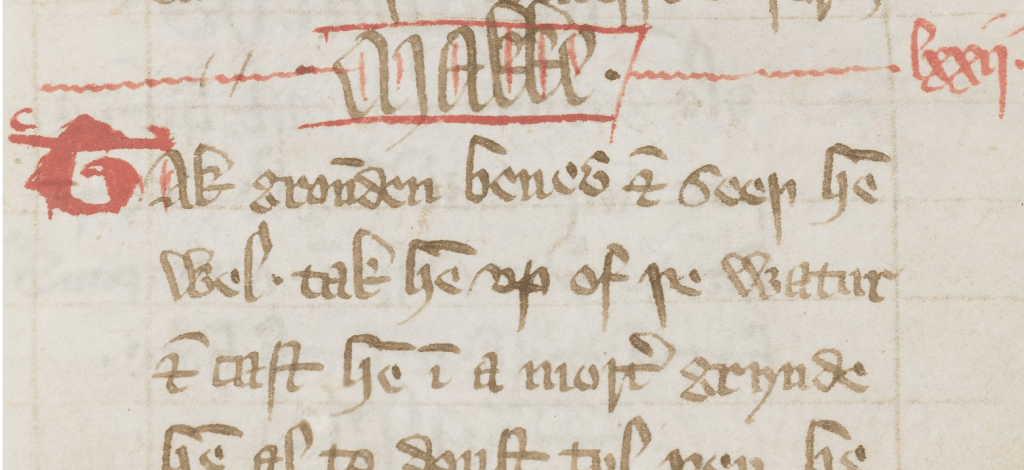
Makke
Tak grounden benes & seeþ hem wel, tak hem vp of þe watur & cast hem in a morter, grynde hem al to doust tyl þey be white as eny mylke, chauf a litul rede wyne, cast þeramong in þe gryndyng & do þerto salt, lesche it in disches, tak oynouns & mynce hem smal & seeþ hem in oyle tyl þey be al bronne, & florysche þe disch þerwith and serue hit forth.
Take split beans and cook them well; take them up from the water and put them in a mortar; grind them all to dust until they be as white as any milk; heat a little red wine, add it to the ground mixture and add salt to this; arrange it in dishes; take onions and finely mince them and cook them in oil until they are all brown, and sprinkle the dish with them and serve it forth.
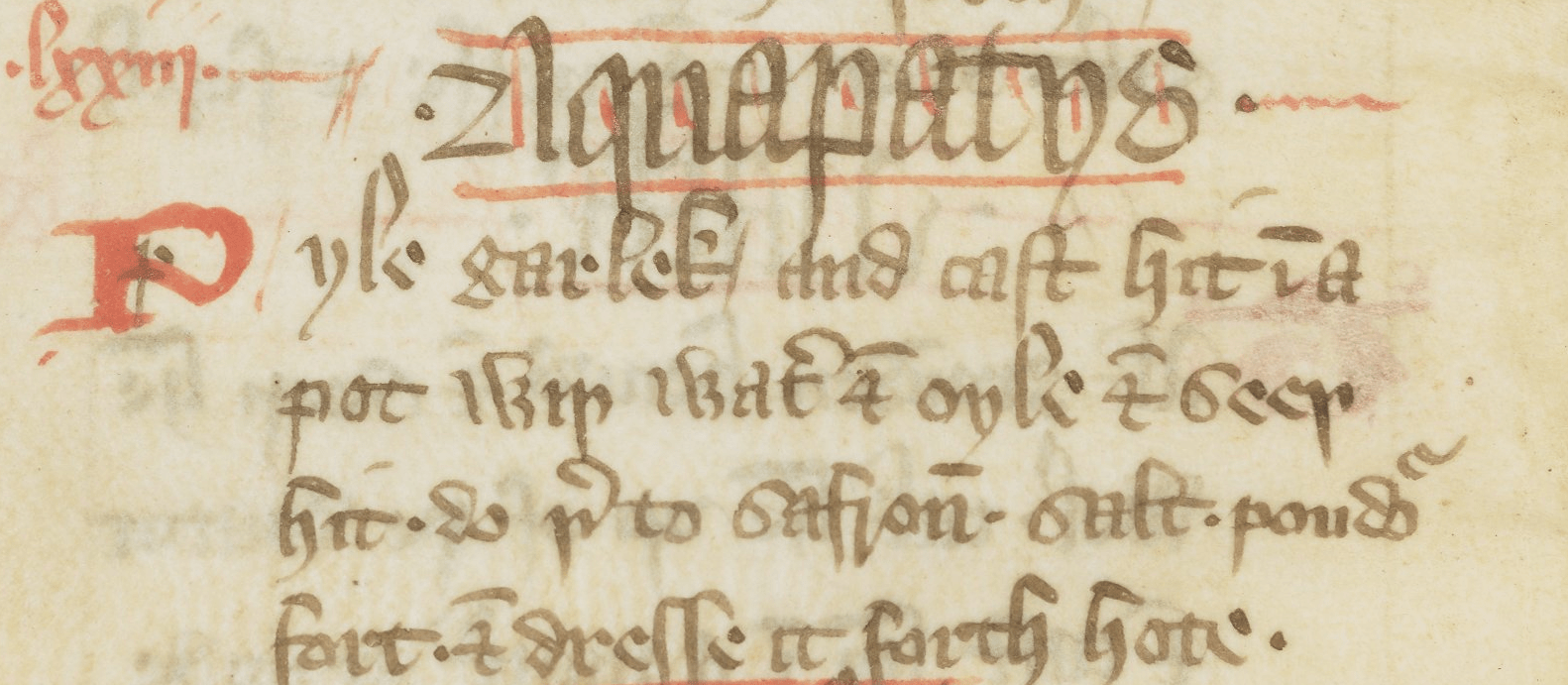
Aquapatys
Pyle garlek and cast hit in a pot wiþ water & oyle & seeþ hit; do þerto safroun, salt, poudour fort, & dresse it forth hote.
Peel garlic and cast it into a pot with water and oil and simmer it; to this add saffron, salt, powder fort, and present it hot.
Middle English text edited from Manchester, John Rylands Library, English MS 7, folio 40. Edition and translation by Christopher Monk © 2024.
The first thing to say is that medieval Makke was made with fava beans, which were widely grown as a field crop in England during the Middle Ages. Unfortunately, I cannot digest significant amounts of fava beans, something I found out when I first experimented with this dish a couple of years ago. So I substituted chickpeas, which were imported into England at the time of the original recipe, i.e. the late fourteenth century, and which appear in the recipe for Chycches (no. 71), the one just before Makke in the manuscript.
Recipe
Ingredients
For Makke you will need:
Chickpeas, 1 tin
Dry red wine, about 100ml
1 onion, chopped then minced in a food processor
Olive oil for frying
Sea salt to taste
For Aquapatys you will need:
1 whole garlic bulb, separated into cloves, peeled
About 100ml extra virgin olive oil
About 100ml water
Saffron, about a dozen strands, crumbled in your hand
¼ teaspoon black pepper corns ground with 2 cloves (or a pinch of ground cloves)
⅛ teaspoon (generous pinch) ground nutmeg
¼ teaspoon sea salt
Method
After peeling the individual garlic cloves – this is a fiddly job – place them into a small saucepan (a milk pan is ideal) along with the rest of the Aquapatys ingredients, i.e. extra-virgin olive oil, water, saffron, black pepper, nutmeg, cloves and sea salt.
You’re looking for the liquid to be almost covering the garlic cloves; so if it isn’t, add some more olive oil and water.
Bring to a gentle simmer and cook for about 20-25 minutes.
In the meantime, for the Makke, add a few tablespoons of olive oil into a frying pan and heat on medium for a couple of minutes. Then add the minced onion (lots of sizzling should ensue), and fry slowly until a nutty brown colour is achieved.
This will take at least 20 minutes. Make sure to keep stirring, so that the onion doesn’t burn. You may need to add more olive oil about half way. Adjust the heat lower, if necessary.
The water in the minced onions will be driven out by the cooking process and thus the volume of onion will dramatically reduce. This may happen quite suddenly.
As soon as the onion turns brown (see the colour in the picture), remove from the heat. You should be left with just a few spoonfulls of sweet, nutty brown onion. Leave aside.
Heat the wine in a small pan; let it simmer for a couple of minutes to evaporate the alcohol; this makes the wine mellower in flavour.
Drain and rinse the chickpeas. Then whizz them in a food processor until smooth.
Next, incorporate the wine gradually; you may not need all of it. You are looking for a fairly loose mixture. You don’t want cement! Think soft houmous.
Season the Makke purée with salt, according to your taste. Bear in mind that some tins of chickpeas already have salt added to the water.
Arrange the Makke in a flattish bowl and sprinkle over the browned onions.
Then arrange the cooked garlic cloves of your Aquapatys over the Makke, and drizzle some of its spiced oil-and-water mix around the bowl.
There you have it! It’s great served with crusty bread or pittas. Or, if you tend to fantasize about medieval feasts, maybe a haunch of spit-roasted venison.
The full video is at the bottom of the page and is available to monthly Premium Content Subscribers (aka Yevers) only. Just sign in if you’re already one (and a big thank you). If you’re not yet a subscriber but would like to have access to the archive of bonus material, just follow the link in this paragraph.
If you would like to make a one-off donation to support my research and creative work, I would also be most grateful.
Buy me a coffee
Choose an amount
Or enter a custom amount
Thank you for valuing my work. Your contribution is appreciated.
Donate
Buy me a coffee
Show your appreciation for my work by “buying me a coffee”. Thank you! If you wish, you can send a direct PayPal payment, using the link paypal.me/drcjmonk. Thanks again!
£2.00

Subscribe to continue reading
Become a paid subscriber to get access to the rest of this post and other exclusive content.
 MONK'S MODERN MEDIEVAL CUISINE