
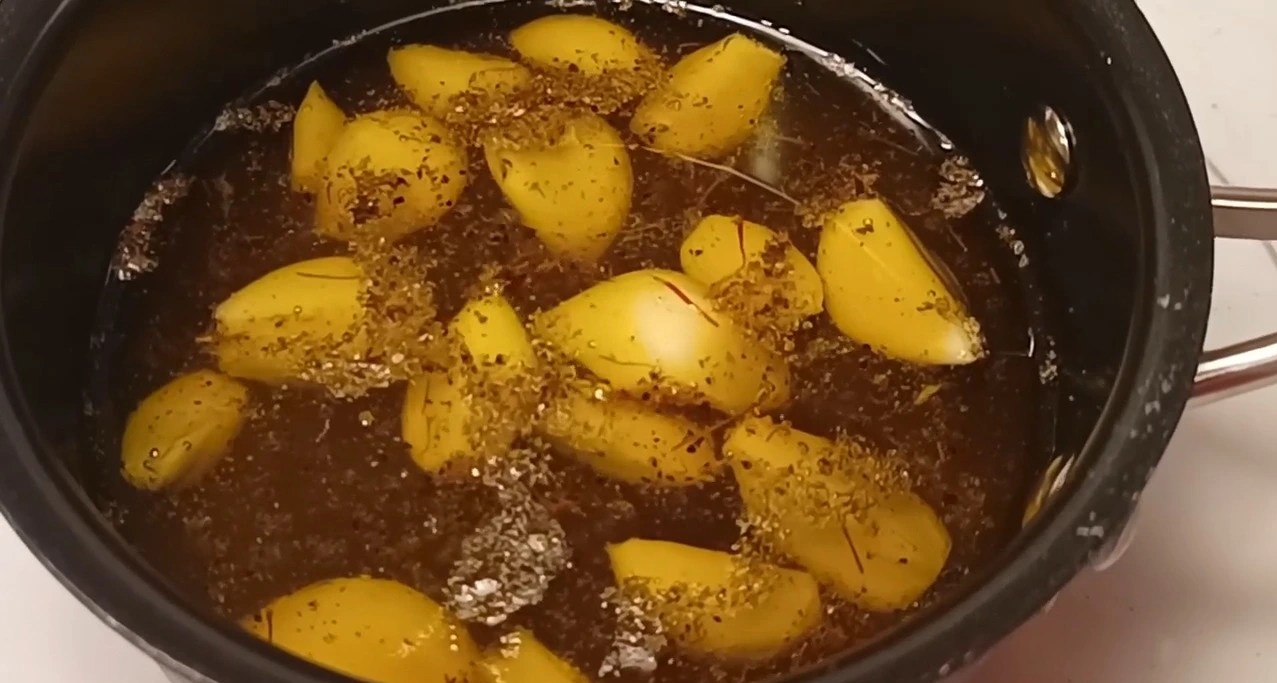
Image: Garlic cloves slowly simmering in olive oil, water, and spices
What do Alexander the Great and dragons in an Anglo-Norman poem have to do with garlic – or, more precisely, the garlic pottage known as Aquapatys found in the recipe book of King Richard II of England?
Well, it is just a little convoluted, but if you get excited by a deep-dive into strange medieval recipe names, then this is the blog post for you.
The recipe Aquapatys (also Aqua Patys) appears just twice in medieval English cookery, in Richard II’s Fourme of Cury (c.1390) and a later collection generally referred to as Ancient Cookery (c.1425). I haven’t yet come across it elsewhere, either in medieval European or Asian collections. Do let me know if you have.
I wrote out the Fourme of Cury recipe last week in my blog post. I also gave there my own recipe for combining Aquapatys with Makke, a legume purée.
Do check the recipe out because there are few things more delicious than the sweet, mellow flavour of slow-cooked garlic cloves – there’s no hot pungency associated with raw garlic.
Here, below, is the other version of the recipe as it appears in Ancient Cookery:
Aqua Patys to Potage.
Take and pille garlec, and sethe hit in watur and oyle, and colour hit with saffron, and do therto pouder marchaunt and salt, and serve hit forthe.
Aqua Patys as Pottage
Take and peel garlic, and simmer it in water and oil, and colour it with saffron, and add thereto powder marchant* and salt, and serve it forth.
*A spice mix, probably purchased ready-ground from a spicier, i.e. a spice merchant, hence the name. The Forme of Cury recipe uses powder fort.
Text taken from the edition found in A Collection of Ordinances and Regulations for the Government of the Royal Household[…]. Also Receipts in Ancient Cookery, ed. Anon. for the Society of Antiquaries (London, 1790), p. 445. My own translation. The manuscript on which the edition is based is London, British Library, Arundel MS 334; this has not yet been digitised by the library.
patys and pastiz
In a video I produced for my monthly subscribers – also in the previous blog post – I explained that Aquapatys may derive from Latin aqua, meaning ‘water’ (that much is secure) + Anglo-Norman pastiz, meaning ‘food’.[1]
Bear in mind that the ‘s’ before some consonants, such as ‘t’, in some Anglo-Norman words (Anglo-Norman is a dialect of Old French) begins to disappear during the late medieval period. This ‘s’ was likely silent, so this shift in spelling makes sense. In modern French the circumflex symbol is placed over the preceding vowel as a reminder of this linguistic history (e.g. château ‘castle’; pâté ‘paste’; and crête ‘crest’).
To illustrate this with Anglo-Norman, the word chastel (‘castle, fortification’) also appears as chatel;[2] and the word chatel (‘chattels, property’) evidently was originally written as chastel but had transitioned to chatel as early as the thirteenth century.[3]
There are numerous other examples of this orthographical shift, i.e. the silent ‘s’ being dropped. Pertinent to this post about the element –patys is the transition of the related Old French pastis, meaning ‘pasture’, which becomes pâtis.[4]
It is apparent, therefore, that –patys may derive from pastiz, an Anglo-Norman word meaning ‘food’.
Moreover, when King Richard’s master cook spoke the name of the garlic pottage, the scribe to whom he was dictating the recipe may have written Aquapatys because that is how he heard the word.

Alexander the Great and dragons
What about Alexander and the dragons? How do they fit into all this?
Well, I need to demonstrate why pastiz means ‘food’. And it’s an Anglo-Norman poem, Le Roman d’Alexandre, a re-imagining of the tales of Alexander, penned by Thomas de Kent between 1175 and 1185, that allows me to do this:
The Anglo-Norman text
Vet s’en Alisandre les puz e les costeiz ,
Les munz e les valeies, les puiz e les larris.
Vers la grant Faascen est l’eire establiz
Decoste le Jordan, çoe dient les escriz.
La troverent serpenz, draguns granz e petiz
Ke hantent as rochers, as vaus e as plessiz,
E portent esmeraudes amunt en lur cerviz.
Manjuent le blanc peivere; n’unt altre pastiz.
Modern French translation
Alexandre s’en va par les rocs, les collines,
les monts et les vallées, les pics et les landes ;
il se dirige tout droit vers la grande Faacen,
en suivant les rives du Jourdain, à ce que disent les textes.
Ils trouvent des serpents, des dragons de toutes tailles,
qui hantent les rochers, les vallées et les haies
et portent une émeraude au sommet de la tête.
Ils mangent du poivre blanc, c’est leur seule nourriture.
English translation
Alexander goes away through the rocks, the hills,
the mountains and the valleys, peaks and moors;
he heads straight towards the great Faacen,
following the banks of the Jordan, as the texts say.
They find serpents, dragons of all sizes,
who haunt the rocks, the valleys and the hedges
and wear an emerald at the top of their heads.
They eat white pepper; it is their only food.
Thomas de Kent, Le Roman d’Alexandre, pp. 568-570, lines C 99-106. Modern French translation by Catherine Gaullier-Bougassas et Laurence Harf-Lancner. English translation of the modern French is my own.
What we see, here, is that the dragons that Alexander the Great discovers along the banks of the Jordan ate only white pepper as their pastiz / nourriture / food. My sincere apologies if you were hoping they ate garlic!
Anglo-Norman pastiz is also used to mean food in The Prophecies of Merlin (see n. 1).
These uses of pastiz date to the twelfth and thirteenth centuries. If my theory about the etymological association of pastiz and -patys in the fourteenth-century Fourme of Cury is tenable – I am happy to be corrected – then we have a sensible meaning for the recipe name Aquapatys, namely ‘food-water’.
It is certainly more plausible, I would suggest, than previous attempts to define its meaning. Hieatt and Butler provide a confusing definition, that the ‘name is probably derived from Lat[in] allium “garlic”’.[5] Surely not!
And the Middle English Dictionary doesn’t offer anything definitive but asks us to compare Old French ‘pa(s)ticier make pastry’.[6] Alas, I think there is some grasping at etymological straws, here. But, then again, many medieval recipe names are distinctly weird!
I would suggest, therefore, that ‘food-water’ is the meaning behind Aquapatys. It certainly has the advantage of being relevant, and actually may even shed some light on how this garlic pottage was eaten.
What would Aquapatys have gone with?
Garlic is an ingredient in Fourme of Cury for the stuffing – and sauce – of roasted goose (Sauce madame), as well as the stuffing for a poached chicken (Chykens hocche). This may suggest Aquapatys could have been served with poultry dishes – garlic and poultry being a tried and tested combination.
And I am sure a carved morsel of spit-roasted goose breast, eaten with a mellow clove of garlic and a drizzle of spiced aqua, would have pleased the gourmand that was Richard II.
It’s possible, too, that the oil and water, in which the garlic is simmered, points to stricter, Lenten fare. Pertinently, the recipe for the onion and herb pottage Chebolace, also in Fourme of Cury, specifies oil and water at Lent as its substitute for the standard meat broth. Perhaps, then, Aquapatys came in handy for spicing up fish and vegetable dishes during the long gastronomic drag of Lent.
I think, however, that my proposed meaning, ‘food-water’, may well point to Aquapatys being used more widely among all sorts of dishes. In essence, it may have been an all-round condiment, or dressing, for many kinds of food, including roasted and boiled meats, poultry and fish. And, I would add, Makke, the bean purée which it follows in the Fourme of Cury manuscript.

Please let me know in the comments section if you have any thoughts yourself on the meaning of Aquapatys and its possible uses at the medieval (or modern) table. And if you have made it yourself, please do let me know. I’d love to see some pics.
Finally, for my lovely monthly subscribers, you can find a short video of my reading of Makke & Aquapatys from Fourme of Cury. Just scroll to the end.
Buy me a coffee
Choose an amount
Or enter a custom amount
Thank you for valuing my work. Your contribution is appreciated.
Donate
Buy me a coffee
Show your appreciation for my work by “buying me a coffee”. Thank you! If you wish, you can send a direct PayPal payment, using the link paypal.me/drcjmonk. Thanks again!
£2.00
Select bibliography
Hieatt, Constance B. & Sharon Butler (eds.), Curye on Inglysch: English Culinary Manuscripts of the Fourteenth Century (Including the Forme of Cury), Early English Text Society SS 8 (Oxford University Press, 1985).
de Kent, Thomas, Le Roman d’Alexandre ou Le Roman de toute chevalerie, trans. Catherine Gaullier-Bougassas et Laurence Harf-Lancner, with the edition by Brian Foster and Ian Scott (Paris: Honoré Champion, 2003).
[1] pastiz 1 :: Anglo-Norman Dictionary. Note the definition for pastiz 2: ‘culin[ary]. food, sustenance’.
[2] chastel 1 :: Anglo-Norman Dictionary. Note the three variant singular forms ‘chatel, chattel, chatthel’ and the variant plural forms ‘chautés’ and ‘chauteux’.
[3] chatel 1 :: Anglo-Norman Dictionary. Note the variant plural forms ‘chastels’ and ‘chasteux’.
[4] DMF 2023 (atilf.fr). You need to enter ‘pastis’ in the search (‘Rechercher’) box. It isn’t entirely clear from this dictionary resource exactly when pastis became pâtis.
[5] Hieatt & Butler, Curye on Inglysch,p. 170.
[6] aqua-patis and aquapatis – Middle English Compendium (umich.edu)

Subscribe to continue reading
Subscribe to get access to the rest of this post and other subscriber-only content.
 MONK'S MODERN MEDIEVAL CUISINE