

Now with recipe, below
I love my garden at this time of year, even if summer warmth hasn’t quite arrived here in northern England – we struggled to get to 13C the other day! In my garden, however, both at the front and the rear of the house, are young elder trees – well, more shrubs than trees – and they, as they’ve come into bloom, have been nagging me this last week or more.
“When are you going to use our blooms to make that medieval cheesecake again?” has been their insistent demand. Well, this afternoon, I finally listened.
This baked cheesecake or, more accurately, cheese curd tart, goes by the name Sambocade, taking its name from Latin sambucus, via Old French sambuc, meaning the elder tree. In my studies to date, I haven’t found the recipe anywhere other than in King Richard II’s cookery treatise, Fourme of Cury, probably written towards the end of the fourteenth century.
Some of you will remember that I produced a video showing how I recreated it. Some of you may have my recipe that went along with this. In it, I mentioned that the egg whites that are added to the curds could be whisked up and folded in, rather than just mixed in, if one wanted to approach the method with a more modern culinary mindset. It would seem, you see, that whisking egg whites was not something being done in medieval English kitchens (please let me know if you know otherwise).
I’ve been wanting to develop a Sambocade recipe that does this, whisks the egg whites up and folds them into the curds. In addition to this, I have been wanting to make my curds from lactose-free milk. I was diagnosed with lactase enzyme deficiency about 30 years ago, and in order to consume most dairy, especially milk, I have to take lactase tablets which in theory ‘consume’ the lactose therein.
I know that making one’s own curds does actually remove the majority of the lactose, since it is found mainly in the whey, which I can discard; but I thought it would be nice to approach my recipe with even more sympathy towards those of us who have to put up with the anxiety of dealing with lactase deficiency, aka lactose intolerance.
I had little idea how curds would form from a homogenised, lactose-free cow’s milk, which is what I had bought from the supermarket. I had some doubt that my new curds would be as good as those I’d produced in the past from unhomogenised, lactose-containing (i.e. normal) milk.
Homogenisation, if you don’t already know, is the modern mechanical process of dispersing the fat molecules in milk, something that wouldn’t have been done in medieval times. Today, makers of acid-coagulation curds (i.e. curds made by introducing acid, such as vinegar or lemon juice, into milk to cause coagulation) often specify un-homogenised milk, as it’s thought to produce better curds.
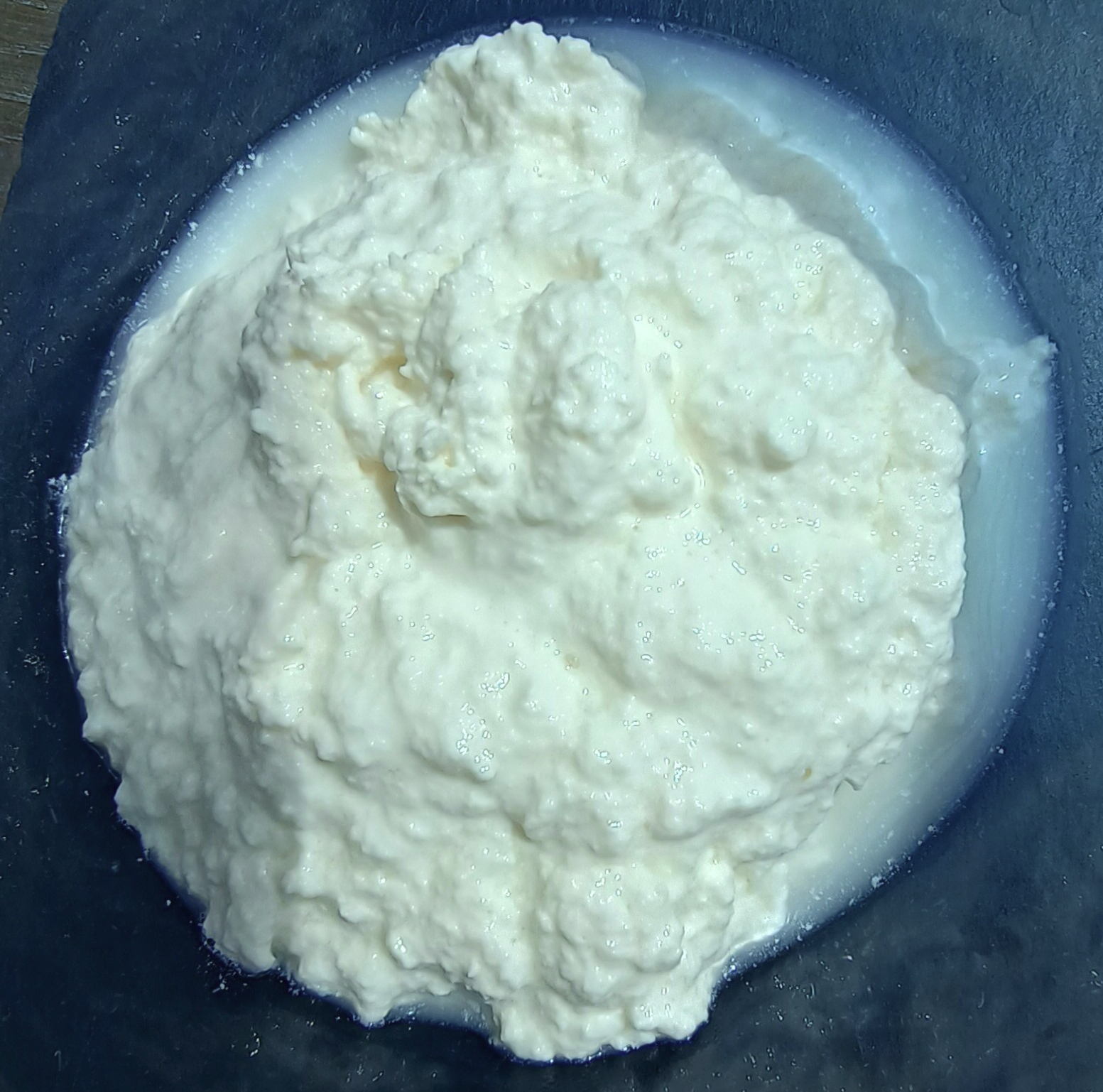
Well, I need not have worried too much. I got my curds from the lactose-free milk – full-cream milk, of course. They did seem softer than those made from normal milk. And perhaps the volume was not as big; I got 275g from 2 litres of milk; not exceptional, by any means. But, wonderfully, they were very easy to use in my new Sambocade method, working brilliantly when folding in my stiffly-whisked egg whites. Success!
Well, I will go on no more. Here are the pics of my modern-medieval, baked elderflower cheesecake. And I’m glad to say, that the taste and texture of the NEW Sambocade is superior to the old one. The filling is lighter, almost fluffy like a soufflé.
I’ll post the recipe as soon as I’ve written it up. But for now I’m going back for seconds!
Recipe below the pics




Sambocade (elderflower) curd tart
Lactose-free, ‘soufflé’ version
Ingredients
1 pastry case (shell), approx. 22-25cm/9-10 inches
I make my own gluten-free pastry. The recipe at Leiths works well.
2 litres of lactose-free whole (regular) milk
3 tablespoons of white wine vinegar
4 tablespoons of lactose-free cream (plus cream for serving)
6 tablespoons of white bread crumbs
I make my own in a food processor using gluten-free bread. Don’t use shop-bought ones, they’re too gritty.
80g of icing sugar (i.e. powdered or confectioners’ sugar), plus some for decoration
3 tablespoons of elderflower liqueur, such as St Germain
2 tablespoons of fresh elderflower blooms (rinsed in water and stalks removed)
Optional, ½ teaspoon of ground ginger
4 egg whites (from large eggs)
Elderflowers for decoration
To make the curds
Put the milk into a large, heavy-based pan. Heat on a medium-high heat, whilst stirring, until it begins to have small bubbles forming around the outside. If you have a thermometer, you’re looking for 80C or 175F.
Reduce the heat to low – the milk doesn’t need to boil. Add the wine vinegar gradually and keep stirring. Soon curds (small coagulated lumps) will start to form. This will take a few minutes.
Take a piece of cheesecloth and put it over a sieve (a large one, if possible). Position this over a large mixing bowl and drain the curds through it. Leave the curds to continue to drain for ten minutes or so, without pressing them. Scoop out your curds and put them into a bowl. It does not matter if there is a little residual whey in the curds.
Tip: clean your cloth and sieve as soon as you can.
Suggestion: you can use the whey as a meat marinade – I don’t do this myself.
If you’re making your own pastry case, you need to blind bake it until slightly golden. I blind bake my gluten-free pastry by pricking it first with a fork, then lining it with baking paper (scrunch this up first; it’s easier to use then) and weighing the paper down with baking beans. I bake this at 180C (350F) in my fan oven (200C/400F in a regular oven) for 10 minutes, remove the paper and beans, then return it to the oven for a further 5 minutes.
To make the curd filling
Whilst the pastry is baking, make the curd tart filling:
Using a food processor, blend the curds and cream until very smooth. Add the bread crumbs, elderflower liqueur, icing sugar, and, if you wish, the ginger powder. Blend until smooth. The ginger gives a bit of background warmth and complements elderflower. Put this mixture into a large mixing bowl and stir in the elderflower blooms.
Whisk the egg whites until they are stiff (i.e. as if making meringues; so you should be able to tip the bowl over your head without the egg whites falling on you). Gently and gradually fold the egg whites into the curd mixture using either a spatula or a large metal spoon. Do not beat the egg whites in – you will lose volume, if you do.
Place the mixture into your pastry case, smoothing it level. Bake in the middle of a preheated oven at 170C (325F) in a fan oven, 190C (375F) in a regular oven, for 25-30 minutes.

The filling will rise – it will probably form a dome with a bit of a dip in the centre. It is done when the middle springs back a little when you touch it with your finger – i.e. it shouldn’t be semi-liquid. If you find the filling is browning too quickly on the edges, reduce the temperature a little, or shield the edges with aluminium foil.
Once baked, cool on a cooling rack. The curd filling will shrink back somewhat, but this is fine.
When at room temperature, sprinkle it with icing sugar and decorate with a few springs of elderflowers (don’t eat the raw blooms, they’re just for decoration).
Serve with lashings of cream (lactose free, of course).

In case you’re wondering, I used blooms from my black elderflower (Sambucus nigra). They’re actually pink, rather than the usual white. Warning: don’t eat them raw; they don’t taste very nice.
If you would like to support my independent research and creative work, please take a look at my Buy Me A Coffee page.
 MONK'S MODERN MEDIEVAL CUISINE
OMG. I so want to make this…just re-watched your original video and loved it. Our elder flowers (different species, but I bet they’d work) are too far past, I think–though I’ll go look in a bit, since I can’t see them from the kitchen window. Wow! Thanks so much! –K
LikeLiked by 1 person
To be absolutely frank, the elderflower blooms are almost inconsequential, that is, if you use the elderflower liqueur. So just cheat 😂.
LikeLiked by 1 person
Is it my imagination or do the curds in photo 3 seem to move and form something like a cameo? I swear I can see a face – or two – at the end!
LikeLiked by 1 person
Ooh! I’ll take a look.
LikeLike
I can see a cartoon-like face, yes! But I see all sorts of faces in clouds, too, and there’s some similarity between curds and clouds, I think.
LikeLiked by 1 person
It’s good to see you back. I hope all is well.
LikeLiked by 1 person
Thank you. I’m waiting for a follow-up consultation to explain some test results. And I’m still waiting for a consultation about another matter which needs seeing to… referral made in October… had a communication yesterday asking if I wanted to cancel it!
LikeLiked by 1 person
That’s one way of bringing waiting lists down I suppose.
LikeLiked by 1 person
I know what the prostate test results mean, because I’ve done the research… I will likely need monitoring regularly and need more biopsies. So I’m annoyed to be sent out a report without any support from the surgeon. I was anxious about it, because the biopsy wasn’t normal, and nothing has been said to me. I know I need to wait for complete healing before a follow-up biopsy can be done. But this is everything I’ve researched myself. It’s poor.
LikeLiked by 1 person
That is poor. I hope you hear something about the next steps soon.
LikeLiked by 1 person
Thanks.
LikeLike
This is a lovely receipt. Thank you!
LikeLiked by 1 person
You’re welcome.
LikeLike