

Update: 5 February, 2025
After further research on the subject of cinnamon and cassia, I would like readers to keep in mind the following when reading the post below.
It is important to understand that the Middle English word canel, in the context of English culinary texts of the fourteenth century, was not used to distinguish a particular type or variety of cinnamon (of which there are several).
It cannot be known, for example, if a cook of the period meant or used true cinnamon bark or cassia cinnamon bark whenever canel appears in a recipe.
The same goes for the so-called buds or flowers of cinnamon trees. We do not know if flour [flower] of canel referred to either cassia buds or true cinnamon buds.
When reading ‘cassia buds’ in this post, it should be understood that ‘cinnamon buds’ is an equally appropriate translation.
The first time I nibbled a cassia bud, on the run up to Christmas in December of 2021, I was surprised how sweet it was – ‘honeyed sweetness’, I wrote down at the time.[i] There was a delicate cinnamon note there, too, which I had half expected. After all, cassia buds come from a type of cinnamon tree, Cinnamomum cassia, from which we also get cassia bark which is often ground and labelled ‘cinnamon’ in supermarkets – though so-called ‘true cinnamon’ is the bark of a different species, Cinnamomum verum.
I ground a few of my cassia buds up and used them to sprinkle on top of a dish I was developing at the time, Flaumpeyns, a shallow pastry filled with a spiced bacon and cheese stuffing. I found the sweet cinnamon note perfect for my bitesize versions of this medieval tart.

Cassia bark, from the tree Cinnamomum cassia, is often ground and marketed as ‘cinnamon’. The same tree also produces cassia buds, which are difficult to find, even in specialist food stores. I bought mine online.
I’ll be honest, I had never heard of cassia buds before embarking on a study of Richard II’s cookery treatise, Fourme of Cury (c.1390). And I must admit that it was some way into my research before I actually identified them in the manuscript as cassia buds, since their name in Middle English, the language of Fourme of Cury, is a false friend. Let me explain.
Flour of canel
Cassia buds appear in nine recipes in Fourme of Cury, which was produced for Richard II by his master cooks. Eight times it is written as ‘flour of canel’ and once, in Anglo-Norman French, as ‘flour de quenel’. Now it was the word flour that gave me so much trouble. I first thought, as others had before me, that this must have meant a powdered form of canel, literally flour – as in rice flour, which is written flour of rys in Fourme of Cury.
Canel, by the way, was probably understood in fourteenth-century elite kitchens as cinnamon bark of some sort, most likely cassia bark, though the distinction between it and the bark of true cinnamon is at times ambiguous. I write about this more fully in my book’s compendium of ingredients. For now, in this post, I will use ‘cassia’ when translating canel and the Anglo-Norman and Middle French equivalents.
I have to say that I was not helped in my initial thoughts on the identity of flour of canel by the resource I first checked. Obviously, one initially goes to any available dictionary when trying to ascertain the meaning of a word, and the definition in the Middle English Dictionary (MED) read, and still does read:
flour of [canel], poudre (of) [canel], powdered cinnamon; ?also, powdered cassia.
So according to the MED, flour meant flour, that is, the canel or cinnamon/cassia bark was ground finely into a powder; indeed, the dictionary implies flour of and poudre of are synonymous.
However, way back in 1985, in their edition of several fourteenth-century, English culinary manuscripts, Constance Hieatt and Sharon Butler did not agree, though they were not sure what exactly flour of canel meant:
[F]lour of canel is probably ‘good quality’ cinnamon, not ‘ground to flour’, since we are told to use it whole […].
So they state in their index and glossary (Hieatt & Butler, p. 188). They refer the reader to the rice pottage dish Mawmene in Fourme of Cury in order to make their point. The relevant section reads:
[…] take clowes & flour of canel hole & cast þerto; take poudour gynger, canelle, clowes[…].
take cloves and whole flour of cassia and thrown them into it; take powder of ginger, cassia and cloves…
(My own edited text from the John Rylands Library version of Fourme of Cury and my own translation.)
The contrast between flour of canel hole [whole] and poudour [powder] cannelle (a variant spelling of canel) struck me. It was clear to me from this recipe that in this particular context Middle English flour could not mean modern English flour or powdered.
Supporting this, we may also draw the inference from other recipes in Fourme of Cury that the cook is being directed to grind flour of canel, something that makes little sense if it is already a powder. Perhaps the clearest of these other recipes is the one written in Anglo-Norman French, for making the spiced wine Ypocras:
Pur fayre ypocras
Troyȝ vnces de queynel & iij vnces de gyngeuer, spyknard, le pays dun denerer, garyngale, clowes gylofre, poeure long, noieȝ mugadeȝ, maȝioȝame, cardemonij, de chescun j quarter donce, grayne de paradys, flour de queynel, de chescun demi vnce; de toutes soit fait poudour et cetera.
To make hippocras
Three ounces of cassia and three ounces of ginger; spikenard, a pennyworth; galangal, cloves, long pepper, nutmeg, marjoram, cardamom, one quarter ounce of each; grains of paradise, ‘flour’of cassia, half an ounce of each; from all one must make a powder, etc.
(My own edited text from the John Rylands Library version of Fourme of Cury and my own translation.)
Here, it seems quite clear, at least to me, that all the spices are whole spices which need to be made into a powder. We should note that both queynel (=canel, i.e. cassia bark) and flour de queynel are listed discretely, underscoring the fact that they are different whole spices.
French recipes
What has really helped in my research in understanding this spice is its use in medieval French culinary collections, particularly the collection of recipes in Menagier de Paris. In this late-fourteenth century work (c.1394) there are six occasions where fleur de canel is an ingredient, and the context always points clearly to it not meaning flour of, or powdered, cassia. In five cases the method requires it to be ground along with other whole spices including, twice, cassia bark. Here’s just one example from that collection:
Gravé d’oiselectz (small birds in ‘gravy’)
Puiz prenez gingembre, giroffle, graine, et fleur de canelle, et les foyes, et les broyez; […] et les espices broyez a fin et sans couler. (Le Menagier, p. 207, lines 34-7.)
Then take ginger, cloves, grains [of Paradise], and cassia buds [‘flower of cassia’], and the livers, and grind them… and grind the spices finely and without sieving.
(Middle French text from the edition of Le Menagier de Paris by Brereton & Ferrier; see the bibliography; the translation is my own.)
You have probably already spotted that the medieval French word fleur is used in the spice’s name, and any modern student of French will know that, today, fleur means ‘flower’. However, in Old French (what we call the French language as it was in the medieval period up to about the middle of the fourteenth century) it was a variant of flor. This can mean both ‘flower; blossom’ and ‘fine flour’.[ii] So, like Middle English flour, it is somewhat of a false friend.
For the French of Le Menagier, written in about 1394 (Le Menagier, p.xxi), we do, however, need to consider how fleur was used in what is termed Middle French, the French language as it was written around the fourteenth and fifteenth centuries. By the way, we shouldn’t think of neat divides between Old and Middle French; the transition from one to the other is approximate.
The entry for fleur1 in Dictionnaire du Moyen Français (1330-1500) reads as follows:
Partie (colorée, souvent odorante) de certains végétaux quand ils sont épanouis, fleur[…]
I would translate this as, ‘The part (coloured, and often odorous) of certain plants when they are in bloom; flower.’
It also offers a figurative use: ‘le meilleur’, i.e. ‘the best’, which may have influenced Hieatt and Butler in their initial definition of the Middle English flour de canel as ‘probably “good quality” cinnamon’.
There are two other fleur words given in the Dictionnaire du Moyen Français: fleur2 meaning ‘Menstrues’, that is, ‘menses’; and fleur3 meaning ‘Odeur, senteur’, that is, ‘smell, scent’.
To summarise, Middle French fleur does not appear to be used to mean flour in the period Le Menagier was written. So we need to understand fleur de canelle as flower (or perhaps blossom) of cassia, not flour of or powdered cassia.
Its deployment in the various recipe methods supports this, since it has to be ground itself into a fine spice mix. Why would one direct a cook to grind something that is already ground? Repeatedly instructing the cook to grind fleur de canelle strongly suggests to me that the author was talking about a whole spice.
It seems logical, then, that this flower or blossom of cassia must correspond to our modern cassia buds, which are, technically speaking, dried unripe fruit of Cinnamomum cassia and also Cinnamomum loureirii. I’ll quote the online Encyclopaedia Britannica’s recently revised and updated entry for cassia, in order to provide the botanical details:
The brown immature fruit is snugly held in a cuplike, hard, wrinkled, grayish brown calyx (the whole commonly called a bud) varying in size but ordinarily 11 mm (0.4 inch) long, including the calyx tube; the upper part of the bud may be about 6 mm (0.25 inch) in diameter.
You can see from my close-up image, below, how it looks like a tiny dried flower bud with a short stem – the calyx tube. It looks rather like the more familiar clove, I’d suggest.
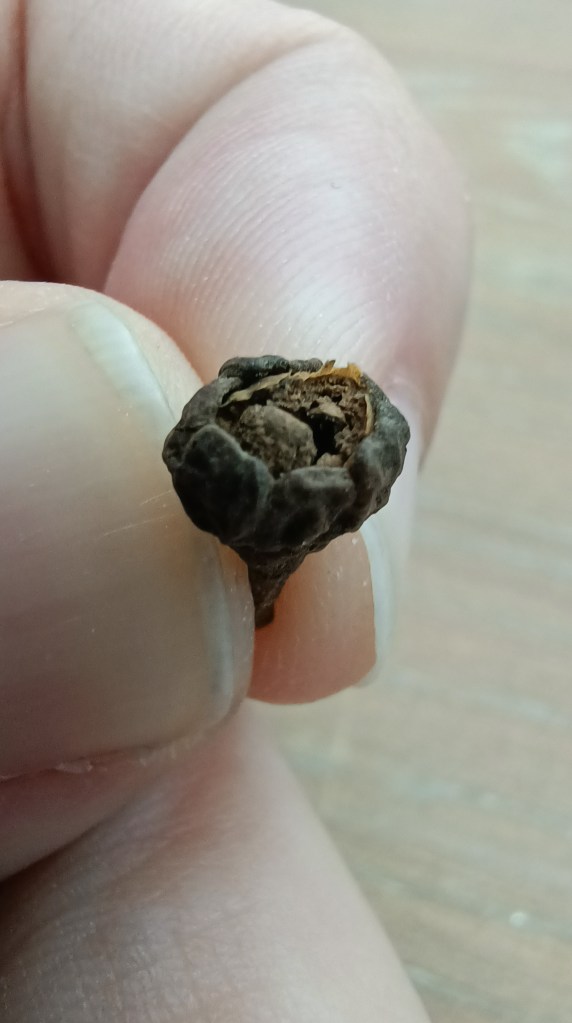
A single cassia bud.
Their size and pointed stem, or calyx tube, made cassia buds suitable for sticking into things like jellies and hard-boiled egg yolks. This technique of decorating dishes is described in both medieval French and English culinary recipes.
Photo by Christopher Monk
Confusion in translations
When it comes to scholars understanding the French fleur de canelle as cassia buds, we meet with mixed success. All scholars make mistakes, of course, and I have to emphasise that of all the ingredients in medieval cookery texts, this is up there at the top of the ‘hard to interpret’ list. So I’m not ‘having a go’ at these excellent scholars; I’m simply building upon what has gone before.
In the most recent translation of Le Menagier by Gina Greco and Christine Rose – a brilliant resource that I use a great deal – the translation of fleur de canelle is inconsistent. In the recipe for the small birds dish that I quoted above, Greco and Rose do translate it as ‘cassia buds’:
Take […] ginger, clove, grain of paradise, and cassia buds and the livers. Then […] grind the spices finely without sieving them […]. (Greco & Rose, p. 283, no. 74.)
Likewise with two other dishes. In froide sauge, the Middle French reads:
Puis broyez gingembre, fleur de canelle, graine, giroffle, et broyez bien sans couler. (Le Menagier, p. 249, no. 244.)
This is translated as:
Grind well some ginger, cassia buds, grains of paradise, and cloves, and do not strain. (Greco & Rose, p. 314, no. 244.)
And in a recipe for Ung soutyé vegay a garder poisson de mer, a vinegar, herb and spice souse for preserving fish, the Middle French reads:
[…] maiz avant ayez broyé coq, ysope, ozeille toute, marjolaine, gingembre, fleur de canelle, poivre long, giroffle, graine, et osté hors du mortier […].’ (Le Menagier, p. 259, no. 277.)
And Greco & Rose translate this as:
[…] grind coq, hyssop, whole sorrel, marjoram, ginger, cassia buds, long pepper, clove, grain of paradise, and remove from the mortar […].’ (Greco & Rose, p. 322, no. 277.)
Perhaps it seemed obvious to the two translators that the meaning had to be cassia buds in these three dishes. It is, though, a little strange that in the other three recipes in which fleur de canelle appears they opted for ‘powdered cinnamon’ and ‘cinnamon powder’.
Here’s the original Middle French, followed by Greco and Rose’s translation for these three. First, Anguille renversee, an eel dish:
Puis ayez gingembre, canelle, clo de giroffle, fleur de canelle, grainne, nois muguectes, et broyez et metez d’une part. (Le Menagier, p. 234, lines 18-20.)
Grind ginger, cinnamon, cloves, powdered cinnamon, grain of paradise, nutmegs and set them aside. (Greco & Rose, p. 303, no.180.)
Next is the dish lamproye boulye, a lamprey dish:
Puis broyez gingembre, canelle, fleur de canelle, giroffle, graine de paradiz, nois muguectes, et poivre long, et deffaictes de vostre boullon […].’ (Le Menagier, p. 235, lines 36-7 to p. 236, line 1.)
Then grind ginger, cinnamon, powdered cinnamon, clove, grain of paradise, nutmegs, and long pepper, and mix with the bouillon […]. (Greco & Rose, p. 304, no. 185.)
The translation, here, strikes me as particularly odd because it makes no sense to grind cinnamon (or, cassia) and powdered cinnamon (or, cassia). Why would a cook use the same ingredient twice?
And finally, we have gellee de char, a meat jelly. Note especially the verb phrase used in connection with fleur de canelle:
[…] et au matin poingnez dedens cloz de giroffle et feuilles de lorier et fleur de canelle, et semez aniz vermeil […]. (Le Menagier, p. 252, lines 27-8.)
[…] and in the morning stick in it cloves and bay leaves and cinnamon powder, and sprinkle with red anise […]. (Greco & Rose, p. 316, no. 251.)
In this dish of jelly, set overnight in a cool room, the cook is directed to stick into it cloves, bay leaves, and – surely – cassia buds. Their little spike at the bottom of the bud lends itself perfectly to sticking into set jelly. One cannot stick in cinnamon powder. It would have to be sprinkled atop, like the red candied anise comfits were.
Terence Scully, in his excellent study of the Viandier of Taillevent, another largely fourteenth-century French culinary compilation, offers a ‘half-way house’ definition of fleur de canelle in his Glossary and Index: ‘(ground) cassia bark or buds’. It is as if he was puzzled and a little unsure. However, in his translation of the three recipes in the Viandier that use fleur de canelle, he translates it as ‘cassia buds’.
For Brouet rousset, a ‘russet broth’ of meat, all four manuscripts that Scully uses in his edition of the text, list fleur de canelle (one has fleur de cannelle) as one of several spices to be ground (the verb used is affiner, ‘to make fine’) and infused into verjuice, and then, presumably, added to the broth (Viandier, p. 60). His translation reads:
Take any meat, sliced onions and parsley leaves and fry these lightly in bacon grease; strain bread and liver into beef broth and wine, and set this to boil with your meat; then add ground ginger, cinnamon, cloves, grains of paradise, cassia buds, infused in verjuice. It should be russet-coloured. (Viandier, p. 281.)
Again, to underscore the correct identity of fleur de canelle, the process of grinding it or making it finer, along with other whole spices, only makes sense if we define it as cassia buds. And, I must say, I really should make this dish; it sounds delicious. It would make a great comfort food dish for autumn.
A fish (or meat) jelly, Gelee de poisson, is the next recipe to use cassia buds. It is a rather long, detailed recipe – great if you want to recreate a medieval jellied dish – so I will just focus on the end of the recipe. There, fleur de canelle is, along with mace, the subject of the direction to ‘powder above’ – ‘poudrez dessus’ – the hot dish that is to become a jelly (Viandier, pp. 127-28). Scully translates it as:
Set out your meat in bowls, and afterwards put your bouillon back on the fire in a bright clean vessel and boil it constantly skimming, and pour it boiling over your meat; and on your plates or bowls in which you have put your meat and broth sprinkle ground cassia buds and mace, and put your plates in a cool place to set. Anyone making jelly cannot let himself fall asleep. (Viandier, p. 287; italics are Scully’s, indicating a variant reading from one of the manuscripts.)
I love the detail here – and the wry remark that a jelly-maker must keep alert. One must not let the jelly cool before the ground, or powdered, cassia buds and mace are added!
The final recipe in the Viandier is intriguing, for it is the same dish that appears in Le Menagier as ‘Pour faire und froide sauge’, discussed above. Indeed, evidence points to the author of Le Menagier using and adapting quite a large number of the Viandier’s recipes (see Le Menagier, p. liii).
Both versions of the dish use fleur de canelle (though in two of the four Viandier manuscripts, only ‘cannelle/canelle’ is used; see Viandier, p. 136, no. 73). Here’s Scully’s translation in full (just in case you want to make it). Note that his use of italics indicates where there is variation between the manuscripts:
Froide sauge: A Cold Sage. Cook your poultry in water, then set it to cool; grind ginger, cassia buds (var.: cinnamon), grains of paradise and cloves, and do not strain them; then grind bread, parsley and sage, with, if you wish, a little saffron in this greenery to make it a bright green, and sieve this; and some people add strained, hard-cooked egg yolks steeped in vinegar ; do not boil. Break your poultry apart into halves, quarters or members, set it out on plates with the sauce over and hard-cooked egg whites on top. If you used hard eggs, cut them up with a knife rather than breaking them by hand. (Viandier, p. 288.)
So, despite the hint of indecision in Scully’s definition of fleur de canelle in his glossary, we can see that he sensibly chooses to translate it as ‘cassia buds’, since in all three instances the spice has to be ground up.
I would like to conclude this piece of research by revisiting Hieatt and Butler’s uncertainty over defining the Middle English flour of canel. Remember, in their glossary they said that it couldn’t mean the spice was a ground flour, but that perhaps it meant a ‘good quality’ cinnamon.
Well, three years after publishing their edition of fourteenth-century English culinary collections, Hieatt wrote an article for the Bulletin of John Rylands Library in order to correct some of the mistakes they had made in their work. The article was primarily an apology for their ‘most glaring oversight’ of the Fourme of Cury manuscript in the John Rylands University Library of Manchester, which she admits ‘ought to have been the base’ manuscript for creating their edition (Hieatt, pp. 45-6). But it was also an opportunity to refine a few minor readings.
Among the amendments Hieatt made was one regarding flour of canel, in which she directs the reader to add, ‘but it may mean cassia buds a more expensive spice’ (Hieatt, p. 52). Indeed, it does mean cassia buds, as I hope this journey through fourteenth-century culinary collections makes abundantly clear.
To round off this piece, I thought it would be rather nice for readers to hear me read, in the original Middle English, one of the recipes using cassia buds.
My lovely monthly subscribers – my Yevers – have another reading, too, with translation and commentary from the draft of my book. Please scroll right down to the bottom of the page to the section ‘Bonus material for monthly subscribers’ (you may need to sign in).
The readings are from the late-fourteenth-century John Ryland Library Fourme of Cury manuscript, which is the only version of the extant copies that can be reliably dated to the period in which Richard II ruled.
If you would like to support me as an independent scholar and creator, you can do so by making a one-off donation, or by joining the monthly subscribers.
Select bibliography (abbreviations)
Greco & Rose. Gina L. Greco & Christine M. Rose (trans.), The Good Wife’s Guide (Le Ménagier de Paris): A Medieval Household Book (Ithaca, NY and London: Cornell University Press, 2009), Kindle edition.
Hieatt. Constance B. Hieatt, ‘Further notes on The Forme of Cury et al.: additions and corrections’, Bulletin of John Rylands Library 70 (1988), pp. 45-52.
Hieatt & Butler. Constance B. Hieatt & Sharon Butler (eds.), Curye on Inglysch: English Culinary Manuscripts of the Fourteenth Century (Including The Forme of Cury) (London: Oxford University Press, 1985).
Le Menagier. Le Menagier de Paris, ed. Georgine E. Brereton and Janet M. Ferrier (Oxford: Clarendon Press, 1981).
OF-ED. Old French-English Dictionary, ed. Alan Hindley, Frederick W. Langley, and Brian J. Levy (Cambridge, Cambridge University Press, 2000).
Viandier.Terrence Scully (ed. and trans.), The Viandier of Taillevent: An Edition of All Extant Manuscripts (Ottawa: University of Ottawa Press, 1988).
Website resources (links)
Dictionnaire du Moyen Français (1330-1500).
Encyclopaedia Britannica online.
Middle English Dictionary online.
[i] My sincere thanks to Elise Fleming for proofreading this post. Any mistakes remain my own.
[ii] Definitions from OF-ED; see fleur and flor.
Bonus material for monthly subscribers

Subscribe to continue reading
Become a paid subscriber to get access to the rest of this post and other exclusive content.
 MONK'S MODERN MEDIEVAL CUISINE