

A truncated medieval history of beet(root) in England
This post, I must confess, is a means to provide you with my partner Ray’s recipe for pickled beetroot, for which – after I had posted pictures and a video about it on Facebook – a number of requests were made. You will find his illustrated recipe below.
However, to qualify as a Modern|Medieval post I have to make at least some attempt at food history 😉. I hope, therefore, you find my seven historical tidbits about the beet(root), Beta vulgaris, at least moderately interesting, if not fascinating.
Let’s start first with the origin of the word beet in English.
1. The Old English word bete ‘beet’ is a Latin loan word, meaning that the Latin beta was Anglicised, ‘refashioned to work in English’, as Stephen Pollington puts it.[1] Though bete likely refers to beta vulgaris – the species from which our modern beet has developed – the ‘identification of Old English bete is not entirely secure’. Pollington points to the illustrations in Anglo-Saxon manuscripts which are, he observes, ‘clearly not beets’. He also notes that one of the vernacular herbariums of the period gives a Latin equivalent which means a kind of burdock![2]
Now for medicine:
2. In Anglo-Saxon medicine, ‘beet’s roots’ were used ‘against headache’. I really cannot recommend this, but here goes:
Against headache: beet’s roots; pound with honey; wring out; put the juice into the nose; let [the patient] lie face-up towards the hot sun and let his head hang down until the brain be reached [by the juice]; let him already have butter or oil in his mouth; let him then sit upright, then bend forwards; allow the pus to flow out from his nose; do that often until it be clean.[3]
3. In fourteenth-century medicine, the juice of ‘the black beet’ was recommended to be smeared on one’s forehead and temples for ‘each manner of evil of the head’.[4] Whether this was juice from the leaves or the root (or both) is a moot point. And the same black beet was to be stamped (crushed) and the juice smeared on the head to treat scale,[5] any type of scabby, crusty disease of the scalp. Lovely.
What about its culinary use?
4. There are few medieval English culinary recipes that use beets as an ingredient, and those that do use the leaves. We cannot be sure of the types of beets that were used in cookery at this time, as the recipes do not specify; and, moreover, it is difficult to ascertain how medieval beets correspond to modern ones. One volume of late-medieval medical texts refers to ‘white’ and ‘red’ kinds.[6]

5. It seems likely that the cooking and eating of beetroot was a post-medieval development. The Tudor botanist-gardener John Gerarde (1545-1612) writes of the ‘common white beet’ having a root that is ‘thick, hard and great’, but doesn’t speak of it being eaten. He does, however, allude to the culinary potential of the root of the red beet:
The great red Beet or Romaine Beet boiled and eaten with oil, vinegar and pepper is a most excellent and delicate salad; but what might be made of the red and beautiful root (which is to be preferred before the leaves, as well in beauty as in goodness) I refer unto the curious and cunning cook, who no doubt when he has had the view thereof, and is assured that it is both good and wholesome, will make thereof many and diverse dishes both fair and good.[7]
6. My research to date has brought forth just a single culinary recipe from the four fourteenth-century Middle English collections that have survived.[8] This is Joutes of flesche (literally, ‘jots for meat’) and is found in Richard II’s Fourme of Cury (c.1390). It requires the leaves of beets and nine other plants to be blanched, pressed and chopped finely, thus creating the tiny jots of herbs and greens of the recipe’s name. (A jot, here, means the smallest of things.) Then these are simmered in ‘good broth’ – this would have been a meat broth, likely beef.
7. There are a few more recipes using beets in the fifteenth century, including a beefed-up version (pardon the pun) of the Fourme of Cury dish, in which marrowbones or beef broth are added to the pot along with bread as a thickener. This dish, known simply as Joutes (‘jots’), was to be served with venison.[9] There is a further development of this method of finely chopped greens in beefy broth known as Hare in Wortes (wort = leafy vegetable). In this, oatmeal and chunks of hare meat are cooked in the broth of chopped plants, including beet leaves; and there is the option to substitute goose for the hare.[10] Versions of this for Lent also appear, using eels, or mussels, or simply vegetables. [11]
Ray’s Recipe for spiced, pickled beetroot
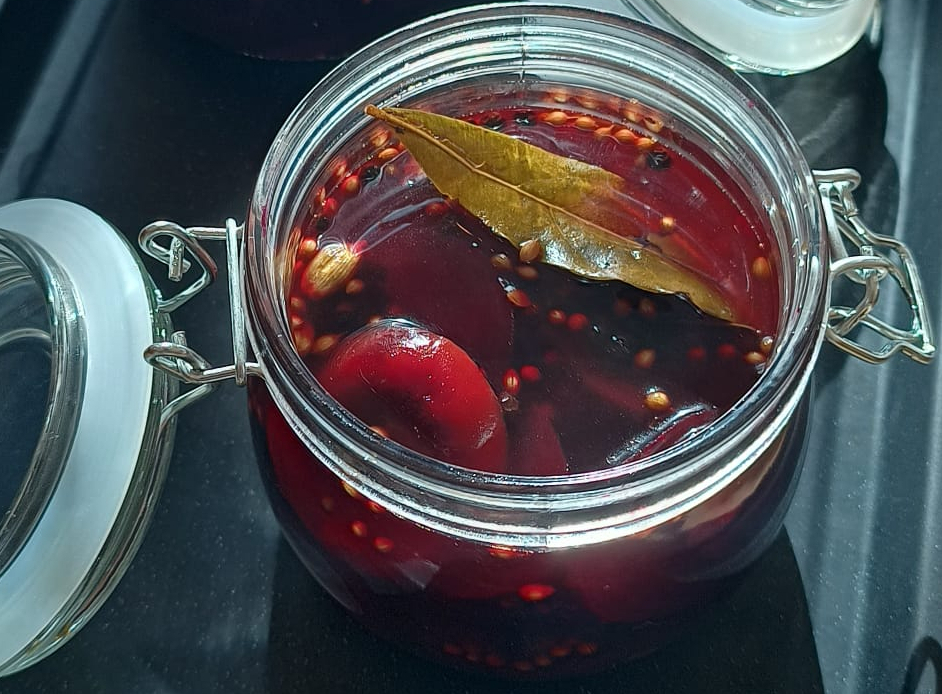
Ingredients
1 kg beetroots
vegetable oil
sea salt, just a few grindings of the salt mill
For the pickling liquor
1 tablespoon whole black peppercorns
1 tablespoon whole coriander seeds
5 whole green cardamoms
3 whole cloves
2 bay leaves
750ml white wine vinegar
100g light brown soft sugar
Method

Gather your beetroots (these were grown in our garden). Wash and remove the thin roots and leaves. (See the note* at the end of the recipe to see what I did with the leaves.)
(Photo by Christopher Monk)
Rub each beetroot with vegetable oil and lightly salt them. Then put them into a foil parcel, placed within an oven-proof dish.
Wrap over the foil, then bake in a hot oven 200°C/180°C Fan/400°F/Gas 6 for 50 minutes to 1 hour, or until tender. Cooking time depends on the size of your beetroot.

After roasting, and when cooled enough, rub off the skin of the beetroots. (Ray uses gloves as the beets do dye your hands somewhat.)
Larger beets with thicker skins may need peeling with a potato peeler.
Once skinned, cut up into slices.
(Video by Christopher Monk)
Sterilise your jars (here, Ray uses Kilner clip-top jars): wash them and the lids in hot soapy water; rinse them; place them onto a baking tray in a low oven (about 100°C, 215°F, Gas mark ¼) for 10 minutes or until completely dry.
If your jars have rubber seals, do not put these into the oven, but instead pour just-boiled water over them.

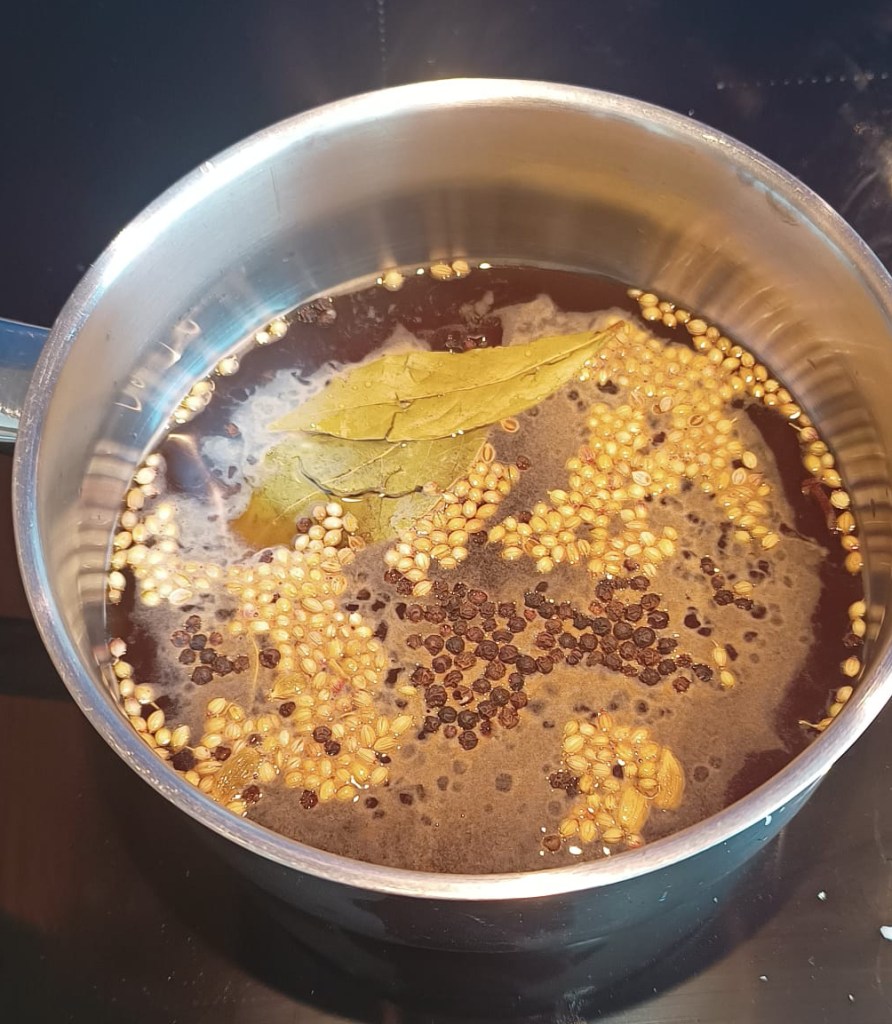
Make your pickling liquor, using a medium saucepan. Toast the whole spices (except the bay leaves) over a low heat until they begin to smell aromatic. Add the bay leaves, vinegar and sugar. Let the sugar dissolve and bring to a simmer.
Pack the sliced beetroot into the sterilised jars, and pour over the pickling liquor.

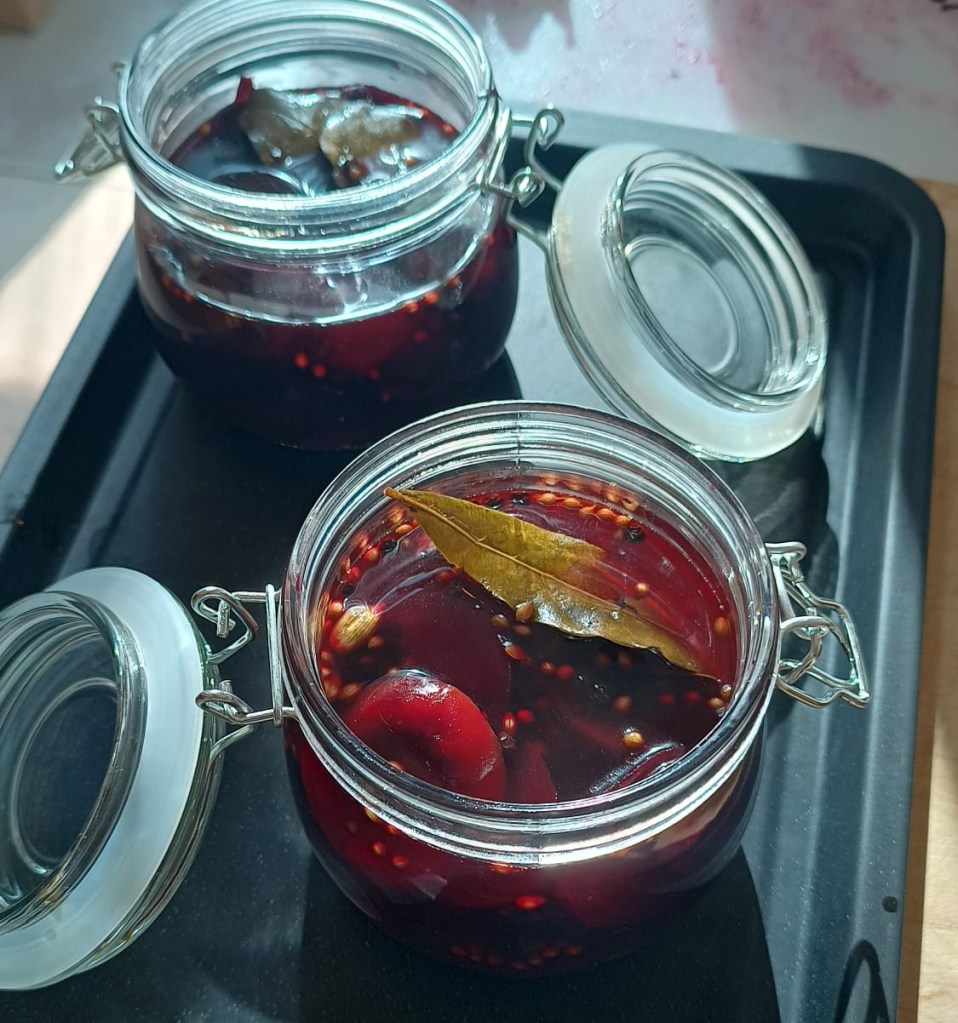
The beets should be fully covered. Allow a little space at the top of the jar. Seal.
The pickled beetroot will be ready in 2 weeks, but we have found that the optimum taste is achieved after about 4 weeks.

Ray wishes to acknowledge that he originally started off with a recipe from goodFood, but decided he wanted to change things up. As well as reducing the salt – the original recipe had far too much in his opinion – he dropped the mustard seeds, mace and chilli flakes, reduced the cloves and introduced green cardamon. The latter is what really makes the difference, in my opinion. The savour is really distinctive.
As it happens, the whole spices he uses are all mentioned in various medieval English cullinary recipes (cardamon is in Fourme of Cury‘s recipe for Hippocras, spiced wine) and bayleaves appear in English medical recipes of the period. So although there is, apparently, no evidence for red beetroot being pickled in medieval England, at least there’s a smidgen of medievalness in Ray’s recipe!
Finally, Ray also suggests a cheat’s version of the recipe, substituting vacuum-packed, pre-cooked whole beetroots from the supermarket. Marvellous!
*Note: I cooked the leaves later by sautéing sliced garlic in butter and olive oil, then adding the leaves, shredded, and a generous amount of powder fort spice mix. I cooked the leaves until soft and reduced in volume, rather like cooked spinach. I added smoked salt at the end to taste. There’s a recipe for powder fort in this post.
If you would like to support my independent research and creative work, you can either become a monthly subscriber by going to the ‘Subscribers’ tab or make a one-off donation via the ‘Buy Me a Coffee’ tab. It all helps to offset the costs of running this website and creating videos, etc. Thank you.
Bibliography
Austin, Thomas (ed.), Two Fifteenth-Century Cookery-Books, EETS OS 91 (London: Trübner & Co., 1888), available online.
Gerarde, John. The Herball, or, Generall Historie of Plantes Gathered by John Gerarde of London, Master in Chirurgerie (1597), available online.
Hieatt, Constance B. An Ordinance of Pottage (Prospect Books, 1988).
Hieatt, Constance B., and Sharon Butler (eds.), Curye on Inglysch: English Culinary Manuscripts of the Fourteenth Century (Including the Forme of Cury), Early English Text Society, Supplementary Series 8 (Oxford University Press, 1985).
Hunt, Tony. Plant names of Medieval England (D. S. Brewer, 1989).
Hunt, Tony (ed.), with Michael Benskin. Three Receptaria from Medieval England: The Languages of Medicine in the Fourteenth Century (The Society for the Study of Medieval Languages and Literature, 2001).
Pollington, Stephen. Leechcraft: Early English Charms, Plant Lore, and Healing (Anglo-Saxon Books, 2000).
Acknowledgment
Many thanks to Elise Fleming for reading through the post for errors and suggesting improvements. Any existing errors or infelicities, however, remain my own.
[1] Pollington, p. 79.
[2] Pollington, p. 98.
[3] Pollington, pp. 180-81, no. 3.
[4] Hunt & Benskin, p. 95 (no. 36), spelling modernised.
[5] Hunt & Benskin, p. 98 (no. 70).
[6] Hunt, p. 50; information on the manuscript, p. xxv, no. 1, spellling modernised.
[7] Gerarde, pp. 251-52, spelling modernised.
[8] The four texts are edited in Hieatt & Butler; note the single recipe given in the glossary, p. 171, bete.
[9] Austin, pp. 5-6, Joutes.
[10] Austin, p. 69, Hare in Wortes.
[11] Hieatt, p. 35, no. 1.
 MONK'S MODERN MEDIEVAL CUISINE
I’m allergic to beets (go figure!) so won’t be trying these, even though they look great – and I’ll definitely pass on the nose thing. But I can say that if you haven’t had beets stewed in honey, you are missing out. So good. Almost tempting enough for me to try beets again (but, um, no to the allergy results afterwards).
LikeLiked by 2 people
I’m sorry about the beet allergy. And sorry I couldn’t tempt you with the medieval sinus cleanse! 😆 I’m interested in your beet in honey stewing. I’ve never heard of this. Oven-baked, glazed with honey, yes, but not stewed in it. Do you dilute the honey?
LikeLiked by 2 people
I’m very fond of beetroot, but my own crop was very poor this year. I have pickled them in the past and this method looks straightforward enough for me to give it a go.
LikeLiked by 1 person
Alas, the vagaries of growing things in Britain. At least it seems like that. I’ve had mixed results across the garden.
This is my best year for beetroot, however. They were grown in a compost mix (of the ?Horizon organic one for growing vegetables mixed with the Horizon mature plants one which is loam-based, so more soil-like) in two plastic troughs. I’m going to double my sowing next year. I’m on a roll! 😆
I hope you like Ray’s recipe, if you have a go.
LikeLiked by 1 person
I’m fond of beet greens (and beets). I’m fond of hare, or was the one time I had it. I’m fond of oatmeal.
But Hare in Wortes sounds very much less than the sum of its parts.
LikeLiked by 1 person
I know what you mean!
LikeLiked by 1 person