
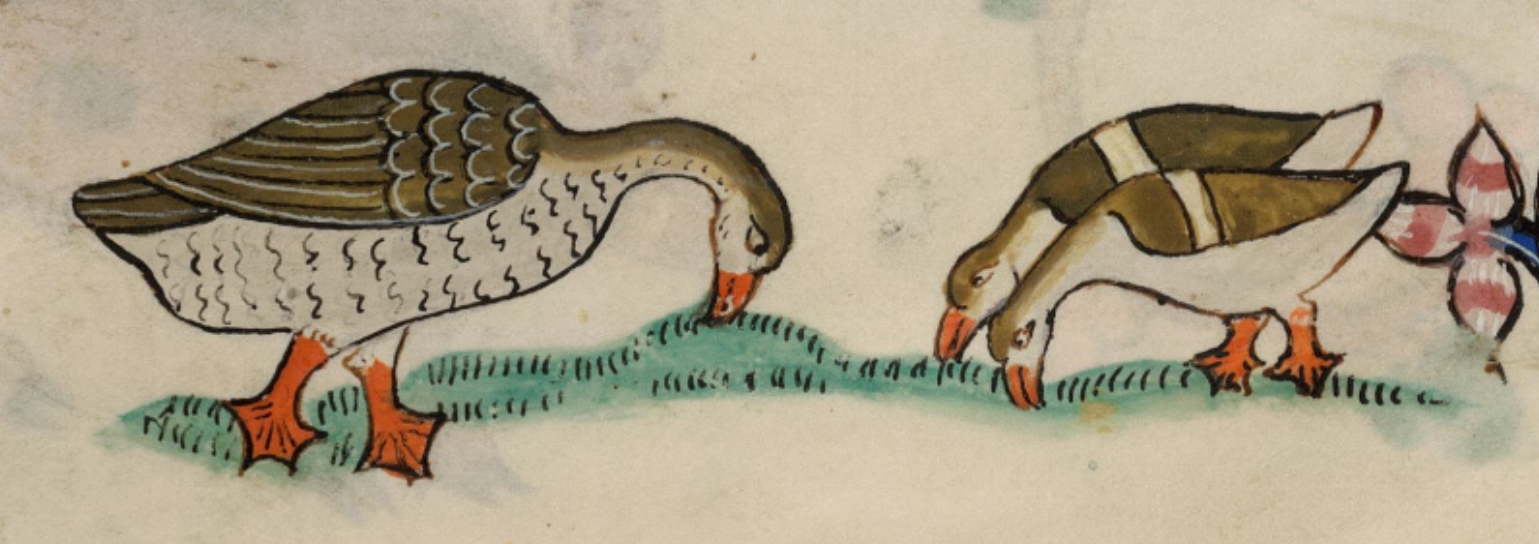
Top Image: Geese grazing, from the Lutterell Psalter, British Library, Additional MS 42130 (Lincoln, England, c.1325-40), folio 19r.
When it’s a peacock, of course!
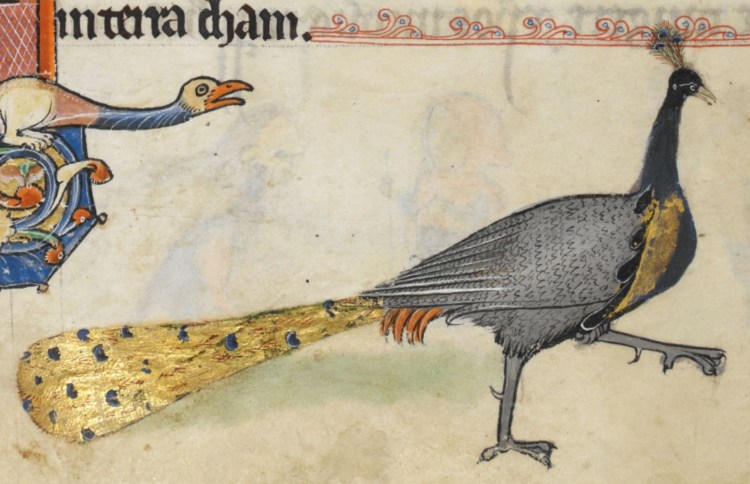
There is no “of course” about it, I hastily add. My feeble joke does, however, have a purpose. As with all things on this website, there is a connection here to food history, and in this case, specifically, to an unusual instruction given by a certain Master Chiquart.
Before I unravel this avian mystery, and before I also delve into the medieval culinary history of the peacock, here’s just a very brief overview of the career of Chiquart, just to set the context.
Chiquart, the master cook
During the early 1400s, Chiquart became master cook for the household of Count Amadeus VIII of Savoy (Amédée de Savoie, 1383-1451), who later, on Savoy becoming a duchy in 1416, became Duke Amadeus I.[1] Chiquart worked for Amadeus until about 1434, when he disappears from the records.
Evidence points to Chiquart also being master cook for the separate household of Amadeus’ wife, Mary of Burgundy (Marie de Bourgogne, 1385-1422), daughter of the preeminent French noble, Philip ‘the bold’ (Philippe le Hardi, 1342-1404), Duke of Burgundy.
Chiquart is known to have overseen several major banquets, including in 1403 one hosted by Amadeus for his father-in-law, and two on the death of Mary (in childbirth) in 1422, one for her interment and one six months later to celebrate her arrival in Heaven.
By 1420, when, as Terence Scully puts it, ‘Chiquart had clearly arrived at a sort of apogee in his career’,[2] Duke Amadeus persuaded his master cook to turn his extensive knowledge and expertise into a ‘compendium of the culinary science of his time and place’.[3] The result was Chiquart’s remarkable Du fait de cuisine (On Cookery).
His work is more than just a collection of recipes. It is a treatise. Chiquart does indeed provide a large number of recipes – including some specifically for the sick – and the methods of these are often usefully written in good detail, but his book also includes a guide on provisioning and arranging very grand feasts. It is in this context that we find what we might loosely call the goose as peacock paradox.
A castle with fire-breathing animals
At one of the towers, a boar’s head, emblazoned and glazed, breathing fire. At another tower, a large pike[…] looking out, breathing fire. […] At the foot of the next tower, a glazed piglet looking out and breathing fire. And at the foot of the last tower a skinned and re-dressed swan, likewise breathing fire.[4]
From Chiquart’s Du fait de cuisine, translated by Terence Scully
Whilst describing the absurdities of what was known as a raised entremets, a constructed, theatrical platform incorporating extravagant food – in this case, a castle with fire-breathing animals – Chiquart addresses the positioning of a peacock:
Alongside the fountain [situated in the courtyard of the castle] should be a peacock which has been skinned and re-dressed. And for that, I, Chiquart, already named, am willing to instruct the master cook doing it in the artifice [Middle French, lart] of that peacock, and that is done in order to do courtesy and honour to his lord and master.[5]
Translation by Scully
What is this?! Fowl play? (Forgive me.)
Certainly, there is culinary deception afoot, though perhaps the great Chiquart’s choice of lart (literally, the art), to describe what is to happen to the peacock, softens the ‘offence’ somewhat.[6] Indeed, this is all in aid of courtesy and honour to one’s lord, we are told.
The skinning and re-dressing of a peacock is just as it sounds – first skinning the bird and then reattaching the skin, with its feathers, after the peacock has been spit-roasted. Other medieval sources, both French and English, allude to this, as I will show later. But, right now, Chiquart is about to suggest a little fakery.
Therefore, he should take a big fat goose and mount it properly on a spit and roast it well, neatly and heartily, and then re-dress it in the raiment of the peacock and place it in the spot where the peacock should be set, beside the Fountain of Love, with its wings stretched out; and make it spread its tail open, and hold its neck up high as if it were alive, by fixing it on a wooden stick in the neck and supporting it.[7]
Translation by Scully
There we have it. A goose is not a goose when it’s covered with the skin of a peacock! How the medieval elite loved to play with their food; though I am sure it was no laughing matter to the cooks who had to get this goose-cum-peacock to look as if it were still happily parading outside the lord’s palace.
Chiquart next explains the process involved in re-dressing the peacock:
For that reason the cook should not singe [MF, escorchier; the sense is perhaps ‘pluck’][8] the peacock but should remove the pinions in order to re-dress the goose with them, and remove the skin and rump of the peacock all together with their feathers. When he sets out the goose, he should use good skewers to make the goose spread its tail in exactly the same way as the peacock would do if it were alive.
Translation by Scully
Clearly, Chiquart wants the lord and master to enjoy the experience of eating peacock, even if it does involve a little trickery. Why eat the infamously dry peacock if one has a fat goose available?
How do you skin a peacock?
The practice of re-dressing spit-roasted peacocks with their feathered skins, complete with tail feathers spread out, is described or alluded to in both English and French medieval culinary sources.[9]
Intriguingly, one fifteenth-century English source notes that the skin should be laid out on a broad table and strewn with ground cumin – presumably it was the inside of the skin that was coated in the spice.[10]
Today, we know cumin has anti-bacterial properties and is used traditionally as a preservative;[11] it has also been used as an antiseptic in India since ancient times.[12]
Perhaps the author of this English recipe considered it sanitary to prepare the skin this way before reattaching it to the roasted bird, which was done once it had cooled.
Notwithstanding cumin’s properties, if I were ever to roast a peacock myself – not very likely – I don’t think I would chance the cumin method. Would you?
But how exactly did medieval cooks remove the skin? Was is just with a knife? The French cookery work known as Viandier de Taillevent is helpful on this matter.
Largely written in the late-fourteenth century by Guillaume Tirel (d. 1395), the chief cook of King Charles V of France (r.1338-1380), but also incorporating earlier text and later additions, it has this to say in one of its post-Tirel recipes:
Peacocks. They should be blown into and inflated like the swans, and roasted and glazed in the same way. […] When they are re-dressed you should get slender, thin sticks of wood to pass through the tail feathers, or a little brass wire to hold the feathers up as if the peacock was spreading its tail.[13]
Translation by Scully
The allusion to the method of blowing and inflating as with swans is amplified in an earlier recipe of the Viandier, presumably written by Tirel himself. He observes:
Take the swan and inflate it between the shoulders as with Stuffed Poultry and slit it along the belly, then remove the skin together with the neck cut off at the shoulders, and with the legs remaining attached to the body.[14]
Translation by Scully
The mention of the stuffed poultry recipe – Poullaille farcie, to give it its Middle French name – provides us with further explication on the removal of the peacock’s skin and feathers. In this recipe, Tirel directs that in order to loosen the skin of a hen – and, by extension, both a swan and a peacock – one must ‘take some sort of straw and push it between the skin and the flesh, and blow.’ It is then, we are told, that the skin can be cut away.
So there you go! What you need to skin a peacock, in addition to the obvious sharp knife, is a straw and strong lungs. Blow hard and one will succeed. Rather Tirel than me!
Style over substance?
We could be forgiven for thinking that all this posing with peacocks was, in culinary terms, style over substance. Why go to all that trouble to eat peacock which was known, as Chiquart’s fakery implies, as a tough bird?
Indeed, one thirteenth-century bestiary in its section on the peacock, recalls the saying, ‘You marvel whenever it unfolds its jewel-like wings, but if you can, give it to the harsh cook.’[15] The inference we may draw, here, is either that it would take a redoubtable mindset for any cook to take on the peacock, or, alternatively, that peacock wasn’t worth the trouble of the finest cooks.
But peacocks were eaten. And, moreover, we should not think that the ostentatious re-dressing of this bird was the only, or even typical, way to present it at elite medieval tables.
Nota: pekok and partryche schulle be perboyled, larded and rosted and eten with gyngyuer.
Note well: peacock and partridge should be parboiled, larded and roasted, and eaten with ginger sauce.
From Fourme of Cury, c.1390; my edited text is based on the John Rylands Library version (English MS 7), and the translation is my own.
Fourme of Cury, for example, compiled around 1390 by master cooks in the court of King Richard II of England (r. 1377-1399), makes no mention of re-dressing a peacock. As you see in the quotation above, it focuses on the need to carefully prepare the bird for tenderness, both parboiling and larding it before spit-roasting.
Parboiling would have meant less time roasting, thus avoiding drying out the outer meat. And larding – inserting pieces of pig fat, likely from its back, into the flesh of the peacock – would baste the bird internally, thus helping to maximise tenderness. I do something similar with my Christmas turkey, by placing butter under the skin, and this keeps the meat juicy.
Of note, too, is that Richard II was actually served roasted peacocks by his supporter Thomas de Spenser (or Despenser, 1373-1400) and the only reference to their presentation at de Spencer’s feasts are to some of the peacocks being endort, meaning they were glazed or gilded in some way, possibly with edible gold leaf.[16]
It may well be that the fashion for re-dressed peacocks had not arrived in England until the fifteenth century. But even in the fifteenth century, the option was there to serve the peacock more plainly. A recipe found in the cookery collection of the British Library manuscript, Harley 4016, dated to about 1445, notes, after giving the method for skinning and roasting:
And let him cool. And then wind the skin with the feathers and the tail about the body. And serve him forth as if he were alive; or else, pluck him dry, and roast him, and serve him as you do a hen.[17]
My own translation
A very similar recipe appears in a contemporaneous collection found in an Oxford Bodleian Library manuscript, Douce 55, with the additional information that the cook should ‘cut his wings by the body and cut the feet and the head and neck as a hen, and sauce him’,[18] presumably meaning that only the body of the bird would be spit-roasted.
Was peacock really awful?
As I have never eaten peacock, larded or otherwise, I’m going to focus in this final section on the medieval experience of eating peacock, at least as far as I’m able to reconstruct it. Was it really so bad that the only loyal thing for a cook to do for his lord was to swap it for a goose and dress it up as a peacock, as Chiquart advised?
First, we should consider that the most knowledgeable of medieval cooks may have used younger adult peacocks, which may have provided relatively tender meat to that of a peacock in his full prime.
In one of the fifteenth-century additional recipes of the Viandier, the ingredients for a pottage do indeed include paonneaulx ‘young peacocks’.[19] This may mean juvenile birds were used for this stew, i.e. birds without display feathers.
For re-dressed peacocks, however, cooks needed the dramatic effect of raising the magnificent ‘eye’ tail feathers, and for this the peacocks would have been at least three years old, as this type of feather only starts to show at that age.[20] So we are not talking juveniles for the re-dressed birds, though for the simply roasted peacocks, juveniles may have been ideal.
To support the idea of younger adult birds, we may again look to the Viandier, specifically to just two of the four surviving Viandier manuscripts, one dating to the fourteenth century, the other to the first half of the fifteenth. Both instruct that the head and the tail (la teste et la queue) be left on the bird whilst it is spit-roasted; the body is larded and given a golden glaze (dorés/doré).[21]
If an older, fully mature bird (in full mating plumage) had been used for this method, its very long train of tail feathers would surely have been damaged in the process of the constant turning of the spit, whereas a younger adult’s tail would more likely have remained intact.
Of course, the re-dressing method, which is not the subject in this particular part of the Viandier text, would have allowed for older birds with their full trains to be used, since they were fully removed with the skin before roasting.
Is there any evidence from medieval art that has a bearing on this matter?
The most well-known representations of re-dressed peacocks appear in a fifteenth-century manuscript of Jean Wauquelin’s Livre des Conquestes et faits d’Alexandre, found in the Petit Palais, Musée des Beaux-Arts de la ville de Paris. (The whole digitised book is here.)
When we compare them with a modern video of a mature peacock (below), we realise that the medieval birds are not always shown with fully developed tail feathers.
Some do have quite long tails, such as this one:

And this one:
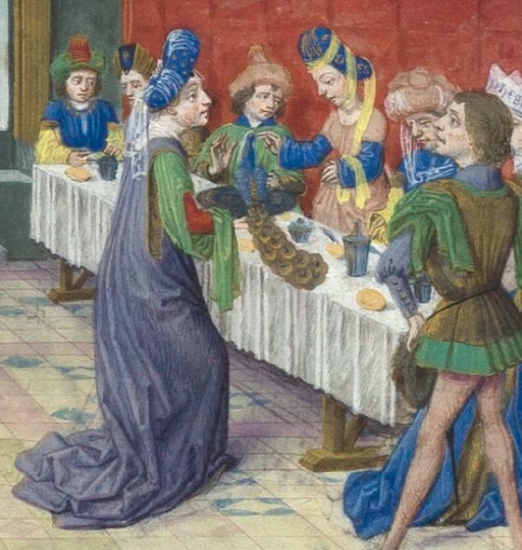
But two of them are decidedly short, even stumpy, we might say:
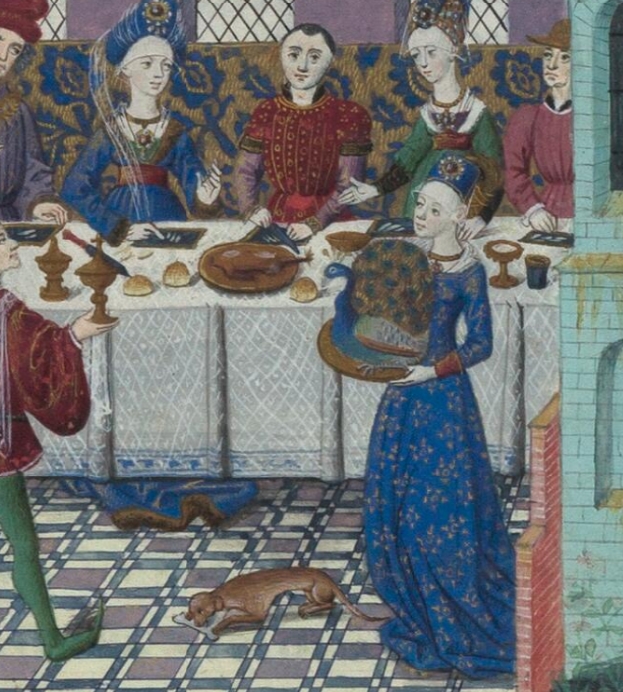
And this one:

Now the longest feathers of a mature peacock can be over 1.5m (about 59 inches) in length,[22] and none of the medieval peacocks’ tails appear to have feathers quite that long. Even the longest seem much shorter than the fabulously long tail feathers seen in this YouTube video (by Paul Dinning):
Does this suggest that at least some of the peacocks brought to medieval tables were in fact younger adults? It may do. But we must bear in mind two things. First, the artist(s) was not necessarily aiming for realism. And, second, peacocks shed their tail feathers annually and need to regrow them, so we may be looking at depictions of older birds with new feathers that are only partially regrown.
The evidence is inconclusive, but I suggest that there remains at least the possibility that younger adult peacocks are being represented in some medieval images of re-dressed peacocks. And, just to emphasise my point, if indeed younger adult birds were eaten, the meat may have been tenderer, and some medieval folk may have considered it all the better for that.
I will finish this culinary history of roasted peacock with the commentary on the eating properties and taste profile of peacock meat given in the Viandier. It’s unlikely that the master cook Guillaume Tirel wrote all of the following (a later contributor probably added the note about the types of meat), but, regardless, we can only be impressed by the analysis – even if some of it may raise our modern eyebrows.
It is better eaten cold than warm, and can be kept for a long time. It lasts well for a month after being cooked, and if it should be mouldy on the surface, just remove the mouldiness and you will find it white, good and sound underneath. Peacock has three types of meat: one similar to beef, another similar to hare, and a third much like partridge.[23]
Translation by Scully
Would you have partaken? Or would you have stuck to Chiquart’s disguised goose? Let me know in the comments below.
If you have enjoyed this post and wish to support my work, consider buying me a virtual cup of mead.
Or become a monthly subscriber.
Bibliography
[Ancient Cookery]. A Collection of Ordinances and Regulations for the Government of the Royal Household, Made in Divers Reigns. From King Edward III to King William and Queen Mary. Also Receipts in Ancient Cookery, ed. Anon. for the Society of Antiquaries (London, 1790), available online, https://play.google.com/books/reader?id=yGxBAQAAMAAJ&pg=GBS.RA2-PA422&hl=en.
Austin, Thomas (ed.), Two Fifteenth-Century Cookery-Books, EETS OS 91 (Trübner & Co., 1888).
Burgess, S. C., ‘The Physical Structure, Optical Mechanics and Aesthetics of the Peacock Tail Feathers’, in Design and Nature: Comparing Design in Nature with Science and Engineering, ed. C. A. Brebbia & L. J. Sucharov (WIT Press, 2002), pp. 435-43; available as an Open Access article at https://www.witpress.com/Secure/elibrary/papers/DN02/DN02043FU.pdf.
Godefroy, Frédéric. Complément du dictionnaire de l’ancienne langue française et de tous ses dialectes du ixe au xve siècle (Paris, 1881-1902), available online via Dictionnaire du Moyen Français (1330-1500), DMF 2023.
Greco, Gina L. & Christine M. Rose (trans.), The Good Wife’s Guide (Le Ménagier de Paris): A Medieval Household Book (Ithaca, NY and London: Cornell University Press, 2009), Kindle edition.
Hieatt, Constance B. ‘The Third Fifteenth-century Cookery Book: A Newly Identified Group within a Family’, Medium Ævum 73.1 (2004), pp. 27-42.
Hieatt, Constance B. & Sharon Butler (eds.), Curye on Inglysch: English Culinary Manuscripts of the Fourteenth Century (Including the Forme of Cury), Early English Text Society Supplementary Series 8 (Oxford University Press, 1985).
Le Menagier de Paris, ed. Georgine E. Brereton and Janet M. Ferrier (Oxford: Clarendon Press, 1981).
Scully, Terence (ed. & trans.). Du fait de cuisine / On Cookery of Master Chiquart (1420) (Arizona Center for Medieval and Renaissance Studies, 2010).
Scully, Terence (ed. and trans.). The Viandier of Taillevent: An Edition of All Extant Manuscripts (University of Ottawa Press, 1988).
Qing Liu, Xiao Meng, Ya Li, Cai-Ning Zhao, Guo-Yi Tang, and Hua-Bin Li. ‘Antibacterial and Antifungal Activities of Spices’, International Journal of Molecular Sciences 18.6 (2017), pp. 1-62, https://www.mdpi.com/1422-0067/18/6/1283 [accessed 16 January, 2025].
[1] And later still, after abdicating his duchy in 1439, he became Pope Felix V (r. 1439-1449), the last of the so-called antipopes. The information presented here concerning Master Chiquart is extracted from chapters 2 and 3 of Terence Scully’s excellent edition and translation of Chiquart’s cookery treatise, Du fait de cuisine, written around 1420. See the bibliography for details of the study.
[2] Scully, Chiquart,p. 30.
[3] Scully, Chiquart, p. 35.
[4] Scully, Chiquart,pp. 138-40. Scully has redressed rather than re-dressed. The latter is meant.
[5] Scully, Chiquart,pp. 141-42; I have corrected redressed to re-dressed.
[6] Middle French, ‘lart dudit pavon’ (the art of said peacock). Somewhat oddly – or at least it seems so to me – Scully suggests in his note that larceny is meant; see p. 142, n. 10.17. I understand that Middle English art can have a malign sense in addition to a positive meaning, but larceny seems too much of a stretch, too specific. Scully’s actual translation of artifice fits the bill better, I would politely suggest.
[7] Scully, Chiquart,p. 142; I have corrected redress to re-dress.
[8] Godefroy, Complément, escorchier, gives the modern écorcher (to skin) and ‘dépouiller de sa peau’, (to strip off one’s skin), C. Godefroy. After much thought, I find myself agreeing with Scully that the standard French meaning of the time, ‘remove the skin from’, doesn’t make sense, but rather the context requires something else. Clearly, the skin is removed. Scully argues that ‘remove the feathers from’ was the intended meaning, and also implies plumer (to pluck), as used in a later recipe for capons, was really what Chiquart meant to use; see Scully, p. 142, n. 10.19.
[9] There are undoubtedly other European sources; I have not checked for Middle Eastern recipes. I have located recipes for spit-roasting and re-dressing a peacock in five English sources; see Hieatt et al, Concordance, p. 65, ‘Peacock, Roast’. In addition to the allusion in Chiquart’s text, roasting and re-dressing are discussed in the French work known as the Viandier, discussed below, and is also alluded to in Le Menagier de Paris; see Brereton & Ferrier, p. 228, no. 153, and Greco & Rose, p. 299.
[10] [Ancient Cookery], p. 439, no. 332, https://wellcomecollection.org/works/evs98d3z/items?canvas=499&query=pecokkes [accessed 16 January, 2025].
[11] See https://www.webmd.com/diet/health-benefits-cumin [accessed 16 January, 2025].
[12] See Qing Liu et al, ‘6. Cumin’.
[13] Scully, Viandier, p. 304, Middle French text, p. 268.
[14] Scully, Viandier, p. 288, Middle French text, p. 135
[15] Patricia Steward and Gabriele Macelletti, ‘Peacock, Rochester Bestiary, c.1230’, Kent Archaeological Society, https://www.kentarchaeology.org.uk/records/rochester-bestiary-peacock [accessed 21 January, 2025]..
[16] Hieatt & Butler, p. 39.
[17] My own translation; see Austin, p. 79.
[18] My translation; see Hieatt, p. 40.
[19] Scully, Viandier, pp. 239, 298.
[20] See ‘Baby Peacocks: All You Need to Know (with Pictures)’ on the Birdfact website, https://birdfact.com/articles/baby-peacocks#:~:text=Whilst%20peacocks%20typically%20reach%20skeletal%20maturity%20in,around%20the%203%2Dyear%20mark%20or%20sometimes%20longer [accessed 20 January, 2025].
[21] See the Middle French text in Scully, Viandier, p. 102, no. 50; his composite translation on p. 284 reads ‘the head and the tail are left on; it is larded and mounted on a spit and glazed as it roasts’.
[22] Burgess, p. 436; see also the feather samples
[23] Scully, Viandier, p. 285, no. 50; Scully’s italics removed. These observations on peacock do not appear in all manuscripts of Viandier. The note on the types of meat appears only in a later fifteenth-century manuscript; see p. 102.
 MONK'S MODERN MEDIEVAL CUISINE
I’ve seen references to the dryness of peacock from British India, too.
Amadeus VIII had an interesting career, including a stint (1439-1400) as antipope under the name of Felix V
LikeLiked by 1 person
Interesting about the British Indian context. I wonder if the same kind of ostentatious display was at play in eating peacock at that time in India?
Yes, antipope, too! (I left that to a footnote.) Scully gives a good overview of the Savoy court at that time in his newer edition+translation. Do you have it? I only recently got it. I’d been using his much older translation.
LikeLiked by 1 person
The Raj reference was to upcountry, where chickens might be har dto come by, but peacocks were native (and a nuisance).
I have a copy of the 1995 Scully. I feel for Chiquart. ‘Oh, by the way, chef, I’ll be hosting my father-in-law in the middle of nowhere. Food for 500, 3 days running. Just throw something together – like a kitchen, a water source, and supply chains. Something to impress the richest man in Europe.’
LikeLiked by 1 person
Yes, it was a massive challenge but he loved it! 🤣
LikeLiked by 1 person
Every time I read about birds (or anything else) being served in their skins I worry about how sanitary (or not) it was. I was glad to read that some thought had been given to this.
It was also interesting to see in the paintings that the peacocks were served by women. I wonder if that means anything.
LikeLiked by 1 person
Yes, mostly there seems to be complete disregard for hygiene. Mind you, when a few years ago Ruth Goodman made her Tudor peacock pie, re-dressed with the skin and feathers, she said nothing about the matter either 😱.
Re. ladies serving, I need to look into this. It is I suspect something to do with the Alexander stories that the images are illustrating. There’s some kind of vow made over the peacock, so the ladies may be serving because the narrative dictates it. It may not necessarily be drawing on actual practice.
LikeLiked by 1 person
Ruth Goodman has cooked in some very unhygienic conditions, but you’d think she’d have something to say on the subject.
That makes sense about the women.
LikeLiked by 1 person
I re-watched the part where she skins the bird and then later reattaches it on a frame over the cooked pie. Nothing was said about food hygiene, not at that point. Whether she said something later, I’m not sure.
LikeLiked by 1 person
She also seemed to be wearing the same outfit/apron, in which she skinned the bird, throughout the day. 😫
LikeLiked by 1 person
One of the very good things about being a vegetarian is that it’s very, very hard to get food poisoning. I’ll try to get the picture of her skinning, cooking and serving the bird without anything much happening in between out of my head.
LikeLiked by 1 person
Good idea. 😊
LikeLiked by 1 person