
- Intro
- The earliest ‘gravy’ recipe
- ‘Gravy’ in Middle English recipes
- My recipe
- Supporting me
- Notes
- Bibliography
Intro
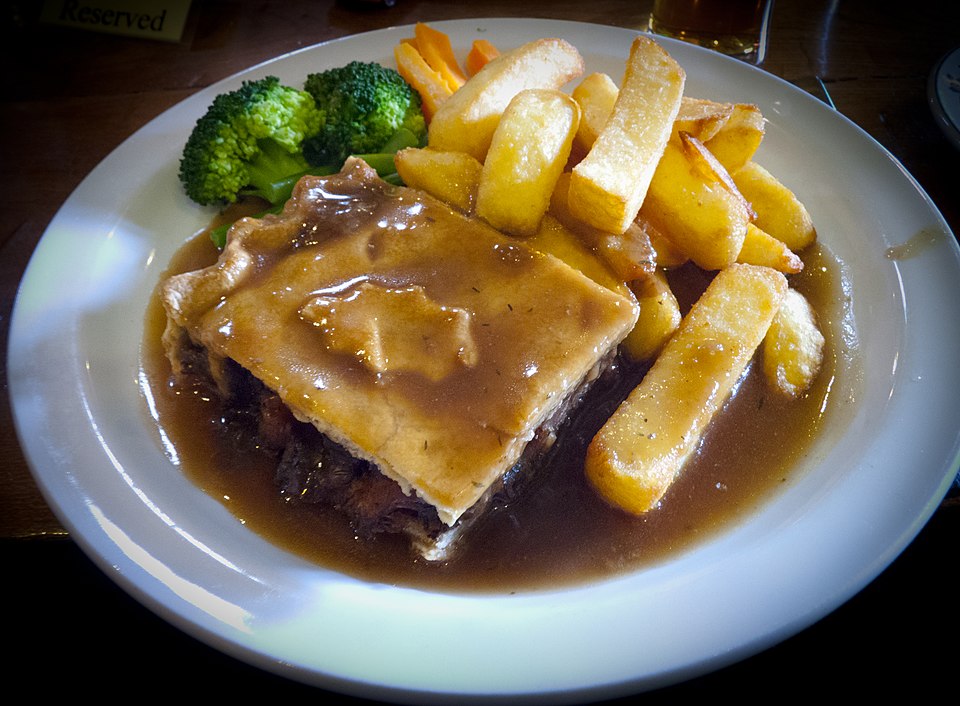
Few people are quite as into gravy as the Brits. By gravy, I mean the meaty sauce which is, at the very least, obligatory for a Sunday roast. And the liquid beef velvet that oozes forth from a steak and kidney pie. And, of course, the essential umami liquor of the classically northern chips n gravy.
In England, however, more than 700 years ago, gravy – specifically, gravee – was really something quite different. It was, indeed, still a sauce of sorts, but it was made by blending broth with ground almonds and spices.
gravy etymology (click on the down arrow to learn more)
The origin of the present-day English word gravy is Old French via Anglo-Norman, the dialect of French spoken in England after the Norman Conquest (from 1066). Anglo-Norman gravé appears in The Treatise of Walter Bibbesworth (c. 1290), as part of the name of the rabbit dish, conins en gravé, which is described as being seen at a high feast. About ten years later it appears as gravee in the Anglo-Norman recipe, discussed below.
The Anglo-Norman word was borrowed into fourteenth-century Middle English. It appears as graue (the u is pronounced as v) in a recipe from a 1381 collection, and as grauey in three recipes from Richard II’s cookery book, Fourme of Cury (c. 1390). These are discussed in more detail, below.
There is an argument that Middle French gravé was in fact a misreading of Old French grané (grain), which was used to mean a stew or broth, but this cannot be substantiated. See https://www.etymonline.com/word/gravy. At any rate, for present-day English gravy, this does not negate its derivation from Anglo-Norman gravé.
The earliest ‘gravy’ recipe
Let’s take a look at the earliest attested English recipe, from a collection written down around the year 1300, and written in Anglo-Norman French:
La manere coment l’en deit fere gravee. Pernez chapouns u gelynes graces, e festes les buyllir must bien, e pernez cel bru e le festes refreyder. Pernez alemaundes, ke seient enblanchies, e fester les tribler en un morter, e festes les destemprer oue cel bru; e pernez masces e kybibes e du sucre, e metez en cel let, e pernez pucynsjefnes, ke seient bien buylli, e hostez la pel, ou conyns, e metez en cel let e festes enchaufer; e pus drescez. En meymes la manere od bru de pessons, a mestre luz e breme.
How to make gravy. Take capons or fat hens, and boil very well, and take this broth and cool it. Take almonds, that are blanched, and grind in a mortar, and temper them with this broth; and take mace and cubebs and some sugar, and put this into the milk [i.e. the broth and almond liquid]; and take poussin – or rabbits – which are boiled well, and remove the skin, and put them into this milk and heat through; and then dress the dish. Do it the same way for fish broth, using luce and bream.
Text from Hieatt & Jones, p. 866. Translation is my own.
In this recipe, gravy was a kind of almond milk, made by mixing ground almonds with poultry (or fish) broth, in which poussin (young chickens) or rabbits (or fish) could be served. Significantly, the gravy was well spiced with Indonesian spices: mace – the aromatic outer covering, or aril, of nutmeg – and cubebs, a variety of pepper. My own version of this dish appears below.
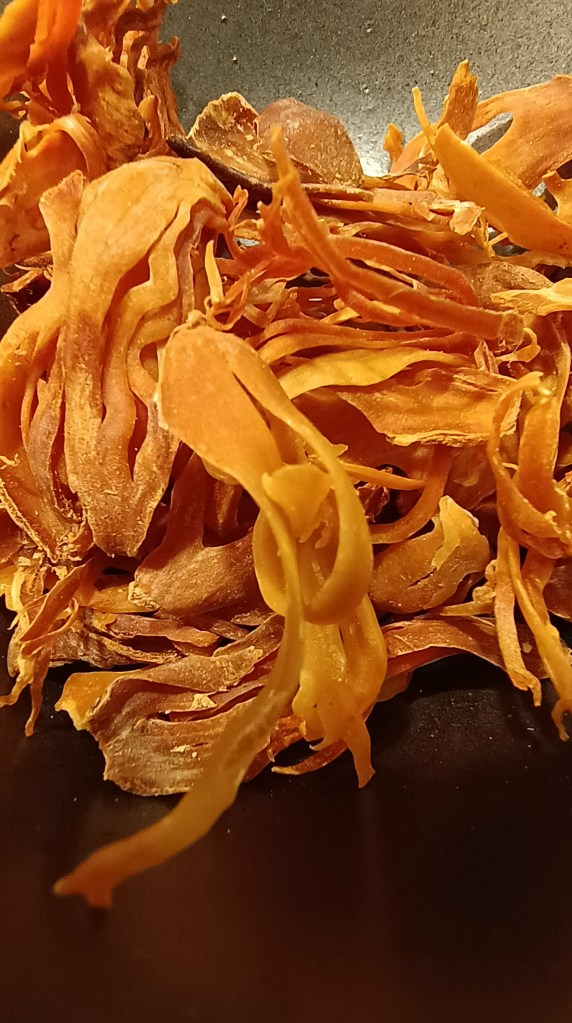
Mace, the outer coating of nutmeg, has a taste similar to nutmeg but is more peppery and citrusy.
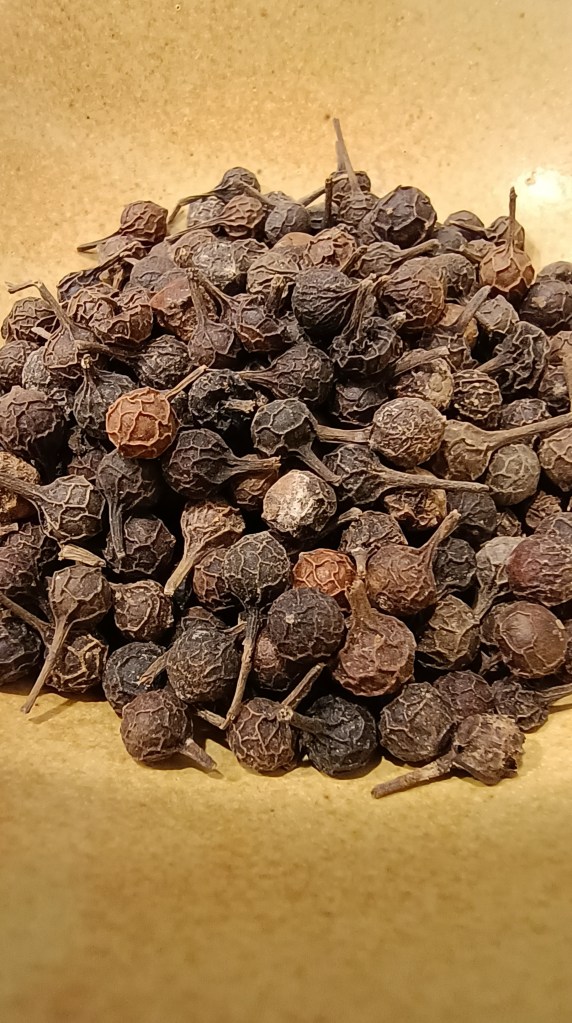
Cubeb pepper is significantly milder in heat than black pepper. It has pine, citrus and woody notes, and leaves behind a pleasing menthol cooling sensation.
‘Gravy’ in Middle English recipes
Around 1381, a collection of recipes in Middle English was written down which includes a recipe for an enriched gravy, appropriately named graue enforce, literally ‘strengthened gravy’. The recipe’s method combines a ground mixture of almonds, ginger and saffron with an unspecified liquid (likely water or broth). This is then boiled, before yolks from boiled eggs, and gobbets of high-fat cheese were added. Once dressed in dishes, the enriched gravy was sprinkled with powdered galangal, a dried rhizome from a plant in the ginger family.
Moving forward to the next decade, Richard II’s famous cookery work, Fourme of Cury, has three gravy recipes. The first two, Conynges in grauey (Rabbits in gravy) and its sister recipe Chykenes in grauey (Chickens in gravy), are essentially, when taken together, the same as the first Anglo-Norman recipe above, with a few modifications, including the choice of ginger as the spice and the direction to first par-boil the rabbits or chickens before finishing their cooking in the gravy.
The third recipe in Fourme of Cury is Oysters in grauey, which notably uses wine, along with the oysters’ ‘own broth’ – that is, the liquid in which they’re cooked – to mix with the ground almonds, before also adding rice flour to make the gravy a little thicker, though ‘not too standing-thick‘ we are told. The spicing is an interesting combo: as well as sugar and salt, powdered ginger, mace and cubebs are all added.
As we progress into the fifteenth century, various recipes use gravy (with various Middle English spellings) to mean not only the finished sauce of the dish (e.g. both rabbits and oysters in grave reappear),1 but also to mean simply the broth from boiling meat or fish.
Two fishy examples are mullet being cooked in grave of fresshe fysshe (fresh fish broth),2 and a sauce for trout being made with his graveye, that is, its own gravy, meaning the liquid in which the trout was first cooked.3 In the fourteenth century, the comparable instruction would have been to use its own broth.
A thorough exploration of the way gravy was used in fifteenth-century recipes – and, indeed, beyond – would likely yield up further insights into how the word was used in a culinary context.
My recipe
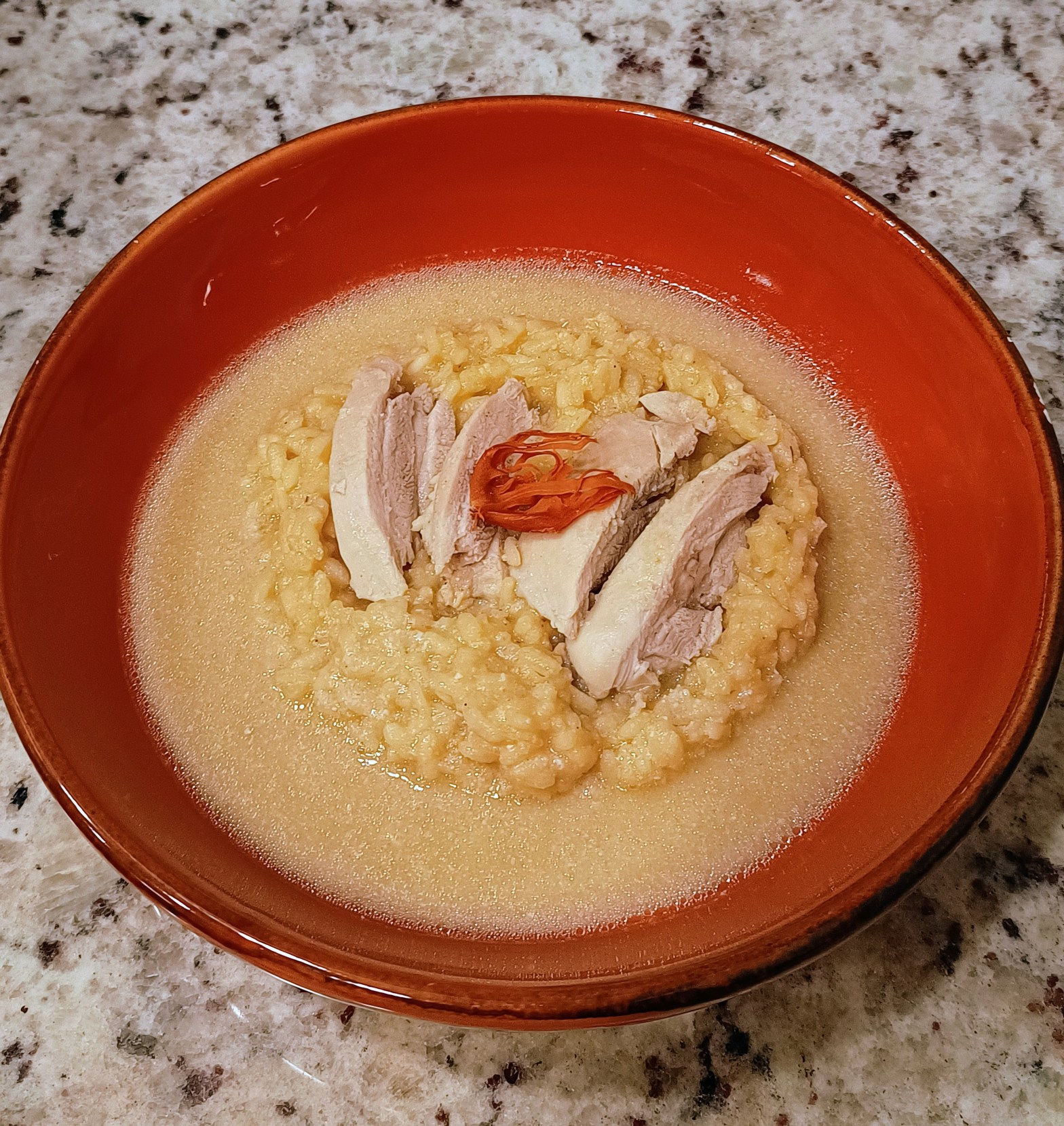
And, so, to my own version of the earliest of the recipes, which I’m calling Chicken in Gravy. I’ve only cooked this once, so what you read here is a breakdown of my first experiment. Both Ray and I really enjoyed it, and I will continue to refine it. It is a delicious, aromatic dish, really quite different from other medieval chicken dishes I’ve cooked.
I confess I didn’t boil my own capon or fat hen broth – oh, the scandal! – but rather used a shop-bought one. I often have chicken stock in my freezer but not on this occasion. You’ll also see that I’ve scaled things down, choosing the convenience of boneless chicken thighs.
Modern-Medieval Chicken in Gravy
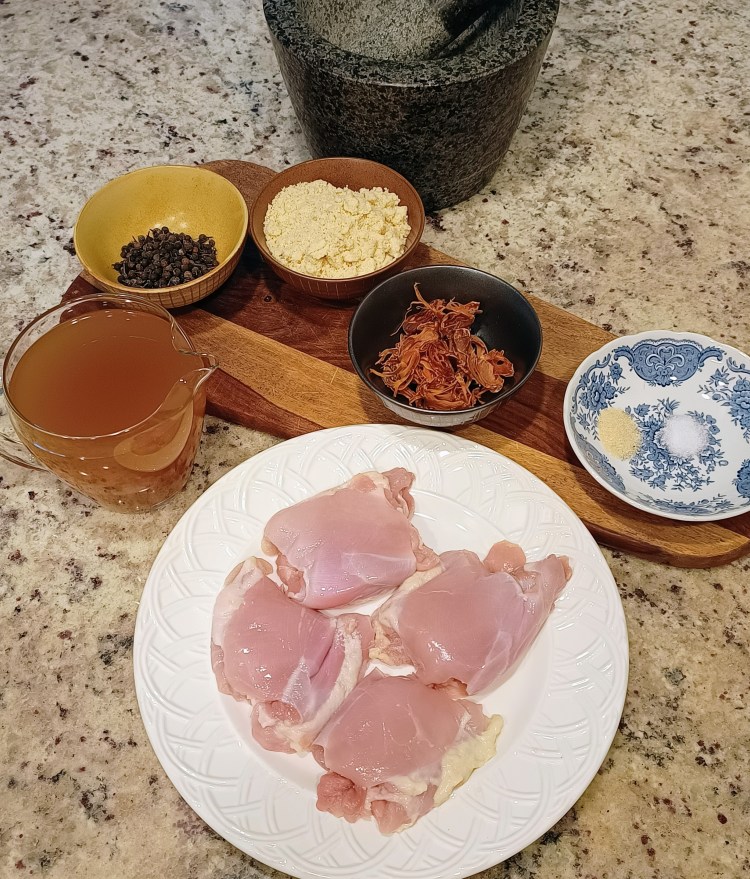
Ingredients (to serve 2 to 4 people)
5 pieces of whole mace
1 teaspoon of whole cubebs
700 ml chicken broth (or stock)
75 g finely ground blanched almonds (almond flour)
½ teaspoon sugar
¼ teaspoon salt
4 boneless chicken thighs
Method
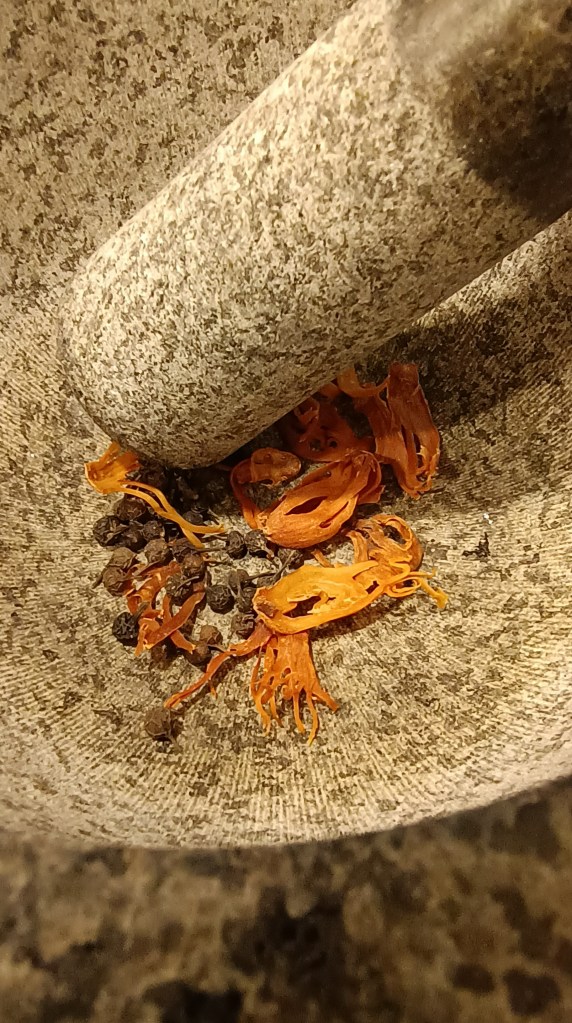
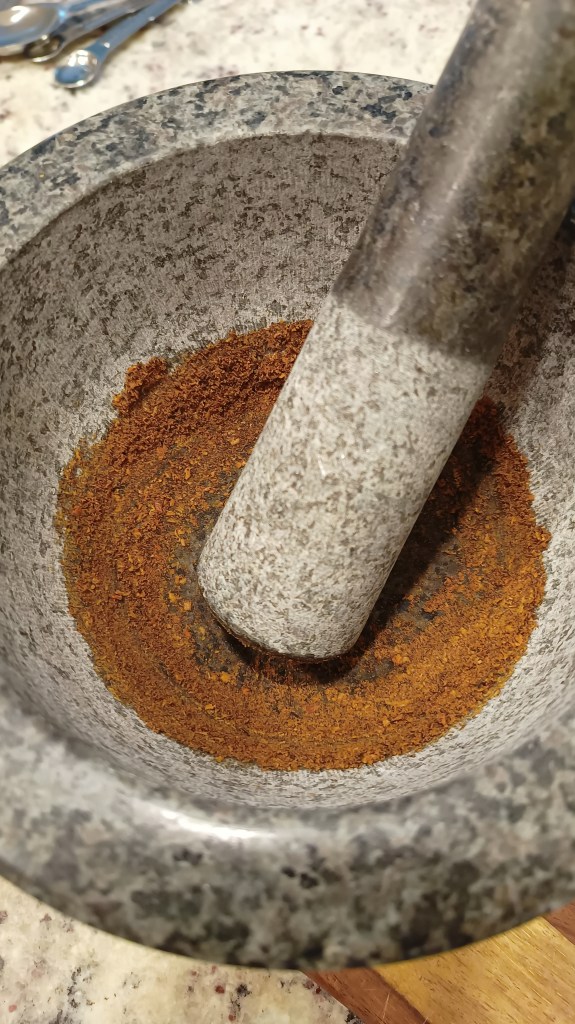
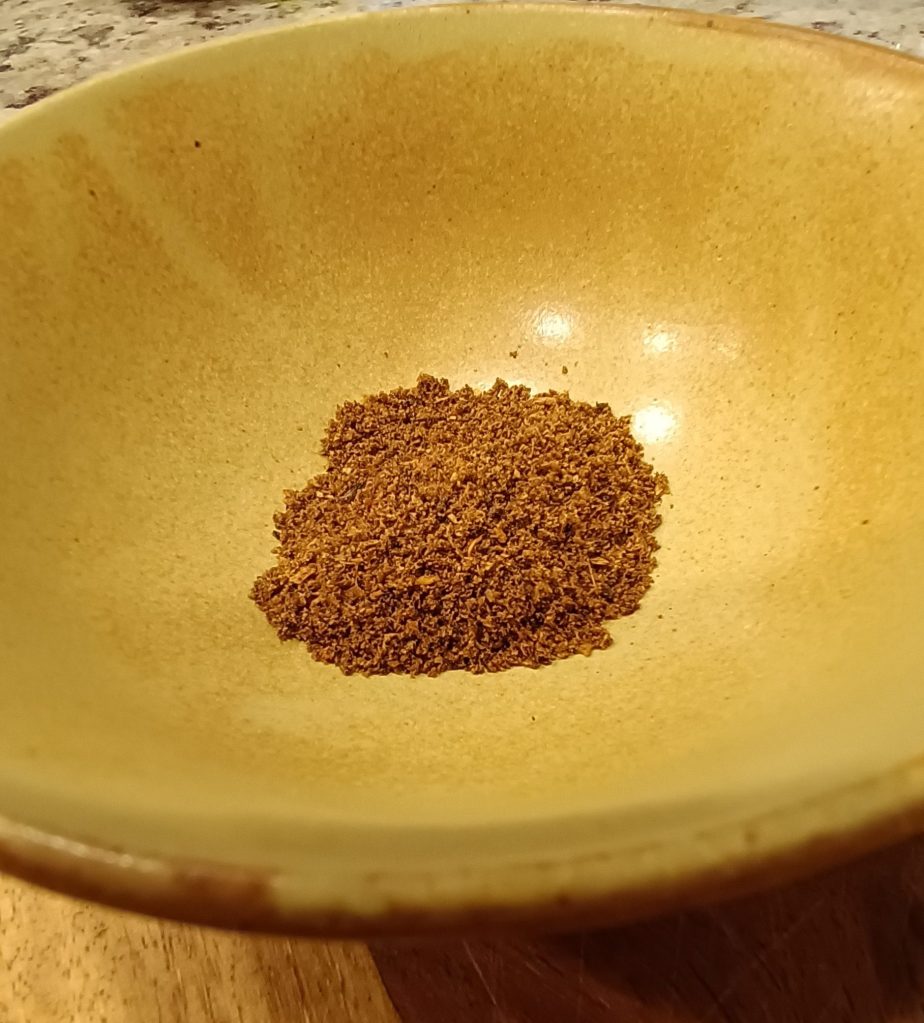
Grind the mace and cubebs with a pestle and mortar. This should yield about 2 teaspoons of ground spice mix. I didn’t use all of this.
Put the ground almonds and chicken broth into a pan and stir. Add some of the ground spices – I used 1½ teaspoon. I might put a smidgen less in next time.
Add the salt and sugar and give everything a thorough stir. Bring the ‘gravy’ to a gentle simmer.
Place the chicken thighs into the pan. Gently cook on a low to medium heat for approximately 15 minutes. Do not boil them rapidly. I had average-sized thighs, so you may need to adjust the time if yours are particularly large.
If the liquid doesn’t quite cover the chicken thighs, turn them over half way through cooking.
The chicken is cooked when it is just firm to the touch, but not as hard as marble! There should be no red or pink juices if you make a small slit into the flesh.
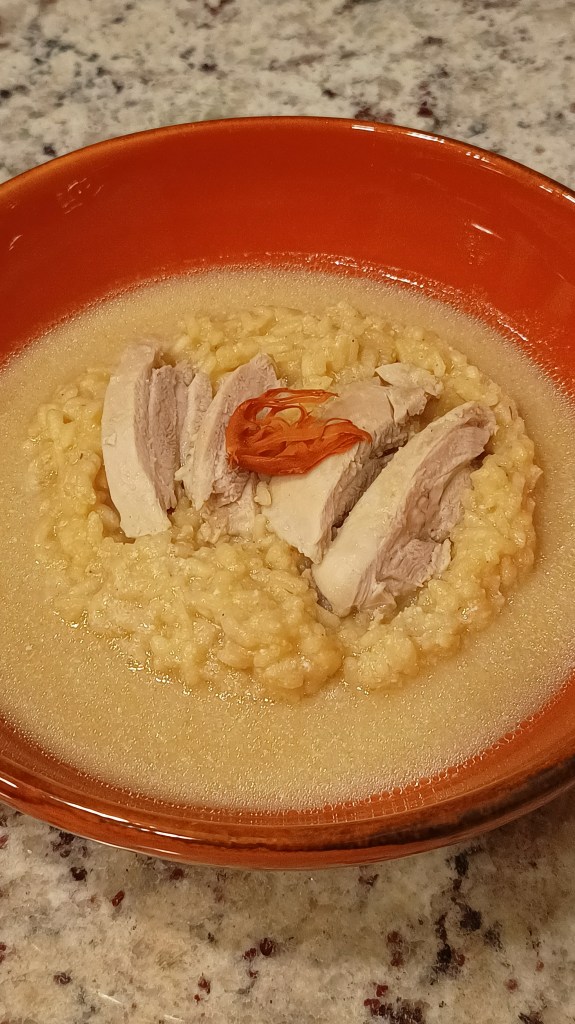
Carve the thighs on a board, then arrange in a dish on top of a mound of cooked saffron rice or risotto, with a moat of the aromatic gravy poured around it. Garnish with a piece of mace.
For my own dish, I adapted my own Saffron Rice (Ryse of fleysche) recipe, which is cooked like a risotto with paella rice. My rice on the day was especially thirsty, so I ended up using several ladles of the ‘gravy’ to supplement the hot broth, making it very harmonious. I’ve made the Ryse of fleysche recipe free to download at my Buy Me A Coffee shop.
Supporting me
If you would like to support my research as an independent scholar or thank me for a particular post, recipe, or video, then you can do so by heading over to the Yieldeth me a cup of mead tab. Or you could sign up as a monthly subscriber.
Thank you,
Christopher
Notes
- Hieatt, Gathering, p. 55, nos 69, 70. ↩︎
- Hieatt, Gathering, p. 74, no. 87. ↩︎
- Hieatt, Gathering, p. 114, no. 164. ↩︎
Bibliography
Hieatt, Constance B. (ed.). A Gathering of Medieval English Recipes (Brepols, 2008).
Hieatt, Constance B. and Robin F. Jones. ‘Two Anglo-Norman Culinary Collections Edited from British Library Manuscripts Additional 32085 and Royal 12.C.xii’, Speculum 61.4 (1986), pp. 859-882.
 MONK'S MODERN MEDIEVAL CUISINE

Just think: change the spicing a little, and gravy becomes blancmange.
How are you doing?
LikeLike
Ha ha! Yes! But not quite like the pink stuff I had at school 😉😆.
I’m doing alright, thank you, Jon. I hope you are battling on, too.
LikeLiked by 1 person
Well, I wouldn’t bet on Gravee/y being tennis-playing aliens from the planet Skyron in the Andromeda Galaxy. But you never know…
I’m acquiring ailments, none of which I asked for. But we press on.
LikeLiked by 1 person
for grains of Paradise, mace, cubebs, long pepper (used in Medieval and also Roman cookery, check out Auntie Arwen’s Spices. They also have blends documented to medieval times.
LikeLiked by 2 people
Yeah, it’s so weird to think of British eating meat and potatoes without gravy till this late in the game, but then there are tons of ‘British’ foods that were imported, like mince pie, fish and chips, pasties, and even the full English breakfast. And curry is just the latest.
I can definitely see how thirsty your rice was in that last picture, but hey, just an excuse to add more tasty gravy!
I also find it interesting looking back at these old sauces (though I’m just a curious dabbler) just how many of them have vinegar. I guess they had a ton of spoiled wine, so might as well use it…
LikeLiked by 2 people
I’m pretty sure origins for the dishes you mention are hotly contested, so I’m not going to join in on those debates (well, not right now).
I’m away at the moment, and was using up whatever was in my store cupboard. I think I picked up a pudding rice, rather than paella, so it went quite mushy 😆.
Vinegar is an interesting topic, which I probably need to spend some more time on in my blog. I think there’s a tendency to assume all these dishes were excessively vinegary, but I believe the use of vinegar (like spices) was much more judicious than some commentators would have us believe. A post for the future.
LikeLiked by 1 person
Somethings don’t change much. Modern Venetian pesce in saor is virtually identical to egredouce of fysche…
I wonder where England got her rice? They were already growing in in the Levante around Valencia, and I suppose the Venetian galleys would be bringing it in with the spices and the alum.
LikeLiked by 1 person
I haven’t been able to prove from where 14th-century England got her rice. It’s likely from Spain, which had been cultivating it since the 8th century. I’ll know more, hopefully, once I’ve dug a little further into Port records.
LikeLiked by 1 person
Aha, pudding rice would do it. Well, I’m sure the flavour was great, even if it could have used more springiness.
And I have definitely enjoyed plenty of food with vinegar that are not vinegar bombs. Like vindaloo, tzatziki sauce, hoisin beef, adobo chicken… Of course there are dishes like sauerbraten where you Notice the vinegar (if made with vinegar instead of wine), but it doesn’t have to be that way. I would be definitely interested in reading anything you find out about this in the future, because it sure seems to be in a lot of the recipes.
LikeLike