

Three wild plants consumed in medieval England
In November, I moved back to Derby, the city of my birth and where I grew up. I’ve been reacquainting myself with the city, a comparatively compact urban area, and also visiting nearby places in beautiful, rural Derbyshire, which begins half a mile up the road from where I live.
One of those places, Haddon Hall, which I revisited last Sunday after twenty-five years, has lovely formal gardens and also an exceptionally well-preserved medieval-Tudor kitchen, dating back in part to the fourteenth century. I will be writing about the kitchen in a future post.
For now, though, I want to focus on my own less grand, but equally lovely, garden. There’s a lot of work to be done. Among my ideas for it, I’m contemplating growing, in the raised beds I’m renovating, plants that were used in medieval cookery.
Moreover, though it dates back to no earlier than 1950, my garden is already offering me glimpses of the medieval past, in the form of plants that were used either in cookery or medicine.
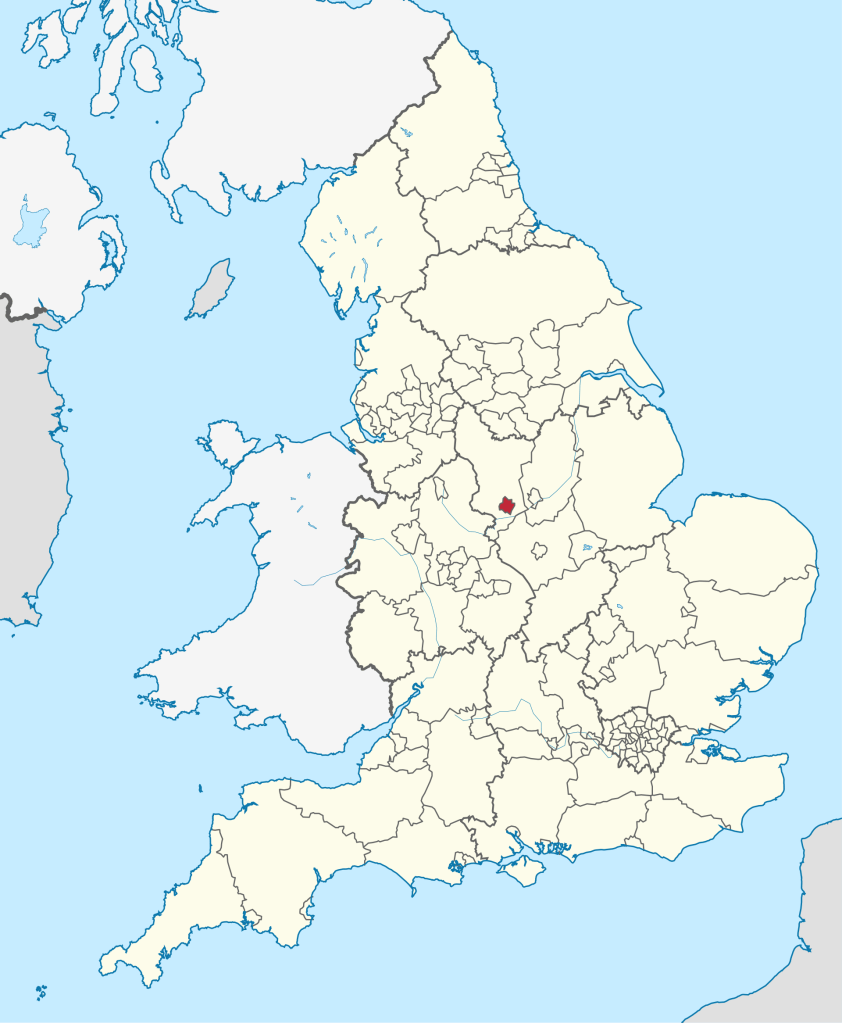
Derby
Derby is amongst the most land-locked urban areas of England. I usually say it’s smack bang in the middle of the country, though that’s really an approximation, as you see from the map (courtesy of Wikimedia).
In the context of its medieval history, it is probably best known for being one of the so-called five boroughs of the Danelaw, hence a Viking stronghold in the ninth century.
If you would like a very quick overview of Derby, the Britannia entry is worth a read. There’s a more informative entry in Wikipedia.
My three plants
Here are my favourite three of the wild plants that I’ve recently discovered in my garden. I must thank my friend Mary for wandering around the garden with me and allowing me to pick her brain on native British species.
Common dog violet, Viola riviniana
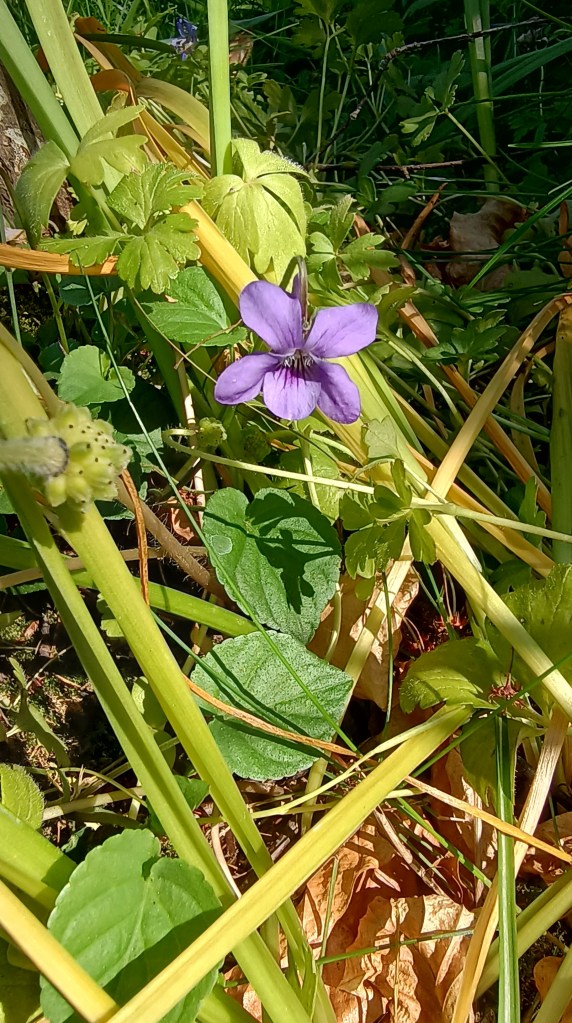
Common dog-violet is, according to Plant Atlas, a perennial plant that prospers in a wide range of habitats, ‘including open deciduous woodland, wood borders, hedgebanks and road verges, meadows, heathlands, moorland, montane grassland, rocky slopes and cliff ledges’1 – and my garden.
As well as being the plant upon which the caterpillars of the silver-washed fritillary butterfly largely depend (fussy eaters!), it may be the violet of a recipe that goes by the name Ioutes of flesche, from King Richard II’s cookery book, Fourme of Cury (c. 1390).
I say may be the violet, as medieval plant nomenclature doesn’t readily distinguish between several native species of violet in Britain.
It is impossible to know for sure if the species of violet growing in my garden was what the master cook had in mind, or whether he meant the sweet violet, viola odorata, which looks almost identical but is scented. It may not have really mattered, as both are edible – flowers and leaves.2
Ioutes of flesche was a very simple broth and was most probably made using a meat broth as the base, the most common at the time being beef broth. This explains the of flesche part of its name, contextually meaning ‘for flesh days’, i.e. meat-eating days of the Christian week (Monday, Tuesday, Thursday, and Sunday).
The ioutes of the name were the ‘jots’ of ten finely chopped herbs cooked and suspended in the broth, one of which was violet.

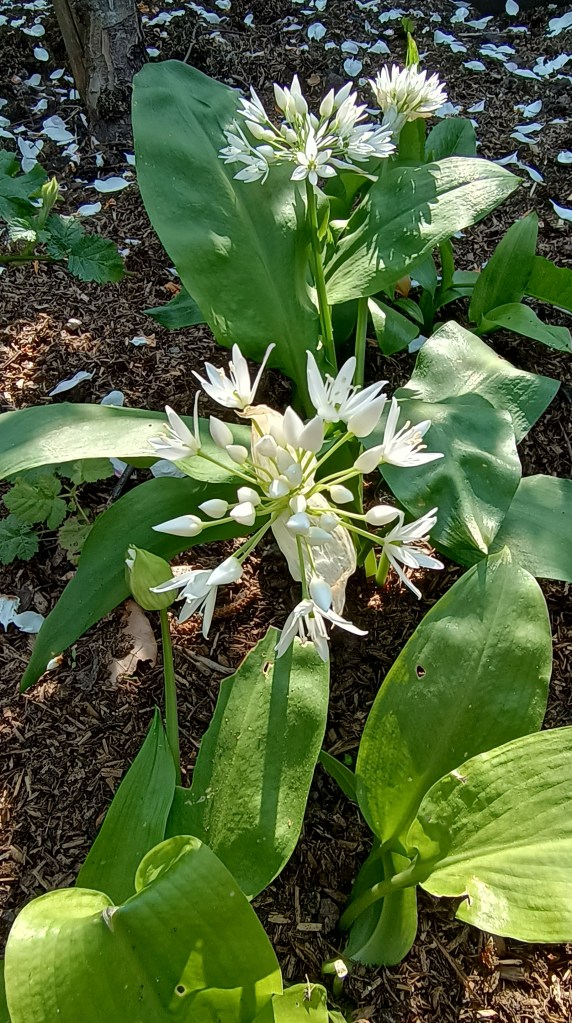
Wild garlic, Allium ursinum
I was delighted to show Mary a small patch of wild garlic which my nose had led me to earlier in the Spring, hiding under one of my inherited apple trees – looking forward to harvesting the fruit off those, and might make some medieval apple and parsnip fritters!
Also known as ramsons, wild garlic has a really beautiful flowerhead. It is a brilliant culinary plant, one which I will make good use of, though for now I want it to spread and establish.
It is quite probable that medieval peasant households foraged for wild garlic. I can imagine farmers’ wives putting it into their pottages to liven things up. But, alas, written recipes for the dishes of everyday folk in medieval England have not survived.
The use of wild garlic in elite medieval cookery collections is also not recorded, at least not directly. I have, however, contemplated the possibility that the master cook of Richard II, who provided the king with the recipe Salat – a raw salad of fourteen different herbs and alliums – may have reached for the milder leaves and flowers of wild garlek rather than the pungent bulbs of its cultivated cousin.
The thing that particularly makes me wonder if wild garlic was intended for the dish is the recipe’s method. It says to wash the fourteen different plants, pick through them, and pluk hem small wiþ þyne honde (pluck them small with your hand), which sounds like an instruction to tear the leaves and/or flowers. Indeed, how would one have plucked garlic bulbs?
Still, for a more secure identification of wild garlic in medieval England, we need to look at medical recipes. And I rather like the following one for a beverage to cure a bladder stone. It appears in a mid-fifteenth-century physician’s book.
Anoþer for the stone. Take þe watir of saxfrage, watir of beteyn, watir of ramson, water of cowslop euen porcionyd, and drynke hem first and last and thow shall fare wele.3
Another
for the stone. Take the water of saxifrage, water of betony, water of wild garlic, water of cowslip in equal measure; and drink it first and last thing [of the day], and you shall fare well.
Feverfew, Tanacetum parthenium
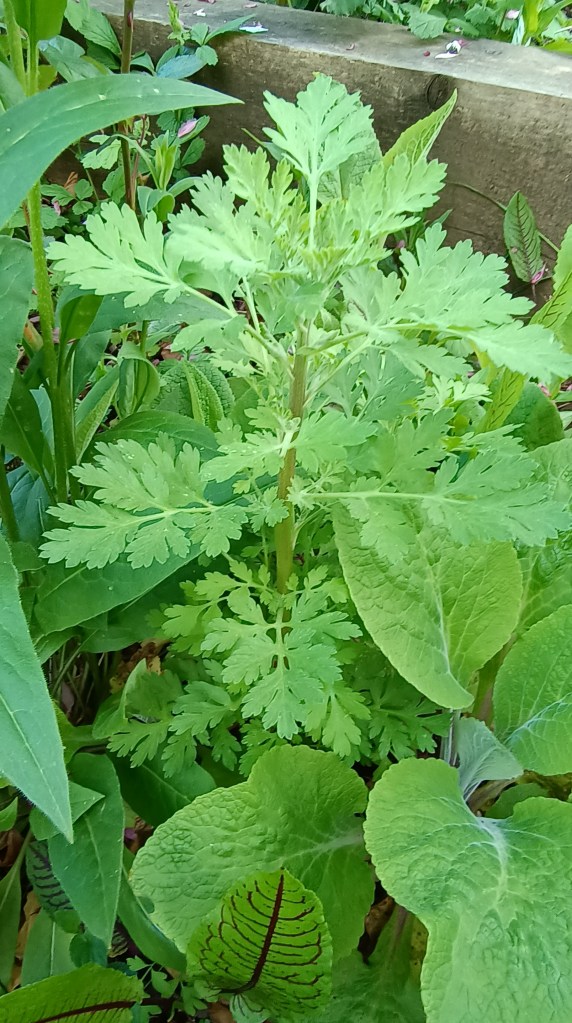
Mary found a couple of feverfew plants hiding amongst foxgloves. Wonderful!
Strictly speaking, a naturalised (technically, an archaeophyte) rather than native perennial of Britain,4 my feverfew plants should, come June, have daisy-like flowers which will provide nectar for pollinators right through to September.
The leaves of feverfew, or fethirfewe in Middle English – amongst at least a dozen other attested spellings – are pungent. I love the smell, somewhere between chrysanthemum and camphor, but it’s not everyone’s cup of tea, as we say in Britain.
It was used in medieval England in a boiled broth of wine and salt, but that is the closest we get to anything remotely culinary. In truth, this was a cure for ‘evil at the heart’, perhaps meaning heart-burn or indigestion.5
It appears also in a drink to counter an ‘evil and swelling abdomen, worms, the flux [severe diarrhoea], and dysentery’:
Tak vj leues of spourge, mynt & cifoil or fethirfewe. Stamp þam & drynk þe jeuse & it sall delyuer the.6
Take 6 leaves of spurge, mint and cinquefoil [?] or feverfew. Stamp them and drink the juice and it shall deliver thee.
The rather quaint deliver thee actually means cause you to vomit – not quite so charming – and is a useful, concluding reminder to us all not to go concocting remedies from wild plants unless we really know what we’re doing.
I’ll stick to the wild garlic!
Support me
If you would like to show appreciation for this or any other post on my blog you can make a one-off donation or ‘tip’ via Yieldeth me a cup of mead.
If you would like to offer me regular support, you might wish to consider a monthly subscription, which you can set at your own rate.
You can also head over to my recipe shop.
Donations allow me to offset the costs of running my website and carrying out independent research, and are therefore very much appreciated.
Notes
All online sources were accessed 03 May 2026. All translations of Middle English are my own.
- ‘Common Dog-violet’, Plant Atlas ↩︎
- For the common dog violet, see https://paulkirtley.co.uk/2011/common-dog-violet-viola-riviniana/ ; for the sweet violet, see https://www.eatweeds.co.uk/sweet-violet-viola-odorata. ↩︎
- Based on the text by Dawson, p. 255, no. 822. ↩︎
- ‘Feverfew’, Plant Atlas. ↩︎
- Ogden, p. 25, lines 1-2. ↩︎
- Ogden, p. 29, lines 14-15. ↩︎
Bibliography
Dawson, Warren R. A Leechbook or Collection of Medical Recipes of the Fifteenth Century (Royal Society of Literature, 1934).
Ogden, Margaret Sinclair (ed.) The ‘Liber de Deversis Medicinis’ in the Thornton Manuscript (MS. Lincoln Cathedral A.5.2) (Oxford University Press for the Early English Text Society, 1938, revised reprint, 1969).


A veritable salmagundy of ingredients! I like the idea of wild garlic leaves in Salat -which, with its herbal content, is quite pungent enough. Save cultivated garlic for Aquapatys.
LikeLiked by 1 person
Wild garlic in Salat is something I’ve pondered for ages. But re-reading it has further persuaded me. I should note that some of the later versions of FoC have ‘grene garlec’, which probably means ‘young garlic’, possibly the leaves thereof.
LikeLiked by 1 person
I used to grow feverfew to make tea. It definitely helps with migraine. Never had it “deliver me” though, lol.
LikeLiked by 1 person
I read that it gets used for migraines. Do you think its aroma has anything to do with that?
I’m going to be using ‘deliver’ in a new (old) way from now on. 🤣
LikeLike
Oh what a nice garden, perfect for a sitdown in the sun with some tea (maybe not feverfew?). I was going to say ‘How English!’ but that picture could easily be of my backyard in San Diego except more tidy and I’m sure the actual plants are mostly different. And I don’t have wild garlic, I envy that!
LikeLiked by 1 person
I loved my old garden in Manchester but it was a lot smaller and there wasn’t that much space to sit out in because of the pond that dominated it. Here, we’ve already sat out for more coffees and g n ts than we did in the last 10 years in Manchester. No tea yet.
LikeLike