
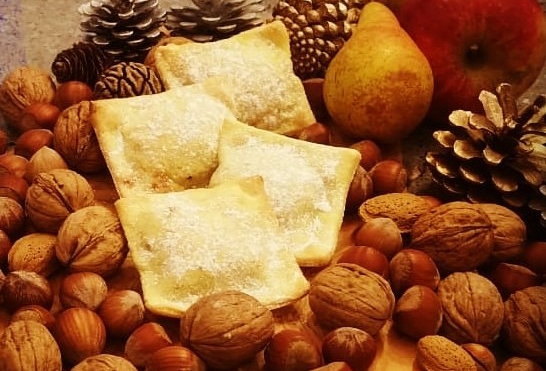
If you want to make and eat the real forebear of the modern mince(meat) pie, that sweet and spicy, perennial delight of the British Christmas, then look no further than the Anglo-Norman Kuskenole!
Never mind the wondrous, and rather big, Christmas pies of Tudor and Stuart England that incorporated actual shredded meat – such as mutton and veal – into their fillings, the English were making individual Yuletide pastries, dainty by comparison, over two centuries earlier. And, what’s more, there wasn’t a morsel of minced flesh to be seen!
Kuskenoles were small, sealed, rectangular pasties that were par-boiled before being griddled. When I first recreated them, I noted how they tasted remarkably like modern mince pies, though a little less sweet and without the booziness of fortified wines or spirits typical of today.
You can see me making gluten-free versions here last Christmas:
Their filling is reasuringly familiar: figs, raisins, pears, apples, dates and almonds, merrily bashed together and enlivened with ‘good powder’ of ‘good spices’. The spices to be used were of the cook’s choosing. But typical of this period in English elite cuisine (13th and 14th centuries) were ginger, cinnamon and cloves; nutmeg, mace and cardamon were also used. All or some of these often find their way into modern mincemeat, too.
The pastry of the kuskenole was not the cardboardesque, flour-and-water variety typical of medieval recipes but rather a tasty egg-enriched crust which was most probably meant to be eaten, and so not simply serving as a container for the goodies within. Both the earlier Anglo-Norman recipe, dating to the end of the thirteenth century, and the Middle English translation thereof – rendered in the plural as ‘cuskynoles’ and dating to the early part of the fourteenth century – state clearly to make the ‘paste’, or dough, using eggs.
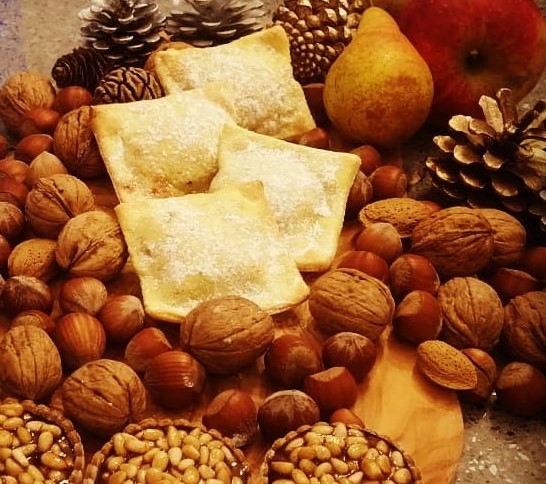
It is the later of these two recipes that helps us understand that kuskenoles/cuskynoles became a Christmas treat. After describing the number of ‘perties’, or pieces, into which the rolled-out pastry was to be cut, each measuring ‘a palm and a half’ by ‘three fingers’, and into which the sweet stuffing was to be placed, the instruction is given to fold these pieces in the Yule manner.
Admittedly rather ambiguous 700 years after it was penned, this directive does nevertheless point to the invoking of a Christmastime tradition. Perhaps the Yule, or Yuletide, manner alluded to the final rectagular shape of the pastries, somewhat vaguely resembling the manger of the Christchild. More assuredly, this instruction confirms that some English folk were indeed cooking and eating spiced fruit pastries at Christmas long before they became known as mince pies.
In my more anachronistic – and rather daft – moments, I like to imagine medieval cooks singing a Christmas carol as they created these little fold-over pies. From which I hastily move on… and offer you a Christmas freebie: my modern medieval version of Christmas Cuskynoles, including a Gluten-free option.
Please do have a go, and send me your pictures!
Season’s greetings


Very cool, will have to keep this one in mind if I ever do the Medieval Christmas feast.
LikeLiked by 1 person
If you do, send me a pic, please.
LikeLiked by 1 person
Will do!
LikeLiked by 1 person