

In my recent post about tendre chese, i.e. young cheese, I included the only recipe in Fourme of Cury, Richard II’s cookery book (c.1390), to include this ingredient. That recipe is for flampens, meaning something like ‘flame-pastries’, derived as it is from Anglo-Norman (AN) for ‘flame’ and ‘pastry’.[1]
By way of reminder of this rather complicated, and at time befuddling, recipe, here’s my modern English translation:
How to make flame-pastries (pork, fig & cheese pies)
Take clean [i.e. wholesome] pork and boil it until tender and then chop it small, and then pound it smaller in a mortar; take figs and boil them in light ale until tender and pound them along with young cheese; then wash them in water and then grind them all together with [?hard-boiled] eggs;* then take powder of pepper, otherwise marchant,** and eggs and an amount of saffron and salt [and add these]; and then take white sugar and eggs and flour and make a dough with a rolling pin; then from this make small balls and fry them brown in fresh fat and set them aside; then with the rest of the pastry make long pastry cases and put the filling into these and seal them well with a lid and pinch them finely all about; then make cuts on top, either four- or six-wise; then take all the [pastry] trimmings and then colour them with egg yolk and plant them thickly into the flame-pastries, above where you have made cuts; and place them in an oven and let them bake slowly, and then serve them forth.
*A later version of the recipe has hard egges. **marchant = a spice powder sold by a spice merchant, probably pepper-heavy.
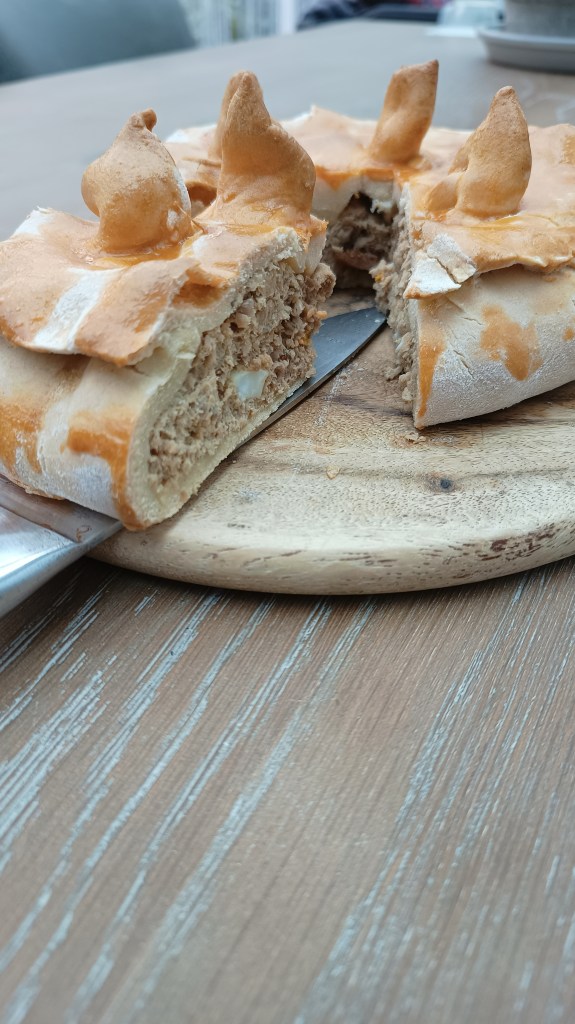
I attempted to make a flampen, perhaps a forerunner to the modern British pork pie, last Friday, using the closest thing to a young cheese I could find: Hebden Cow (York Soft).


I obtained the fresh, almost citrusy Hebdon Cow cheese from the Courtyard Dairy, arguably the best artisan cheesemongers in the north of England (if not the whole of England). This particular cheese, which has the desirable squishy texture of a young cheese, is made by hand by Kathy Swinscoe who co-owns the shop with her husband Andy, and here’s how their website describes it:
The cheese is made from fresh, grass-fed organic raw milk from 20 cows grazing on Keasden Moor nearby, and is slowly set overnight. Once set, the curd is then gently hand-ladled, before being moulded and aged for three weeks.
As it ages, it forms a wrinkly rind that breaks down the delicate fresh cheese to give it a smooth texture and crème-fraiche, buttery, grassy flavours.
The Courtyard Dairy is so worth a visit. There is a wonderful olfactory experience on entering its doors, and behind the counters are remarkable, knowledgeable people who will let you sample the exciting array of cheeses before you buy.
Here’s the Courtyard Dairy website.
Learning from experimenting
My flampen was certainly very tasty and, overall, a reasonable success – even Ray quite liked it – but I do need to make some changes.
I’m still trying to perfect my gluten-free whole egg pastry; it was a little too thick in places, and so a bit tough. Nevertheless, I still think my final pie looks pretty good – don’t you? – and though not long, as in the original recipe, it still approximates quite well the intended look.
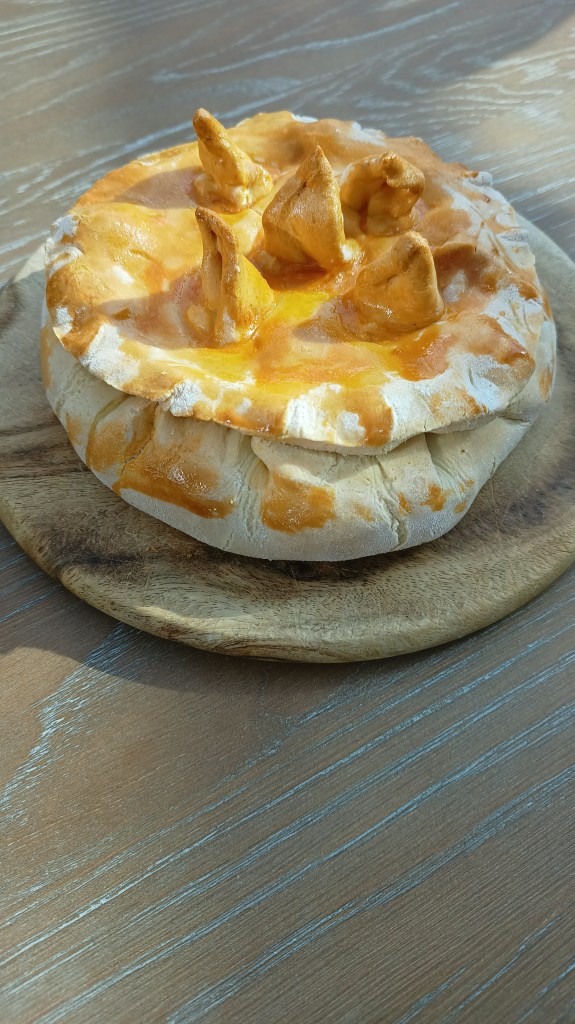
Naughtily, however, I didn’t bother frying any little balls of pastry which were presumably for further decorative enhancement. Are they meant to be the ‘coals’ to go with the ‘flames’, do you think?
The filling was very tasty indeed. For the pork, I chose shoulder steaks, which had some desirable fat necessary for moistness, and simmered these gently in chicken stock with crushed black pepper and long pepper, along with a few dried bay leaves. This definitely worked well, though next time I may look for steaks which have been trimmed less.

What I regret most was not using a greater ratio of the young cheese to the pork shoulder meat. I definitely could have used half of the pork I used. So, before I finalise a recipe for you all, I do need to adjust this in order to allow the cheese greater prominence.
I may also experiment further by making this a layered pork, cheese, and fig pie. That, I believe, would be even more pleasing to the tastebuds, as well as being more visually appealing.
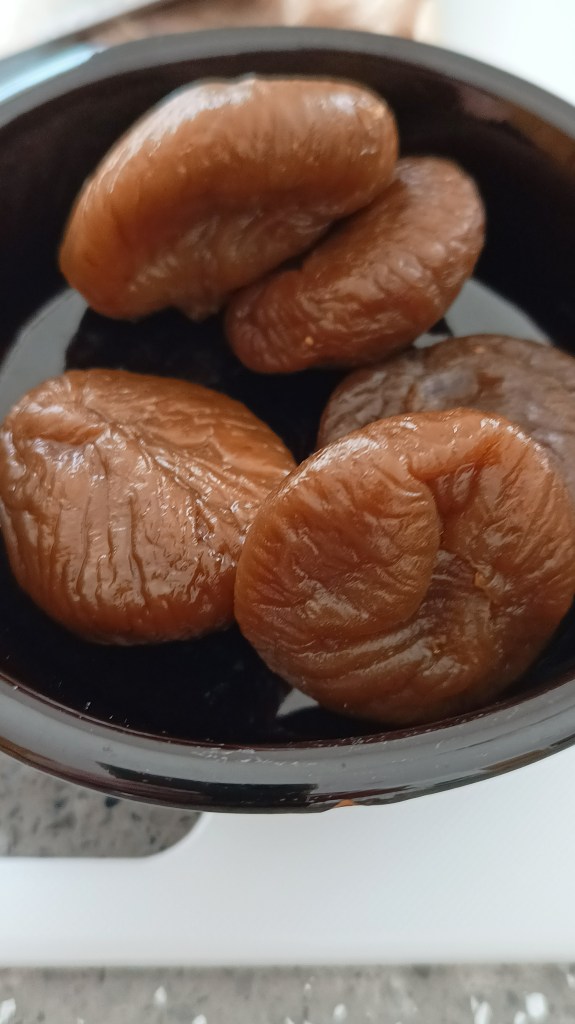
I did love the figs in the filling – not too sweet at all. I didn’t need, however, any light ale in order to re-hydrate them, as I purchased some gorgeous, soft-eating ones which are already partly rehydrated. Moreover, in the fourteenth century, ale would have been made without hops, and it is very difficult to find something similar today, so I made do.
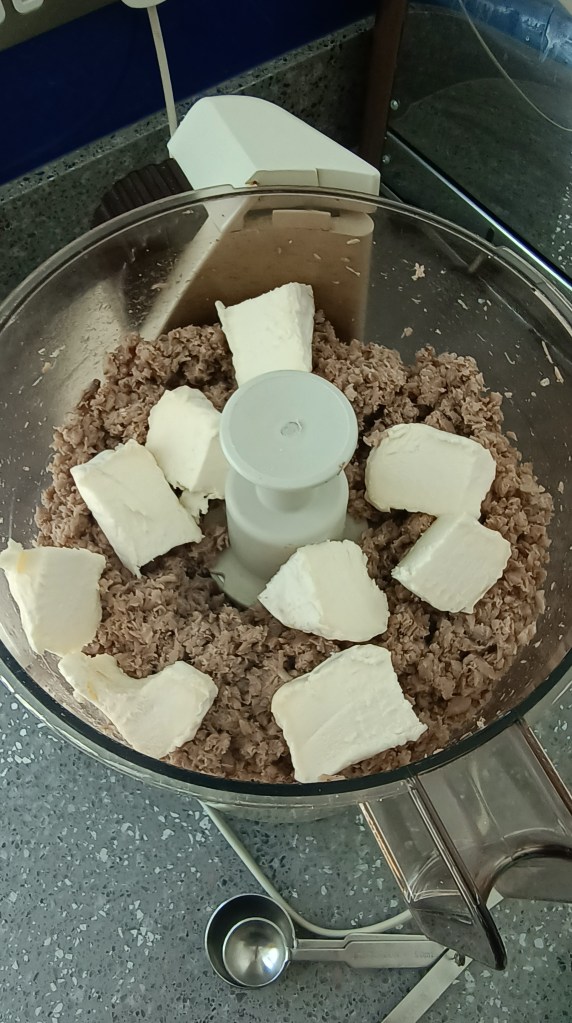
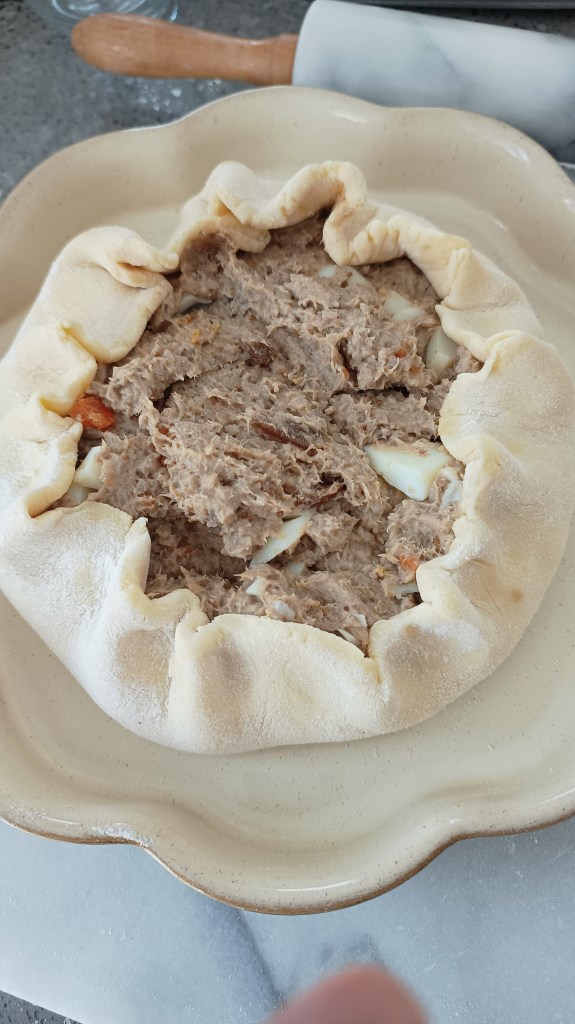
Anyway, below are a few more pics from my Friday experiment.
Just before you take a look at those, perhaps you would like to support my work with either a one-off donation via the Yieldeth me a cup of mead page, or by joining the monthly subscribers.



[1] For the numerous variant spellings of the AN word for ‘flame’ see flambe :: Anglo-Norman Dictionary. For the AN word for ‘pastry’, see pain 1 :: Anglo-Norman Dictionary, 3, ‘culin. pastry, mix of flour and water to form a paste and baked’. The fourteenth-century citation is given with the example chapon en peyn (capon in pastry) [both entries accessed 15 June, 2025].
 MONK'S MODERN MEDIEVAL CUISINE
I envy you your cheese access. These sound delicious – but didn’t you do flampeyn tartlets many moons ago?Have you ever tried making your own, un-hopped ale?
LikeLiked by 1 person
The cheeses are remarkable at Courtyard Dairy. I’ve got a small piece of Fellstone waiting to be eaten with a glass of good wine. It’s a revival of a traditional Wensleydale that had died out. Delicious.
You’re right, I did do some tartlettes, flamepoints, quite similar to the flampens. The differences are that they had fatty bacon, lard and a more mature cheese in them, plus cinnamon buds as the spice. They also didn’t have boiled eggs in the mix as these flampens do.
I’ve never made any alcoholic beverage myself. Shame on me!
A herbed ale does sound quite appealing. On the to do list.
LikeLiked by 1 person
I think playing with the herbes would be the best thing about home-brewed ael
LikeLiked by 1 person
I think doing the figs in mead would be in character and would yield a nice honeyed note to go with the cheese and pork.
LikeLiked by 1 person
Now that’s a great idea.
LikeLike
Have you any idea what spice mixture is “marchant” ((Poudre Marchant)? Since it seems to say that it could be used in place of pepper, I’m guessing that pepper is one of the ingredients. Does that spice mixture appear elsewhere in Forme of Cury?
LikeLiked by 1 person
It means ‘merchant powder’, i.e. a spice powder from a spice merchant. We don’t know exactly what would have gone into it;, but, as you say, it was likely pepper-based, akin perhaps to powder fort. I’m away from my study right now so can’t check if marchant powder appears in any other recipes. My memory is saying no, or perhaps one other recipe.
LikeLike