

How were herbs dried in medieval England? You may assume, as I did, that bundles of herbs were hung in a warm, dry, well-ventilated room. This may well have been the typical way, assuming those conditions were easy to arrive at.
Recently, however, I came across a few lines from a medieval English cookery text that raised my eyebrows in quizical surprise (a weird look, I admit). This was something I’d missed when previously looking at this text, and it took a while to work out what was actually being said. Yes! Herbs were dried in a pie!
The recipe, below, is from Liber cure cocorum, written in rhyming verse around 1475 in a Lancashire dialect. Here’s a side-by-side rendering of the Middle English text, based upon the edition by Richard Morris,[1] and my own modern English (non-rhyming) translation:
To keep herbȝ ouer þe wyntur To keep herbs over the winter
Take floure and rere þo cofyns fyne, Take flour and raise the coffins* fine
Wele stondande withouten stine; Well-standing without delay**
Take tenderons of sauge with owte lesyng, Take tender stalks of sage so true***
And stop one fulle up to þo ryng; And top one up full to the rim;
Þenne close þo lyd fayre and wele, Then close the lid fair and well,
Þat ayre go not oute never a dele, That not even a bit of air may get out;
Do so with saveray, percil and rewe; Do so also with savory, parsley and rue;
And þenne bake hom harde, wel neȝe brende; And then bake them hard, well-nigh burnt;
Sythun, kepe hom drye and to hom tent; After, keep them dry and to them attend.
Þis powder schalle be of more vertu, This powder shall be of more virtue
Þen opone erþe when hit gru. Than when upon the earth it grew.
*coffins = pastry cases; **stine for stint; withouten stint is a common expression; ***with owte lesyng, a common rhyme-tag, literally, ‘without lying’
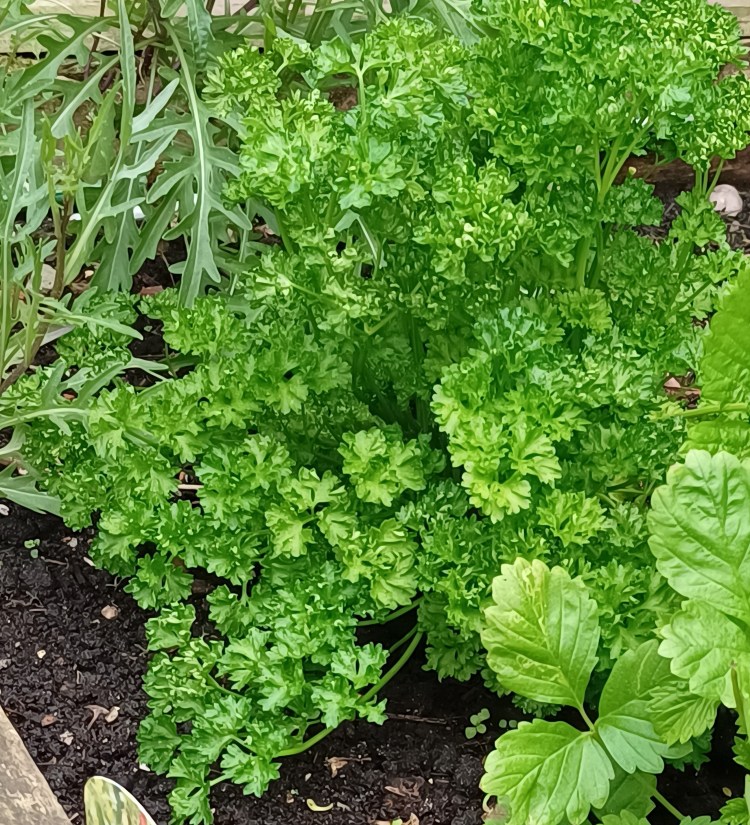
The result of drying sage, savory, parsley and rue, each inside its own tightly-sealed pie, was to make these herbs dry enough to grind into powders, suitable for culinary use during the winter when herb gardens were essentially bare.
That each powder would be of more vertu than their fresh counterpart strongly suggests that dried herbs were appreciated for their intensified flavour, as they still are today.
If you would like to make a small donation to support my independent research, please head over to Yieldeth me a cup of mead, or to my recipe shop. Or, you may wish to consider joining those who support me as monthly subscribers. Many thanks indeed!
[1] ‘Liber cure cocorum. Copied and edited from the Sloane ms. 1986, by Richard Morris.’ In the digital collection Corpus of Middle English Prose and Verse, https://name.umdl.umich.edu/CME00146. University of Michigan Library Digital Collections [accessed 06 June, 2025].
 Monk's Modern-Medieval Cuisine
Rue is a surprising addition. I thought it went out with the Romans.
LikeLiked by 1 person
It’s in one recipe in Fourme of Cury, if I remember correctly. I might get a rue plant for my new garden, if our offer on the house is accepted. Never had it. I’m curious.
LikeLiked by 1 person
Wow, that’s pretty neat! In retrospect (as always) it’s obvious: the weather does not always co-operate for air drying (especially in the British Isles) but herbs baked in a pastry coffin till the pastry is hard, nigh airtight, should be pretty well dry if left to sit for a while. The pastry absorbs some moisture too, making it triple drying action (baking, absorption, time).
LikeLiked by 2 people
That’s a good point about pastry absorbing moisture. And, re. weather, Lancashire (the likely place the text was written) is today renowned for a relatively high rainfall, and I assume that was so back in the 15th century.
LikeLiked by 1 person
That’s a practical and fairly quick method and would take up a lot less space than air drying. I’ve just picked my small crop of garlic and finding somewhere for them to hang and dry out for a couple of weeks in the right conditions wasn’t easy. Finding space for a load of herbs would be really difficult.
LikeLiked by 2 people
Good point! I’m going to have to give it a try.
LikeLiked by 2 people