

The fires brenden vpon the auter brighte, That it gan al the temple for to lighte. Chaucer, The Knight’s Tale
In this series of short research pieces, I will be shedding a little scholarly light on lesser-used ingredients from medieval cookery, with particular focus on Richard II’s late-fourteenth-century cookery book Fourme of Cury (method of cookery).
Great raisins

Though raysouns (raisins) appear as an ingredient in thirteen of the 194 recipes of the John Rylands Library’s Fourme of Cury, the term grete raysouns (great, or large, raisins), appears just twice, a fact that merits attention in the context of lesser-used ingredients in medieval cookery.
Great raisins first appear in the recipe for Leche Lumbard, a spiced pork and dried fruit pudding cooked inside a bladder, served with a great raisin and red wine sauce.
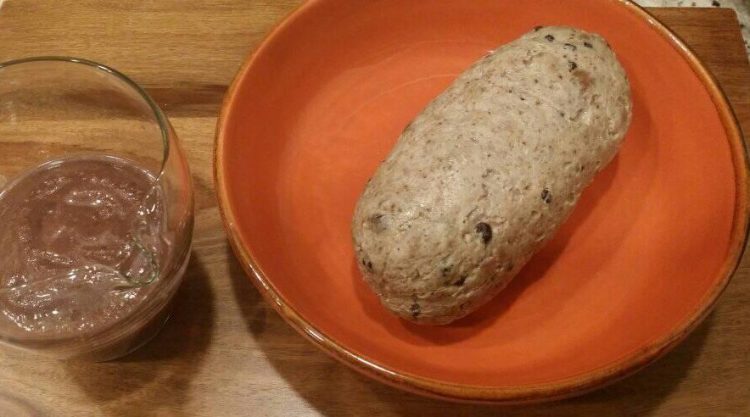
I made Leche Lumbard a few years ago. To cook the pudding, I did use cling-film rather than a bladder!
The second occurrence is in the recipe for Egredouce of fysche, a dish of fried fish covered with a sweet-and-sour sauce into which great raisins are incorporated. The texts for these, along with my translations, are reproduced at the end of the post.
Did the specifying of great raisins for these two dishes differentiate these particular dried grapes from, what we might loosely refer to as, standard raisins, found in those thirteen other recipes of Fourme of Cury? Perhaps, but it is difficult to be sure, especially as raysouns and grete raysouns are never mentioned together in a single recipe.
What they were not
Great raisins were certainly distinguished from raysouns of corauns, i.e. raisins of Corinth, which were exported from Corinth, Greece, and are better known today in the UK as currants, and elsewhere as Zante currants.
To be clear, the modern English word currants derives from the medieval word for Corinth, and developed after raysouns of corauns was shortened to just corauns.1
These raisins of Corinth/currants appear as an ingredient in more Fourme of Cury recipes than do standard raisins, twenty times, in total.

We know that great raisins were not the same as raisins of Corinth/currants because they get listed together in the two recipes just mentioned. Note, for example, the instruction in the fish dish recipe concerning the sweet-and-sour syrup: do þerto oynouns ycorue, raysouns corauns & grete raysouns (add to this chopped onions, Corinth raisins/currants and great raisins).
And, of course, if you know your currants from your raisins, you will be aware that the former are significantly smaller than other raisins; are much darker, almost black, in colour; and are also generally seedless, which other raisins may or may not be.
Both raisins and currants are dried grapes, but currants are produced from the small grape variety known as Black Corinth, i.e. Vitus vinifera, var. Apyrena, to use the Latin designation.2
Raisins more generally are, and probably were, produced from multiple varieties. In fourteenth-century England, evidence points to raisins produced from Moscatel, or Muscat, grapes, and that these were being imported from Spain, Portugal and Italy.
Documenting types of raisins is not straightforward, but I provide below an overview of my research of primary sources to date.
It must be stressed that it may simply have been the case that Richard II’s cooks used grete to distinguish standard-sized raisins from their smaller cousins from Corinth. But it is also possible these cooks had access to particularly large raisins, and it was these that prompted the designation grete.
What is the evidence?
In medieval records
That raisins were imported into medieval England there is no doubt, but differentiating what types of raisins these were is an exercise in intrigue.
Port records from England
Port records from the early fourteenth century indicate that Spanish merchants were importing raisins into England, as we see, for example, from a 1303 customs record for the port of Sandwich, where a certain Martin Vincent de Hispannia (of Spain) paid tax on 18 pounds of raisins; and, about two years later, Pedro, the servant of Andre Peres paid tax on the 30 pounds and 10 shillings of figs and raisins, as well as Spanish wool (lane Hispanie) and olive oil.3
Deducing the nationality of names, written in Latin, is not an infallible process, but a significant number of the merchants do have hispanic names, though there are others bringing in raisins that have French, Germanic and English names, so a name doesn’t always indicate the origin of goods, but rather the nationality of the merchant.
Elizabeth de Burgh, Lady of Clare
Elizabeth, a wealthy widow and member of the higher nobility, lived primarily in her castled estate in Suffolk. Many of her estate and household records have survived, and are edited by Jennifer Ward. One of particular interest, in the context of raisins, is her wardrobe and household account of 1339-40. From it we learn the name of her chief supplier of spices, sugar and dried fruits, a certain Bartholomew Thomasin.
Six pounds of currants were bought from him on 22 December 1339, costing 6 shillings, and on 19 February 1340, a further 6 pounds at the same price. On this same day, 28 pounds of ‘raisins of Malaga’ were bought from him, a snip at 7 shillings. (Figs, also designated ‘of Malaga’, were bought, too.) Just over a month later, on 23 March, a further 14 pounds of ‘raisins of Malaga’ arrived from him, this time costing twice as much per pound, with the total value of 7 shillings.4
It is reasonable to conclude that the designation of Malaga referred not simply to the city port whence these raisins were exported, but rather to the grape-growing region of the province of Málaga in southern Spain.
Certainly, today, Málaga is famous for its raisins. Those that have the prestigious Málaga Designation of Origin are specifically produced in the province and region of La Axarquía and the town of Manilva.
The raisin is there called la pasa. Check out this post on andaluciamia.com, all about its production, complete with excellent pictures (including the one below). You’ll notice how the raisins have wonderful hues of purple, due to their being sun-dried naturally.
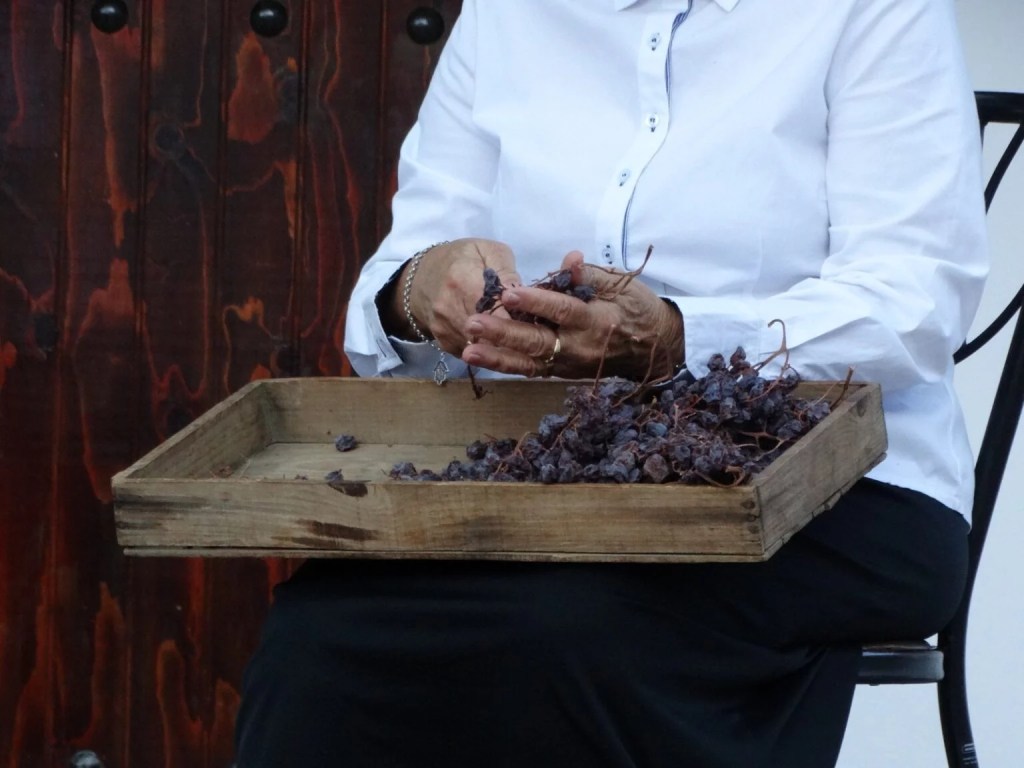
The result of this production is described by the Diputación Provincial de Málaga as ‘an age-old produce which is made of Moscatel grapes’, and as ‘rather big raisins in comparison with those that can be purchased in the market, such as Sultana or currant types’.5
More on sultanas, below, but the distinction here regarding the size of raisins of Málaga is striking in view of Elizabeth de Burgh’s record. Were her raisins of Malaga the same as the great raisins of the Fourme of Cury? Perhaps.
King Richard II
Since the distinction of grete raisins appears in Richard II’s cookery book, I thought it would be fruitful (pardon the pun) to check records from his reign. The information I’ve been able to glean only relates to places rather than types, however. But it’s worth noting.
We have several legal records, typically petitions ordering someone or other to deliver goods from a merchant ship lying in port to their intended destination elsewhere; often the ship had been affected by storms.
In these accounts, raisins are mentioned, though only generally, and sometimes they are lumped together with figs. Sometimes an amount in pipes, frails, or small barrels is given.6
We learn that the raisins arrived from both Spain and Portugal. For example, in 1384, ‘a great ship of Spain’ was driven by a storm to the port of Plymouth, and among its goods were ‘378 frails of raisins’.7 And in 1388 ‘two hundred small barrels (copulas) of figs and raisins’, were brought to London, ‘laded in Portugal’ with the order to take them to York or Kingston (upon Hull, presumably).8
A petition order of 1380 reveals that ‘thirteen pipes of raisins’ were part of a cargo that had been ‘lately laded in Genoa’, Italy. Intriguingly, a ‘fellowship’ of ‘merchants of Genoa’ is referred to but the master of their ship Seint Cristofore was a Catalonian, from Barcelona. The cargo was actually heading for Flanders, but had been driven ashore by storm at Dunster and seized by Joan de Mohun, lady of Dunster, who was now required to relinquish the goods to the merchants.9
Though we learn from these examples three potential countries of origin for raisins during Richard’s reign, we are never provided with any other differentiation or identifying term. These raisins are just raisins; whether from Corinth or ‘great’ was not deemed important in these records.
In guild records
I thought it worthwhile stretching my research into the fifteenth century, and, of course, there is probably more I could find from the century following Richard’s demise. Well, there is always more research to do!
I was very intrigued by what I found in the fifteenth-century records from the guild of the Holy Cross in Stratford-upon-Avon, specifically relating to the category of ‘spices’, which incorporated dried fruits. The information is summarised in table-form in the ever-useful study by historian Christopher Woolgar, The Culture of Food in England, 1200-1500.10
The records there show that four types of raisins were purchased across several years: raisins, raisins of Corinth, great raisins, and small raisins. Unfortunately, the surviving records never show more than two types being bought in one year.
So we see raisins and raisins of Corinth in 1407-8 and 1408-9; raisins of Corinth and great raisins in 1412-13, 1425-6, 1426-7, and 1427-8; and, very late, for 1490-1, we see great raisins and small raisins together.
Thus we cannot say with confidence that great raisins were ever distinguished from a standard raisin. Indeed, the late reference to both great and small raisins may have just meant standard raisins and raisins of Corinth, the latter being smaller than the former.
Arabic records: a modern horticultural study
I decided to move out of my area of expertise to explore what was being said in current horticultural studies about raisins in the medieval period. I discovered a recent journal article about grape cultivation in Al-Andulus,11 that is, the Muslim-ruled area of the Iberian peninsula (from 711 to 1492), which encompassed present-day Spain and Portugal.
The article sheds some light on types of raisins produced in the medieval period. The study notes that ‘[m]edieval al-Andulus witnessed diverse viticulture with eastern table grapes and “sultana” raisins’.12
A number of Arabic agricultural treatises, spanning the tenth to fourteenth centuries, describe both cultivation techniques and varieties of grapes. Size was among the differential traits of grapes, along with shape, colour, sugar content, and other criteria. ‘Notably, Almurjardal and Melar grapes were prized for their flavor and raisin suitability’, observe the authors.13 A comparison of these medieval names with modern cultivars is, unfortunately, not clear from the study, or at least not to me. A little frustrating.
In this highly technical horticultural analysis of medieval grapevine seeds (which I won’t pretend to fully understand), it is revealed that there were seedless cultivars of grapes present in one of the medieval sites, Alquería de La Graja, suggesting ‘the utilization of Sultanina-type grapevines, intended for raisin production’. Though generally seedless, some ‘very narrow anomalous seeds’ were present and these were ‘comparable to those of present-day “sultanas” from Iran and Afghanistan’.14
There seems to be a rather complex (confusing?) picture of the varieties of sultanas from both these countries. Or maybe that was just my impression after doing a deep-dive, AI mode search on my PC!
However, to focus on Iranian sultanas, it would appear that they are not as big as raisins from Málaga, and are typically brown to dark brown, seedless, and naturally sweet. Any golden sultanas/raisins you come across have been bleached with sulphur dioxide.
I did find the Pink Star website quite useful in its description of Iranian dark brown sultanas, and it did have some great pics:

Going back to the horticultural study, it highlights the ‘extensive exchange’ between cultivated and wild populations of grapevines, evidenced by the presence of intermediate seed types and grape varieties.15
This, I feel, underscores the problem we have, as food historians, of interpreting medieval texts that refer to raisins (and, indeed, to other produce), be they great or otherwise. In other words, we really can’t be sure exactly what was meant in terms of the raisins available back then. At best, we observe, through the literature, that some distinctions were occasionally made.
It may be possible in the future that research involving, as recommended in the conclusion of the above study, ‘systematically and widely collecting plant remains in medieval excavation sites’,16 will provide a clearer picture of the diversity of grapes in medieval viticulture and raisin production.
Conclusion
It is not possible at present to offer a truly comprehensive and direct comparison of medieval grapes to modern cultivars used for raisin production. We can reasonably say that multiple types of raisins were being consumed, seedless and otherwise; and, with quiet confidence, that medieval ‘raisins of Corinth’ correspond to modern day currants.
If I were to hazard an educated guess about the raisin types used in the kitchens and dining halls of Richard II’s court, then I would say that his cooks had available to them three types of raisins: the standard-sized, perhaps sultana-type, raisin; the smaller raisins of Corinth, i.e. currants; and, finally, yes, those great raisins… perhaps from Málaga!
If you would like to support my independent research, consider making a one of donation, or joining the monthly subscribers. Thank you.
The recipes
Leche Lumbard (64)
Tak raw pork & pulle of þe skyn & pyke out þe synowes & bray þe pork in a morter wiþ ayroun rawe, do þerto suger, salt, raysouns coraunce, dates mynced & poudour of peper, poudour gylofre & do it in a bladder & lat it seeþ til hit be ynowh, & whan it is ynowh kerue it. leche hyt in liknes of a peskod, and take grete raysouns & grynde hem in a morter, drawe hem vp with rede wyne, do þerto mylke of almaundes, colour hit with saundres & safroun, & do þerto poudour of peper & of gylofre & boyle hit, & whan hit is yboyled, tak poudour of canel & gynger & temper it vp wiþ wyne & do alle þes þynges togyder & loke þat it be rennyng & lat hit not seeþ after þat hit ys cast togyder, & serue hit forth.
Lombard slice (sliced pork sausage in red wine sauce)
Take raw pork and pull off the skin and pick out the sinews, and pound the pork in a mortar with raw eggs; to this add sugar, salt, raisins of Corinth, minced dates, and powder of pepper [and] clove powder; and do it in a bladder and let it simmer until done, and when it is done, carve it: slice it in the likeness of a peapod. And take great raisins and grind them in a mortar; mix them up with red wine; to this add almond milk; colour it with sanders and saffron; and to this add powder of pepper and of cloves and boil it. And when it is boiled, take powder of cinnamon and ginger and temper it with wine. And add all these things together and make sure it [the sauce] is of a running consistency, and let it not simmer after it is combined together; and serve it forth.

Egredouce of fysche (131)
Take loches oþer tenches oþer sooles & smyte hem on pecys; fry hem in oyle; take half wyne, half vyneger, sugur, & make a syryp; do þerto oynouns ycorue, raysouns corauns & grete raysouns; do þerto hole spyces, good poudours & salt; messe þe fysche & lay þe sewe aboue, and serue hit forth.
Sour and sweet fish
Take loach or tench or sole and chop them into pieces; fry them in oil; take half wine, half vinegar, sugar and make a syrup; add thereto chopped onions, currants and great raisins; add thereto whole spices, good powders and salt; dish up the fish and pour the sauce over and serve it forth.
Notes
- Middle English courans (and it variants) is a loan word from Anglo-Norman, which itself has an etymology from Old French Corauntz; see the Middle English Dictionary, courans n., and the Anglo-Norman Dictionary, Corinthe . See also the Oxford English Dictionary, currant [all accessed 14 September 2025] ↩︎
- See the introduction to Sun dried Corinthian currant (Vitis Vinifera L., var. Apyrena) simple sugar profile and macronutrient characterization – ScienceDirect ↩︎
- Gras, Early English Customs, p. 268 and p. 335; the second example is from the record for Michaelmas (29 September) 1304 to the following eve of Michaelmas (28 September) 1305 but no specific date is given; see p. 302. ↩︎
- Ward, Elizabeth de Burgh, p. 22. ↩︎
- Internationally Renowned Málaga’s Raisins with Appellation of Origin Designation – Province – Diputación de Málaga [accessed 04 August 2025] ↩︎
- Helpful on weights and measurements is the glossary of the Medieval England Maritime Project ↩︎
- Lyte, Close Rolls, Richard II, vol. 2, p. 436 ↩︎
- Lyte, Close Rolls, Richard II, vol. 3, p. 368. For another example of raisin importation from Portugal, see pp. 371-72. ↩︎
- Lyte, Close Rolls, Richard II, vol. 1, pp. 291-92. ↩︎
- Woolgar, Culture of Food, pp. 139-40. ↩︎
- Valera et al, ‘Insights into Medieval Grape Cultivation in Al-Andulus’. ↩︎
- Valera et al, p. 1 (my own emphasis). ↩︎
- Valera et al, p. 2. ↩︎
- Valera et al, p. 17. ↩︎
- The study points to the probability ‘during restriction periods’, alluding to the restriction on wine production, of vineyards being abandoned and later reintroduced, leading to hybridization with wild vines; Valera et al, p. 20. ↩︎
- Valera et al, p. 20. ↩︎
Select Bibliography
Gras, Norman Scott Brien. The Early English Customs System: A Documentary Study of the Institutional and Economical History of the Customs from the Thirteenth to the Sixteenth Century (Harvard University Press, 1918).
Lyte, Maxwell, H. C. (ed.). Calendar of the Close Rolls, Richard II, 6 vols. (H. M. Stationery Office: 1914-27).
Valera, Javier, et al. ‘Insights into Medieval Grape Cultivation in Al-Andulus: Morphometric, Domestication, and Multivariate Analysis of Vitus vinigera Seed Types’, Horticulturae 10 (2024), pp. 1-24. Available as an Open Access publication, Insights into Medieval Grape Cultivation in Al-Andalus: Morphometric, Domestication, and Multivariate Analysis of Vitis vinifera Seed Types [accessed 14 September 2025].
Ward, Jennifer (ed. and trans.). Elizabeth de Burgh, Lady of Clare (1295-1360): Household and Other Records (The Boydell Press, 2014).
Woolgar, C. M. The Culture of Food in England 1200-1500 (Yale University Press, 2016).
 MONK'S MODERN MEDIEVAL CUISINE
Huh, really interesting! I know you love researching this stuff, and I love reading it. I knew about modern currants vs raisins, of course, but not that currants and raisins were so blurred in the past (though it makes sense) and that there were ‘grete raysouns’. In retrospect it’s obvious that there are just a great range of grape-ish things you can dry and no hard cutoffs for size so you can call them all whatever you want. So unless you actually find some manuscript saying ‘we got [x] grete raysouns which are dried [y] from [z country]’ you can never really know.
But it’s still good to know what you don’t know, thanks!
LikeLiked by 1 person
I must say, this was one of the hardest pieces of research I’ve done. Though I’m sure it’s not over 😆. What you’re saying here in your comments makes me appreciate that much was about perception and perspective, how the cooks, spiciers, port workers, and petition order writers saw matters. And, on reflection, that’s pretty cool, getting to know a little of what went through the minds of people who lived so long ago.
LikeLike
Thanks for this, Christopher – REALLY interesting post! And it sent me down a rabbithole in search of pasas de Málaga (which do not come cheap, even today).BTW, have you ever re-created Egredouce of fysche? Apart from species, it’s almost identical to modern Venetian agradolce…
LikeLiked by 1 person
Thank you, Jon. I can imagine the Málaga ones are expensive. I will have to get some at some point.
No, I’ve not made Egredouce of Fysche, but want to.
I’ll check out the Venetian version.
Hope all’s well x
LikeLike